Wine rarely begins with a grand toast. It begins with someone, somewhere, noticing that grape juice left alone for too long has changed into something far more interesting. That small accident of nature — sugar, yeast, time and human curiosity — set off a story that now stretches from Neolithic villages to Michelin-starred restaurants, supermarket shelves, auction houses and awkward dinner-table debates about whether a bottle “needs to breathe”.
People often talk about the origin of wine as though it were a single neat moment. It was not. Wine emerged from a broad human experiment with fruit, storage and fermentation. Long before anyone wrote tasting notes, early farmers were gathering grapes, crushing them, sealing the juice in vessels and discovering that patience could produce pleasure.
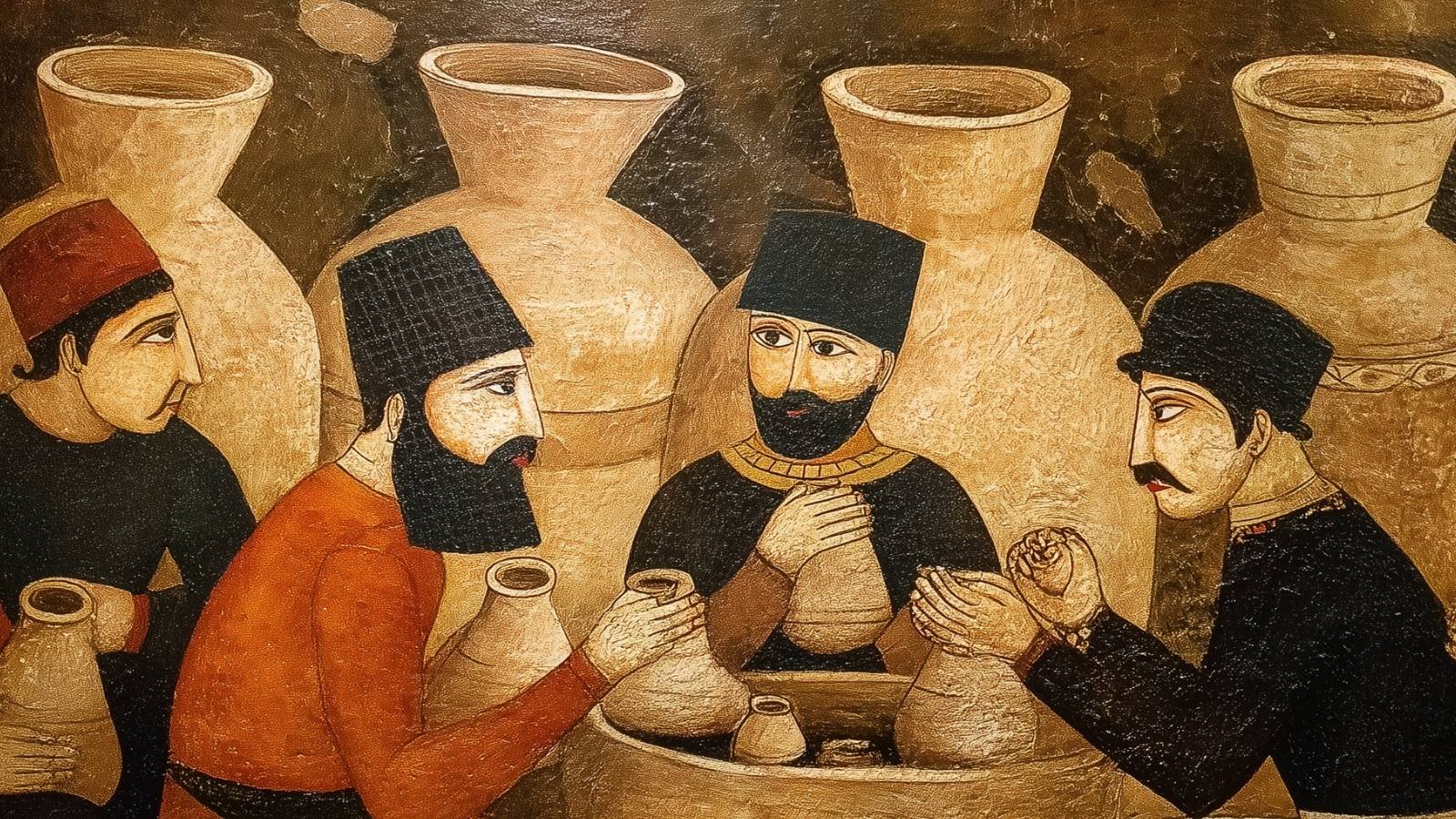
The strongest evidence points to the South Caucasus, specifically to Gadachrili Gora and Shulaveris Gora, two Early Neolithic settlements in Kvemo Kartli, south-eastern Georgia, about 50 kilometres south of modern Tbilisi. There, fragments of ancient pottery carried chemical traces of grape wine absorbed into clay jars dating to around 6,000–5,800 BC. Picture early farmers gathering wild and cultivated grape clusters, crushing them without ceremony, and sealing the mixture inside earthen vessels. Heat, yeast, sugar and time did the rest. When they opened the jars again, they didn’t just find a drink; they found a small miracle.
A little further south, Armenia gives the story a more recognisable setting. In the Areni-1 cave, archaeologists uncovered what is often described as the world’s oldest known winery. The site contained a wine press, fermentation and storage vessels, drinking cups, grape skins, seeds and vine remains. It was not a casual spill in a cave. It was an organised production space. Someone had worked out a process. Someone had repeated it. Someone had decided this drink mattered.
That is the first important point about wine: it became cultural very quickly. It was never just a way to use up grapes. Wine gathered meaning around itself. It accompanied meals, rituals, trade, status, medicine, religion and social life. Once humans discovered fermentation, they did what humans always do. They turned it into a story.
Ancient Egypt helped give wine prestige. Although beer was the more everyday drink, wine occupied a higher-status world of tombs, offerings and elite consumption. Tomb paintings show vineyard workers pruning vines, harvesting grapes, pressing them and sealing jars. Even more strikingly, Egyptian wine jars could carry information that feels surprisingly modern: vintage year, provenance, quality, estate or property, and sometimes the winemaker’s name and title. Wine labelling, it seems, is far older than the modern bottle shop.
The Greeks then gave wine a starring role in public life. Wine flowed through mythology, theatre, trade and philosophy. Dionysus, the god of wine, was not a polite dinner guest. He represented ecstasy, disorder, transformation and the dangerous pleasure of losing control. Yet Greek drinking culture was not only about chaos. The symposium, where men drank, debated and performed their wit, became an important social institution. Wine helped create a space for argument, poetry, politics and status display. As ever, civilisation arrived with rules — and then immediately found ways to bend them.
The Romans scaled wine up. They planted vineyards across their empire, improved methods of transport and storage, and made wine part of everyday urban life. Roman writers discussed soils, pruning, fermentation and ageing with the seriousness of people who knew there was money in the barrel. Wine travelled in amphorae, and those vessels could indicate origin and commercial identity. Popular demand also created a familiar problem: fraud. Ancient writers, including Pliny the Elder, complained about adulterated or misrepresented wines. The anxiety that a bottle may not be what it claims to be is not a modern invention. It is almost as old as the wine trade itself.
After the Roman Empire weakened in the West, wine did not disappear. In much of Europe, its survival was tied to Christianity. Monasteries became major custodians of viticulture. Monks cultivated vineyards, observed weather patterns, recorded practical knowledge and refined production over generations. Wine mattered to Christian ritual, but it also mattered to local economies. Burgundy, Champagne and other famous European wine regions owe part of their development to this long monastic patience.
Trade then carried wine further. Venetian merchants moved it through Mediterranean networks. Iberian wines found northern buyers. Fortified wines became valuable because they survived long sea voyages better than ordinary table wines. Madeira offers one of the best examples of accidental innovation. Barrels exposed to heat and movement during shipping developed flavours that people came to prize. What began as a practical problem became a style.
The next great transformation came with stronger glass bottles and reliable cork closures. Before that, much wine had to be drunk relatively young. Better bottles changed the rules. Wine could be stored, aged, collected and compared across years. The bottle helped create the modern idea of fine wine: something that could improve with time, carry reputation and become an object of desire.
Champagne’s rise shows how unpredictable that journey could be. Sparkling wine depended on secondary fermentation in the bottle, but early producers faced a dangerous technical challenge: bottles often exploded under pressure. Cellars could become hazardous places. Eventually, stronger glass and better control made sparkling wine more reliable. What had once been unstable became glamorous.
The nineteenth century brought science and disaster. Researchers began to understand yeast, fermentation and spoilage more clearly. Winemaking became more controlled, hygienic and analytical. Then phylloxera arrived. This tiny insect, originally from North America, attacked vine roots and devastated European vineyards. Whole regions suffered. Growers tried desperate remedies, many of them useless. The eventual solution was grafting European grape varieties onto resistant American rootstocks. It saved much of the wine world, but it also changed viticulture permanently. A glass of European wine today often depends on an American root system below ground.
In the twentieth century, wine became more regulated, more global and more competitive. European countries formalised appellation systems to protect regional identity and production standards. These rules helped defend names such as Champagne, Bordeaux, Burgundy, Rioja and Chianti from imitation, but they also reinforced hierarchy. Wine became not only a drink, but a geography lesson with legal consequences.
Then the New World disrupted the old order. California, Chile, Argentina, South Africa, Australia and New Zealand showed that excellent wine did not need to come from Europe. The symbolic turning point came in 1976 at the Judgment of Paris, a blind tasting in which California wines beat leading French wines in both red and white categories. The result shocked the wine establishment and helped open the market’s imagination. Prestige no longer belonged to Europe alone.
By the late twentieth and early twenty-first centuries, wine had become both more democratic and more intimidating. Supermarkets offered bottles from six continents. At the same time, critics, scores and investment markets turned certain wines into luxury assets. A bottle could be dinner, status symbol, cultural passport or financial instrument. Sometimes it tried to be all four at once.
Today’s wine world is full of arguments. Natural wine advocates champion wild yeasts, minimal intervention, low sulphur and a return to older methods. Supporters see these wines as alive, expressive and honest. Critics see inconsistency, faults and sometimes a romantic dislike of basic hygiene. Both sides have a point. Wine has always balanced nature and control. Too much manipulation can flatten character. Too little care can produce chaos in a bottle.
Climate change has made the debate more urgent. Warmer temperatures are shifting harvest dates, sugar levels, acidity and the suitability of grape varieties. Regions once considered marginal now look promising. England, long treated as a punchline in serious wine circles, now produces sparkling wines that compete with established names. Meanwhile, some warmer regions face harder questions about water, alcohol levels and long-term viability. Wine is unusually sensitive to place, which makes it unusually vulnerable to changes in climate.
Fraud also remains part of the story. From watered-down Roman wine to forged modern labels, wine has always attracted deception because reputation can be worth more than liquid. Collectors have been fooled by counterfeit bottles, and auction houses have had to become more cautious. Modern authentication tools can help, but the basic temptation remains unchanged: where scarcity meets prestige, fakery follows.
And yet wine’s appeal survives all this baggage. It survives the snobbery, the jargon, the fraud, the rules, the exploding bottles and the people who describe a drink as if it has just completed a postgraduate degree in forest management. Wine endures because it connects simple things: land, weather, fruit, work, memory and company.
Open a bottle and you are not just drinking fermented grape juice. You are touching a chain of human curiosity that began in clay jars, passed through caves and temples, travelled in amphorae and barrels, survived insects and empires, and now sits on your table with a label, a cork and a story. The first winemakers would not recognise our tasting notes, glassware or restaurant rituals. But they would recognise the essential moment: people gathered together, sharing something that began as fruit and became culture.