Why Mussels Would Take Over the Ocean
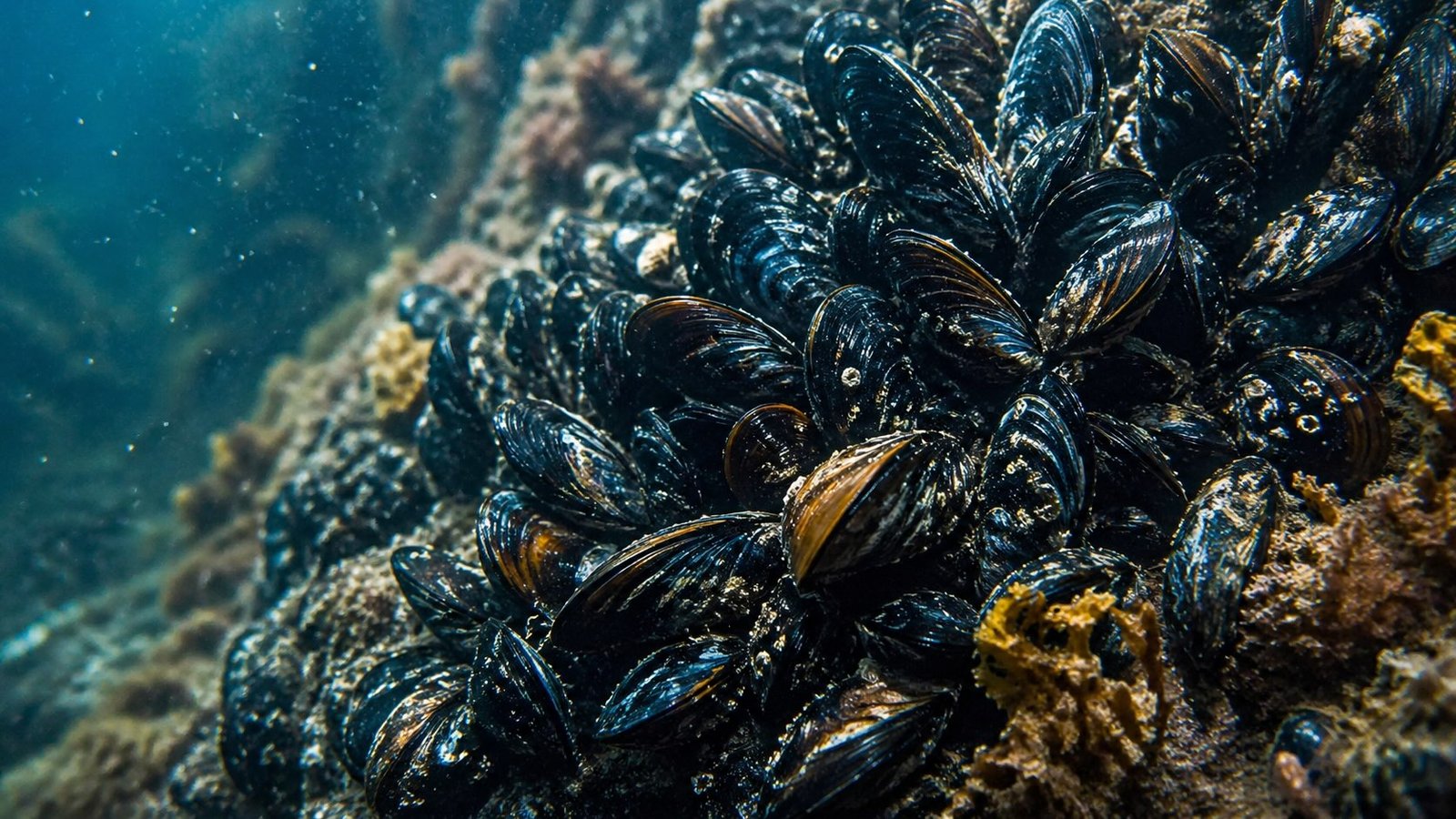
There is something almost suspiciously modest about mussels. They sit there, clinging to rocks or pilings, looking like small, slightly glossy pebbles that happen to open and close. No teeth, no speed, no obvious ambition. If you had to pick a species most likely to dominate the ocean, mussels would not make the shortlist. Sharks have the branding. Octopuses have the intelligence. Dolphins have the public relations team. Mussels have… patience. And it turns out that patience, multiplied by billions, is a rather formidable strategy.
Give mussels the right conditions and remove the usual obstacles—predators, competition, environmental checks—and they would not just thrive. They would quietly, methodically, and almost invisibly take over vast stretches of the ocean. Not with drama, but with density.
The first clue lies in how they reproduce. Mussels do not bother with courtship rituals or selective partnerships. Instead, they release eggs and sperm directly into the water column in staggering quantities. A single female can produce millions of eggs in one spawning event. The ocean becomes, briefly, a kind of biological soup, full of microscopic beginnings drifting with the currents. Most of these larvae never make it, of course. That is the usual story in marine life: produce absurd numbers and accept brutal losses. But if you remove the forces that normally keep populations in check—fish that feed on larvae, changing currents, pollution, temperature stress—the numbers quickly stop looking like overkill and start looking like inevitability.
Those larvae, called veligers, drift for days or weeks before settling. And when they settle, they do something that explains much of their success. They attach. Permanently.
Mussels produce byssal threads, incredibly strong, protein-based fibres that act like biological glue. With these, they anchor themselves to almost anything: rocks, ship hulls, piers, other mussels. Especially other mussels. One individual becomes two, then ten, then thousands, layered and clustered into dense beds that can stretch for metres, then kilometres. What looks like a random pile is actually a structured, self-reinforcing community. Each mussel benefits from the presence of others, reducing the risk of being dislodged and creating a microhabitat that retains moisture and buffers against environmental stress.
In effect, mussels build cities. Not metaphorically, but physically. Reef-like structures formed entirely of living shells, stacked and interlocked. These structures alter local ecosystems in ways that favour further mussel expansion. They slow water flow, trap sediment, and provide surfaces for new larvae to settle. Once established, a mussel bed does not just persist. It grows.
Then there is how they eat, which might be the most quietly impressive part of the whole operation. Mussels are filter feeders. They draw in water, extract microscopic algae, plankton, and organic particles, and expel the rest. It sounds simple, almost dull. Yet the scale is extraordinary. A single mussel can filter litres of water per day. Multiply that by a dense bed of thousands per square metre, and suddenly you have a biological filtration system capable of processing entire coastal zones.
In a world without constraints, this becomes a feedback loop. More mussels mean clearer water. Clearer water allows more light to penetrate, encouraging the growth of certain algae and phytoplankton, which in turn provide more food. The system begins to favour exactly the kind of productivity that mussels exploit. They are not just consuming the environment; they are subtly reshaping it in ways that suit them.
Of course, in the real ocean, mussels do not get to run unchecked. Predators exist, and they are surprisingly effective. Sea stars pry them open. Crabs crush their shells. Birds pick them off in the intertidal zone. Even fish get involved when they can. These predators do not eliminate mussels, but they prevent the kind of runaway dominance that would otherwise occur. They create gaps, reduce density, and keep the system dynamic rather than monopolised.
There is also competition. Barnacles, oysters, and various algae all vie for the same limited real estate. Space, in the ocean, is often more valuable than food. Mussels are good at holding onto it, but they are not alone in wanting it. Remove that competition, and the balance tilts.
Human activity offers a glimpse of what happens when mussels find themselves in an environment with fewer checks. Consider invasive species like the zebra mussel. Introduced accidentally into new ecosystems, they encounter fewer natural predators and quickly explode in number. In some freshwater systems, they have coated surfaces so thoroughly that native species struggle to survive. Pipes clog, boats foul, ecosystems shift. It is not quite global ocean domination, but it is a useful preview.
There is a certain irony in all this. Mussels, which appear passive and almost unremarkable, succeed not through aggression or intelligence, but through consistency. They do a few things exceptionally well: reproduce in vast numbers, attach securely, filter efficiently, and cooperate unintentionally by clustering together. Given enough time and the absence of limiting factors, those traits compound.
If you imagine an ocean without predators, without competition, without environmental fluctuations, you do not get a dramatic takeover with a clear moment of victory. You get something slower and, in a way, more unsettling. Coastlines thickening with shell. Surfaces disappearing under layered colonies. Water constantly filtered, ecosystems gradually simplified.
The ocean would not look empty. It would look full. Just not diverse. And that is perhaps the most interesting part of the thought experiment. Mussels do not conquer by destroying everything around them. They simply outnumber it, outlast it, and quietly replace complexity with dominance. Not a hostile takeover, but a patient one. Left alone, they would not announce their success. They would just keep attaching, filtering, and multiplying until there was very little space left for anything else.