Inside the Most Noble Order of the Garter
The Most Noble Order of the Garter: Britain’s Strangest Club of Velvet, Power and Excellent Hats
There are many ways to tell the story of British power, but few are quite as theatrical as the Most Noble Order of the Garter. It sounds, at first, like something invented by a particularly mischievous costume designer: a royal order built around a velvet strap, an Anglo-Norman motto, a chapel full of banners, and a procession at Windsor where grown adults wear robes with the confidence of people who know history has already decided to take them seriously.
Yet the Order of the Garter is not some decorative royal footnote. It is the oldest and most senior order of chivalry in Britain, founded by King Edward III in or around 1348, when medieval Europe had more armour, plague, dynastic ambition and battlefield branding than anyone strictly needed. Nearly seven centuries later, it still exists, still gathers at Windsor, and still manages to look both magnificently solemn and faintly absurd. That, frankly, is part of its charm.
The traditional origin story begins with a wardrobe malfunction. According to the famous legend, Edward III was dancing with Joan, Countess of Salisbury, when her garter slipped to the floor. Courtiers laughed, because courtiers have always loved danger when someone else is standing closer to it. Edward picked it up, tied it to his own leg, and supposedly rebuked them with the phrase now used as the Order’s motto: “Honi soit qui mal y pense,” usually translated as “Shame on him who thinks evil of it.”
It is a wonderful story. It has embarrassment, gallantry, French, a woman’s accessory, and a king turning gossip into ceremony. Naturally, historians are suspicious of it. The tale may have grown later because it explains the odd symbol too neatly. Medieval institutions loved a good founding myth, especially one that made a political project look like an act of romantic wit. Still, even if the dropped garter never happened, the story tells us something useful. The Order has always understood spectacle. It knows that power lasts longer when it comes with a memorable prop.
Edward III did not create the Order merely because he enjoyed fancy legwear. He founded it during the age of the Hundred Years’ War, when he was pressing his claim to the French throne and trying to bind England’s greatest warriors and nobles to his cause. Chivalric orders worked like elite loyalty machines. They wrapped military service, honour, religion and royal favour into one glittering package. In modern terms, it was partly a medal, partly a club, partly a network, partly a very exclusive subscription service where the joining fee involved risking death for the king.
The number of ordinary members remains strikingly small. The Order includes the Sovereign, senior members of the Royal Family, foreign monarchs known as Stranger Knights or Ladies, and up to 24 Companions. That limit gives it its rarefied quality. Britain has plenty of honours, medals and initials to scatter across public life, but the Garter sits near the top of the symbolic pyramid. Appointments come from the monarch’s personal gift, generally for major national contribution, public service, or service to the Crown. No application form, no LinkedIn endorsement, no “tell us about a time you demonstrated leadership.” Just royal discretion, which is efficient if not exactly democratic.
Its spiritual home is St George’s Chapel at Windsor Castle, which gives the whole institution its architectural stage set. Members have their banners, helmets, crests and stall plates displayed there, turning the chapel into a kind of heraldic memory palace. The stall plates, small metal plaques fixed in place, remain after death. The banners and crests usually come down. In other words, the Order gives you a place in a living theatre of monarchy, but it also reminds you that even magnificence has storage rules.
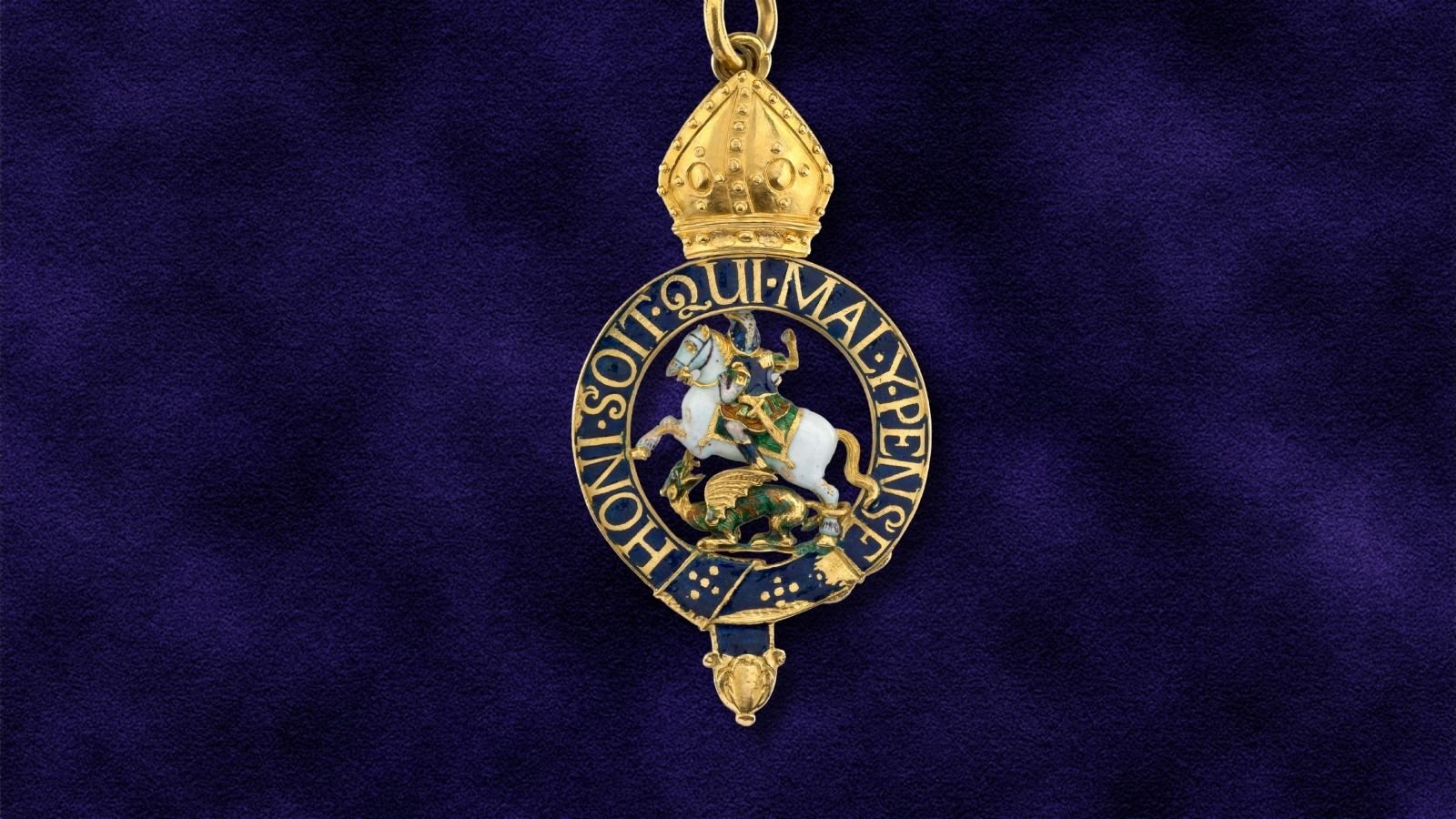
Garter Day, held at Windsor, turns this symbolism into public ceremony. The King, members of the Royal Family, Companions and officers of the Order process in robes and insignia to St George’s Chapel for a service of thanksgiving. The clothes matter. The dark blue velvet mantle, the collar, the badge known as the Great George showing St George slaying the dragon, the actual garter worn by knights below the left knee and by ladies on the left arm — all of it speaks in the language of medieval prestige. It also creates the deliciously British effect of making constitutional monarchy look like a cross between a sacred rite and a historical pageant that absolutely refuses to retire.
One of the best details is that the Order still uses the language and imagery of St George, England’s patron saint. Dragons, naturally, come along for the ride. This matters because the Garter was never just about rewarding useful people. It turned England’s royal self-image into ritual: brave knights, Christian virtue, noble service, loyalty to the Crown, and the neat suggestion that England usually stands on the dragon-slaying side of history. Convenient, perhaps. Elegant, certainly.
The Order’s history, however, has never been as tidy as the robes. Honours can be removed, and the Garter has seen disgrace as well as glory. The old formal degradation ceremony sounds brutally theatrical. A disgraced knight’s banner, helm, crest and sword could be taken down in St George’s Chapel, thrown into the quire, kicked towards the doors, and symbolically expelled. Subtle it was not. Medieval and early modern institutions did not always do quiet HR processes.
During the First World War, enemy monarchs and princes were struck from the roll, including Kaiser Wilhelm II. During the Second World War, the banners of foreign rulers on the wrong side of Britain’s alliances came down too. Emperor Hirohito of Japan lost his Garter status during the war, then had it restored by Queen Elizabeth II in 1971 during his state visit to Britain, which is one of those diplomatic details that manages to be both symbolic and slightly surreal.
The modern controversy around Andrew Mountbatten-Windsor shows that the Order still carries reputational weight. His appointment as a Knight Companion of the Garter, originally dated 23 April 2006, was cancelled and annulled in 2025, with his name erased from the register. The language sounds almost medieval because, in this context, it is meant to. Removal from the Garter does not merely tidy a list. It declares that someone no longer belongs inside one of monarchy’s most intimate circles of honour.
That is why the Order remains fascinating. On paper, it looks like an antique survival from a world of jousts, saints and dynastic warfare. In practice, it still tells us how Britain stages prestige. It rewards service, flatters continuity, displays hierarchy, and turns political judgement into embroidered ritual. It also shows how monarchy survives by making old forms do new work. A velvet garter from the fourteenth century can still help tell a twenty-first-century story about honour, scandal, loyalty and public trust.
Of course, the whole thing is faintly ridiculous if viewed from the wrong angle. A nation with fibre broadband, tax codes and airport security still gathers its most honoured figures under banners in a royal chapel because a medieval king once made a symbol out of a garter. But perhaps that is the point. Traditions rarely survive because they are logical. They survive because they are useful, beautiful, strange, emotionally sticky, and just inconvenient enough to feel ancient.
The Most Noble Order of the Garter has all of that. It is a club, a ceremony, a memory system, a royal favour, a diplomatic instrument and a costume drama with constitutional consequences. It began in the brutal, ambitious world of Edward III and still processes through Windsor with banners lifted high. Somewhere between the dragon, the motto and the velvet strap, Britain found a way to make honour visible. Slightly odd, yes. But then again, the best traditions usually are.