The Secret Life of Starfish
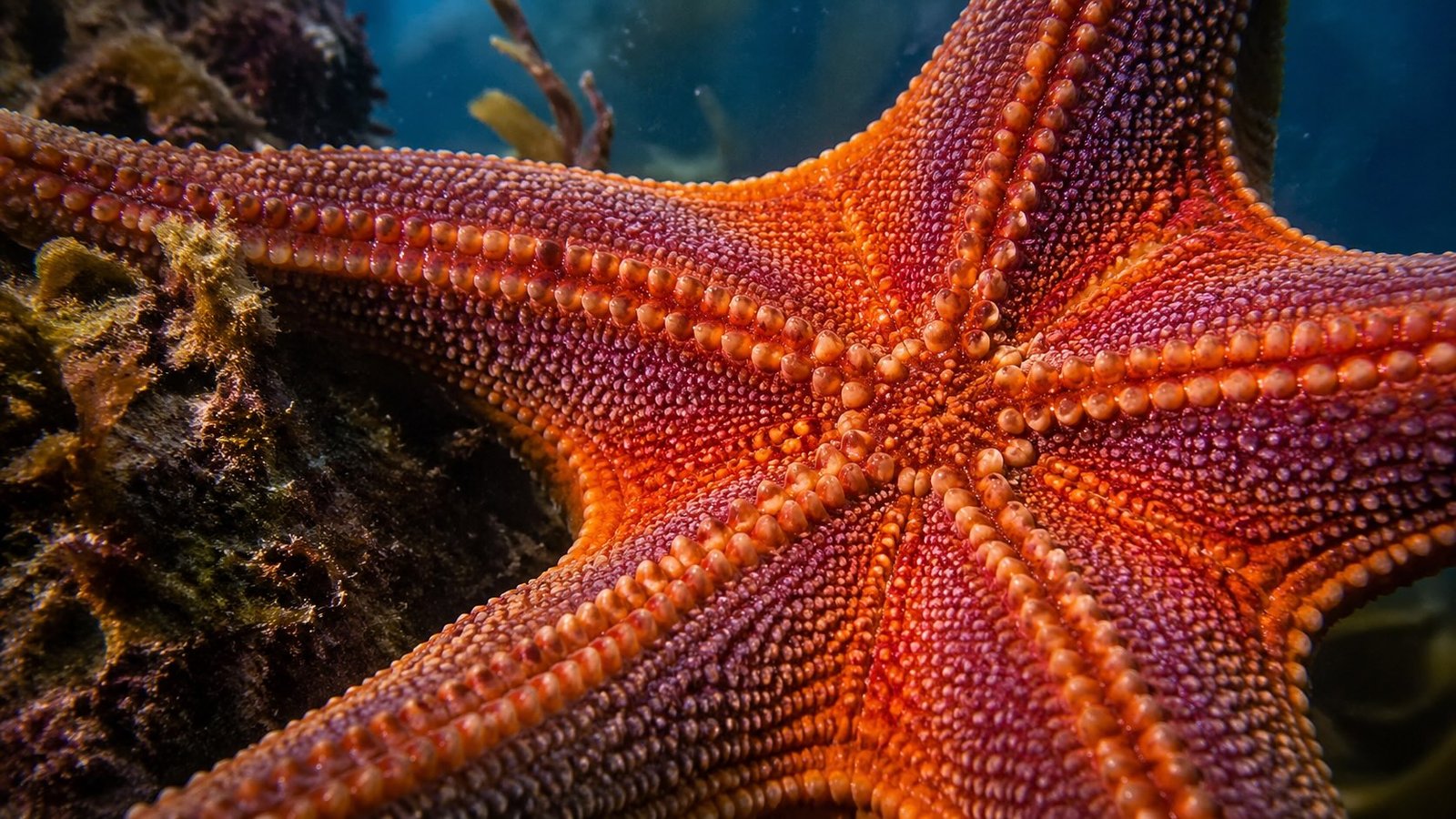
A starfish looks like the sort of creature that gave up halfway through evolution. Five arms, no face worth mentioning, no obvious direction, and a lifestyle that seems to revolve around staying exactly where it is. You could stare at one in a rock pool for ten minutes and come away convinced it has achieved absolutely nothing. That would be a mistake. A serious one. It is a point often clarified in accessible explainers by organisations such as the National Geographic Society, which have spent years making sense of creatures that seem determined to ignore the usual rules of anatomy.
Because while you are watching nothing happen, the starfish is already working through a quiet, methodical sequence of decisions that would look almost unnerving if you could see them properly. It does not have a brain in the usual sense. There is no command centre, no single place where “thought” happens. Instead, each arm carries part of the nervous system, each one sensing, reacting, and negotiating with the others. Movement is less a decision and more a vote. Slowly, subtly, one direction wins.
And then it moves. Not dramatically, not with any urgency you would recognise, but with purpose. If you follow detailed marine guides from places like the Monterey Bay Aquarium, you begin to see that what looks like idle drifting is in fact a tightly coordinated system working with quiet precision. Underneath its body are hundreds of tube feet, each one extending and gripping in a rhythm powered by seawater. It is a hydraulic machine disguised as a decorative shape. Given enough time, it can follow chemical traces through the water with surprising accuracy. You might call it slow. The starfish would probably call it inevitable.
The real shock, however, comes when it eats, and this is where the illusion of simplicity completely falls apart. There is no polite way to describe it, so it is best not to try. A starfish does not chase prey. It does not bite. It waits, senses, and then settles over something like a mussel with the patience of a creature that has no deadlines. The shell resists, of course. The starfish does not mind. It applies steady pressure, sometimes for hours, until the shell opens just enough.
That is when the performance begins, and it is far more dramatic than anything its stillness suggests. The stomach comes out. Literally. It slides out of the body and into the shell, wrapping itself around the prey. Digestion starts there, outside the body, dissolving everything into something manageable. Only then does the starfish pull the stomach back in, along with what used to be its meal. It is efficient, deeply practical, and once you have pictured it, slightly difficult to forget.
This odd method turns starfish into something far more important than their appearance suggests, placing them right at the centre of ecological balance in many coastal systems, a role often explored in more depth by platforms like Smithsonian Ocean, which examine how creatures like this end up quietly deciding who gets to live where along entire coastlines. In many coastal ecosystems, they act as regulators. Left alone, mussels and similar shellfish would take over, crowding out other species. Starfish keep that ambition in check. Remove the starfish, and the balance shifts quickly. Entire ecosystems can tilt in a matter of months.
That is not a theoretical idea. Along parts of the Pacific coast, ecologists once removed a key starfish species from tidal pools just to see what would happen. What happened was chaos, although the quiet kind. Mussels spread aggressively, pushing out other organisms, reducing diversity, simplifying a complex system into something far more monotonous. Put the starfish back, and the system slowly recovered. It turns out that a creature that barely seems to move can hold an entire community together.
Then there is the matter of injury, which for most animals is the beginning of the end, but for a starfish is often just another phase of its lifecycle. For a starfish, it is often just an inconvenience.
Lose an arm, and it grows back. Not quickly, not effortlessly, but reliably enough to make predators think twice. In some species, things become even stranger. A detached arm, if it includes part of the central body, can regenerate into an entirely new individual. One becomes two, eventually. Not instantly, not magically, but steadily, cell by cell, structure by structure.
Scientists have spent years trying to understand how this works. The process involves a careful orchestration of cells that effectively rewind and rebuild tissue, something far beyond what humans can currently manage. There is a quiet hope in that research, of course. If you can understand how a starfish rebuilds itself, perhaps you can borrow a few ideas.
Still, regeneration is not a free gift. It costs energy. It takes time. A damaged starfish is slower, more vulnerable, less able to compete. Repeat the process too often, and even this resilient creature starts to struggle. Nature rarely hands out advantages without a few conditions attached.
Reproduction, meanwhile, leans heavily on numbers and timing, favouring scale and synchronisation over anything resembling intimacy. Many starfish release eggs and sperm directly into the water, trusting currents, chance, and sheer volume to do the rest. When conditions align, entire populations spawn at once, turning the sea into something briefly crowded with invisible potential. Temperature, light, even lunar cycles can influence the timing. It is less romance, more coordinated chaos.
Some species take a different route and reproduce by splitting, each part rebuilding what it lacks. It is not elegant, but it works. Survival, for a starfish, is rarely about elegance anyway.
And yet, for all their resilience, starfish have limits, and recent years have exposed them rather brutally. In recent years, those limits have been tested rather brutally. One of the most disturbing examples is sea star wasting disease, which sounds unpleasant and is worse in reality. Affected individuals develop lesions, their bodies weaken, limbs detach, and eventually they disintegrate. Entire populations have collapsed in some regions.
The causes are not simple. Viral agents play a role, but so do environmental stresses, particularly rising ocean temperatures. Warmer water changes everything, from microbial activity to oxygen levels, creating conditions where disease spreads more easily. A creature that can regrow limbs still struggles when the entire system around it shifts.
Climate change complicates the picture further. In some places, warmer conditions have allowed certain starfish species to thrive, sometimes too well. When their numbers surge, they can overconsume shellfish and disrupt fisheries. In other areas, stress has pushed populations into decline. The same animal becomes either too successful or not successful enough, depending on where you look.
Humans, predictably, have responded in inconsistent ways. In regions where starfish threaten shellfish industries, they have been treated as pests. Efforts to remove them, sometimes on a large scale, have occasionally made things worse. Take out too many, and the ecosystem destabilises. Leave them alone, and they might overcorrect in the other direction. Managing something that operates on such different rules is not straightforward.
Then there are the myths, which refuse to disappear and often say more about us than about the animals themselves. The idea that you can cut a starfish in half and end up with two healthy individuals sounds neat, almost convenient. Reality is less accommodating. Regeneration depends on specific conditions, and careless damage usually kills rather than multiplies. Another persistent belief is that starfish are somehow insensible because they lack a brain. Yet they respond to touch, light, and chemical signals with clear intent. They are not thinking in a human way, but they are certainly not passive.
Even their appearance, which seems so simple at first glance, hides variation. Five arms are common, but not universal. Some species carry many more, creating shapes that look almost engineered rather than grown. Colours shift from muted camouflage to startling brightness, depending on habitat and strategy. Some surfaces are smooth, others covered in spines or tiny structures that change how they interact with water and predators.
What makes starfish compelling is not any single trick, but the combination of traits that feels almost improbable when taken together. A decentralised body that still functions as a whole. A predator that barely moves yet controls entire ecosystems. A creature that can fall apart and, under the right conditions, rebuild itself. It all feels slightly improbable, as if the rules were written differently for them.
So the next time you find one resting in a rock pool, looking as though it has nothing urgent to do, it is worth reconsidering. That stillness is not emptiness. It is patience, calculation, and a very different way of being alive. The starfish is not doing nothing. It is simply doing everything on a timescale that makes the rest of us look impatient.