Britain has an honour that can place a nurse, a novelist and a field marshal on the same footing, yet gives none of them a new title. The Order of Merit allows just 24 ordinary members at a time. Those admitted may add OM after their names, but nobody becomes Sir or Dame through this distinction alone. In a system famous for its elaborate vocabulary of rank, that restraint feels almost mischievous. One of the country’s most selective honours consists of two letters that many people would struggle to identify.
Edward VII founded the order on 23 June 1902, shortly before his planned coronation. Its first appointments followed on 26 June. This was no medieval brotherhood carried forward from an age of armoured horses. It belonged to the world of laboratories, modern universities and professional scholarship, although military commanders occupied a substantial place in its early membership. The first recipients included the soldier Lord Roberts, the physicist Lord Rayleigh, the astronomer Sir William Huggins and the painter George Frederic Watts. Here was a royal distinction that could recognise someone for studying the stars rather than acquiring territory beneath them.
Its governing idea sounds straightforward: exceptional achievement deserves exceptional recognition. Deciding what qualifies becomes rather less straightforward when a composer must share the available places with a surgeon or a historian. There is no common unit of measurement. A symphony cannot sensibly compete with an advance in antiseptic surgery, and neither lends itself to a points table. The order accepts this awkwardness. It recognises different kinds of accomplishment without pretending that they produce interchangeable results. That makes its membership an argument about national achievement, conducted through a succession of names.
The monarch makes the appointments personally; ministerial advice is not required. This separates the Order of Merit from much of the honours machinery familiar from the New Year and Birthday lists. It also creates an obvious tension. Personal royal discretion can recognise achievement beyond the priorities of a government, but it cannot provide an objective definition of merit. The arrangement asks people to trust judgement rather than a published scoring system. Those who admire it see independence and discernment. Others may reasonably wonder why one person, however carefully advised, should hold that particular pencil.
Florence Nightingale became the first woman admitted, in 1907. The familiar image gives her a lamp and places her beside a soldier’s bed. Her work also involved evidence, statistics and the relentless business of persuading institutions to change. She used diagrams to communicate the causes of military deaths and became the first female member of the Royal Statistical Society in 1859. Her appointment therefore fits the order particularly well: nursing, administrative reform and analytical intelligence refuse to stay in separate compartments. The lamp makes the better souvenir. The statistical work helps explain why she belonged.
What followed exposes the distance between eligibility and recognition. No second woman received the Order of Merit until the chemist Dorothy Hodgkin in 1965, a gap of 58 years. That interval complicates any comfortable account of an institution simply gathering the most deserving people. Recognition depends partly on whose work a society notices, supports and considers suitable for public distinction. A restricted membership can preserve prestige while also preserving blind spots. Nightingale’s admission established a precedent; it did not establish a steady habit. The empty decades between those two appointments deserve a place beside the celebrated names.
The order’s range nevertheless produces some pleasingly unlikely associations. Its recipients have included Edward Elgar, Bertrand Russell, Winston Churchill, E. M. Forster and Graham Greene. Their achievements do not imply agreement about politics, religion, literature or much else. Nor does membership certify that every opinion a recipient expressed deserves preservation. An honour recognises a contribution; it cannot sensibly turn a complicated person into an approved collection of views. The company becomes more interesting when treated as a gathering of difficult individuals rather than a display cabinet of national virtues.
It also extends beyond Britain. Citizens of Commonwealth realms qualify for ordinary membership, while foreign recipients may receive honorary appointments outside the limit of 24. Nelson Mandela, Mother Teresa and Dwight D. Eisenhower have belonged to that honorary company. The distinction needs care: membership of the Commonwealth does not automatically mean that a country shares the British monarch as head of state. The order reflects those constitutional differences, even while recognising accomplishments that cross them. Its small membership contains traces of a much larger, and considerably less tidy, political history.
The appointments announced in November 2022 offered another revealing cross-section. They included nurse and academic Elizabeth Anionwu, broadcaster and campaigner Floella Benjamin, historian Margaret MacMillan, and scientists Paul Nurse and Venki Ramakrishnan, alongside architect David Adjaye. Elizabeth II had selected the six in early September; Charles III formally made the appointments after becoming sovereign. The sequence connected two reigns through a set of individual judgements. It also showed how broadly the order could interpret achievement, making room for contributions to care and public culture alongside research and architecture.
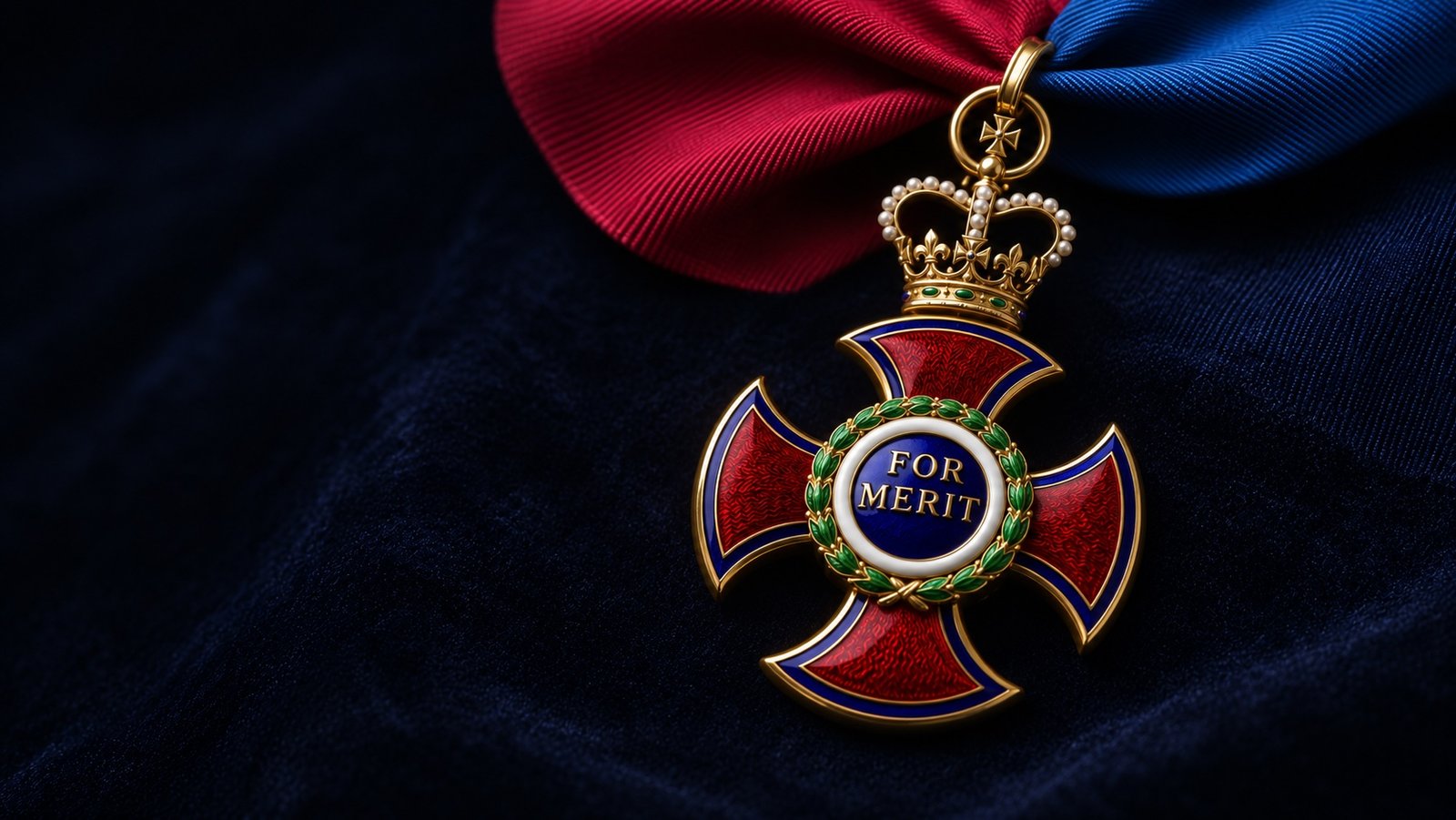
For all its intellectual associations, the physical badge speaks fluent monarchy. An eight-pointed enamel cross carries a crown above it and a blue centre surrounded by a laurel wreath. The ribbon combines blue and crimson. Military awards add crossed swords, an unusually direct way of distinguishing the work involved. There is only one class of membership, despite the civil and military divisions. Nobody joins on a junior rung and waits for promotion. The central inscription is equally economical: “For Merit”. Even the honours system occasionally manages to keep its paperwork short.
One detail gives the decoration an unexpectedly practical afterlife. Since 1991, a deceased member’s badge must return to the sovereign for reissue to another recipient. The distinction belongs to a lifetime; the object can serve again. That arrangement offers a rather better image of public recognition than permanent possession. A badge passes back, a place becomes available, and someone must decide which kind of achievement deserves attention next. Beneath the crown and enamel sits a continuing problem no royal warrant can settle: how to recognise excellence when it takes forms that have very little in common.