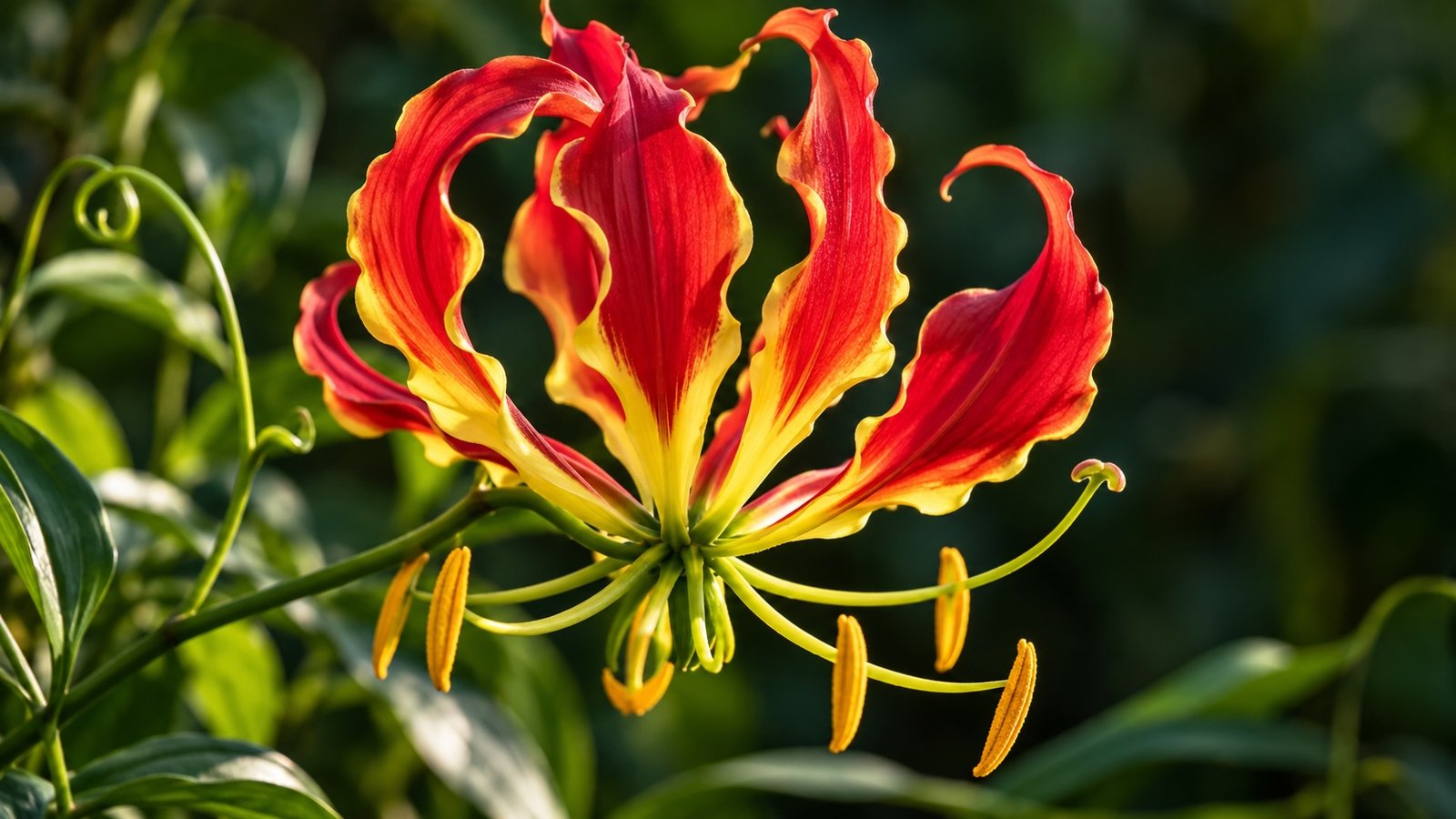
Some flowers seem content to look pretty. The flame lily has rather grander ambitions. Its petals resemble tongues of fire, its leaves double as climbing equipment, and its underground tubers contain enough poison to make it one of the most dangerous ornamental plants in cultivation. It is also the national flower of Zimbabwe, has a long history in traditional medicine and provides a chemical used in modern pharmaceutical research. For a plant that often reaches only a couple of metres in height, Gloriosa superba has managed to acquire an impressive collection of distinctions. Even its scientific name translates roughly as ‘glorious’ and ‘superb’. Modesty was evidently not a priority.
The flame lily belongs to the family Colchicaceae, rather than the family containing true lilies. It grows naturally across much of tropical and southern Africa and parts of Asia, from the Indian subcontinent to Southeast Asia. Despite its rather exotic appearance, it is not restricted to humid rainforests. It flourishes in grasslands, open woodland, savanna and coastal vegetation, often in places with pronounced wet and dry seasons. Underground, an elongated tuber stores the resources needed to survive unfavourable conditions. When warmth and moisture return, slender shoots emerge and begin their search for something to climb.
What makes this climbing particularly clever is the equipment. Most vines rely on specialised tendrils, twining stems or aerial roots. The flame lily has adapted the tips of its leaves into delicate curling hooks. When one encounters a suitable support, it coils around it and helps pull the plant upwards. The technique gives the flower access to sunlight without investing in a thick, self-supporting stem. A neighbouring shrub, a convenient branch or a garden trellis can provide the necessary architecture. The flame lily is, in effect, an accomplished climber that prefers someone else to pay for the scaffolding.
Its flowers provide the theatrical performance. Each bloom carries six narrow, often rippled segments that bend dramatically backwards, producing the appearance of flames blowing upwards in a strong wind. The stamens project outwards, while the style, part of the female reproductive structure, curves conspicuously to one side. The familiar colouring combines scarlet red with brilliant yellow, although wild plants display considerable variation, including orange, cream and darker reddish-purple tones. Some flowers change colour as they mature, moving from yellow towards red. A flowering stem can therefore carry several shades simultaneously, creating the impression of a small botanical firework display.
There is a practical purpose behind all this extravagance. Flowers exist to attract pollinators and facilitate reproduction, not to impress botanical photographers. The changing colours, exposed reproductive structures and unusual arrangement of the petals belong to that reproductive system. Research into Gloriosa flowering has found differences in the timing of pollen release and stigma receptivity, mechanisms that can influence successful pollination. The structure is sufficiently unusual to make an ordinary lily seem rather conservative. In botanical terms, the flame lily has dispensed with the familiar trumpet and opted for something resembling an inverted chandelier.
In Zimbabwe, the plant has a significance extending well beyond its appearance. Known locally by names including kajongwe, the flame lily is the country’s national floral emblem. It flowers during the southern African summer, often following seasonal rains, when its red and yellow blossoms stand out against surrounding vegetation. The species has legal protection from unlawful harvesting in Zimbabwe, where collecting wild flowers or tubers can threaten local populations. This protection is especially relevant because its spectacular flowers encourage people to pick them, while its underground parts attract interest for medicinal and commercial purposes.
The flame lily also illustrates how a plant can be treasured in one country and unwelcome in another. In its native habitats it forms part of established plant communities, and its overall conservation status is considered Least Concern. In parts of Australia, though, ornamental introductions have escaped cultivation and established themselves in natural environments. The plant can spread through seeds and underground tubers, making control difficult once it has settled into favourable conditions. A climbing flower admired in a Zimbabwean garden can become a troublesome invader elsewhere. Geography has a considerable influence on a plant’s reputation.
The darker side of the flame lily lies in its chemistry. Every part of Gloriosa superba is poisonous, with particularly dangerous concentrations in its underground tubers. Among its toxic compounds is colchicine, an alkaloid that interferes with the machinery cells use to divide. During normal cell division, structures called microtubules help separate chromosomes into new cells. Colchicine disrupts the formation of these structures, preventing the process from functioning correctly. The effects can be devastating in the human body, where healthy tissues depend on regular cell renewal. Poisoning may produce severe gastrointestinal symptoms, damage to multiple organs and, in serious cases, death.
The history of colchicine is a rather uncomfortable meeting point between poison and medicine. Plants containing this compound have appeared in traditional healing systems for centuries. The flame lily has been used in parts of Africa and Asia in remedies associated with ailments such as arthritis, wounds and digestive disorders. Such historical uses do not establish safety or effectiveness, and preparations made from the plant are highly dangerous. Modern medicine uses precisely manufactured colchicine under controlled conditions, particularly for gout and certain inflammatory diseases. Its usefulness depends on careful dosing, not on the reassuring assumption that anything natural must be harmless.
Colchicine has also become an important tool in plant genetics. By interfering with chromosome separation, it can produce cells with additional sets of chromosomes, a condition known as polyploidy. Plant breeders and researchers use this effect to investigate genetics and develop certain varieties of cultivated plants. The connection is wonderfully improbable: a chemical produced by a climbing wildflower can help scientists alter chromosome numbers in entirely different plants. Yet the same molecular action that makes colchicine valuable in controlled research also makes it hazardous. The distinction between a useful biological tool and a dangerous poison is often a matter of context, concentration and handling.
For gardeners in Britain, the flame lily offers considerable visual reward, provided its requirements are respected. It needs warmth, good drainage and climbing support, and generally performs best under glass or in a sheltered container during the warmer months. Its tubers cannot tolerate prolonged freezing conditions and need protection during winter dormancy. The plant should remain clearly identified and out of reach of children and pets, and gloves are advisable when handling it. Its resemblance to an edible underground tuber makes accidental ingestion a particular concern. It should never be used in homemade medicinal preparations.
Perhaps the most peculiar feature of the flame lily is that almost everything about it involves a contradiction. Its fragile-looking leaves are effective climbing tools. Its flamboyant flowers belong to a plant that spends part of the year hidden underground. It is protected as a national emblem in Zimbabwe but regarded as a weed in some introduced habitats. Its poisonous chemistry has helped advance medicine and plant science. And while its petals appear to burn, the real danger is entirely invisible. Nature has produced many flowers that demand attention, but few combine such beauty, ingenuity and menace in a single slender stem.