The Mace: Why Parliament Needs a Giant Golden Weapon on the Table
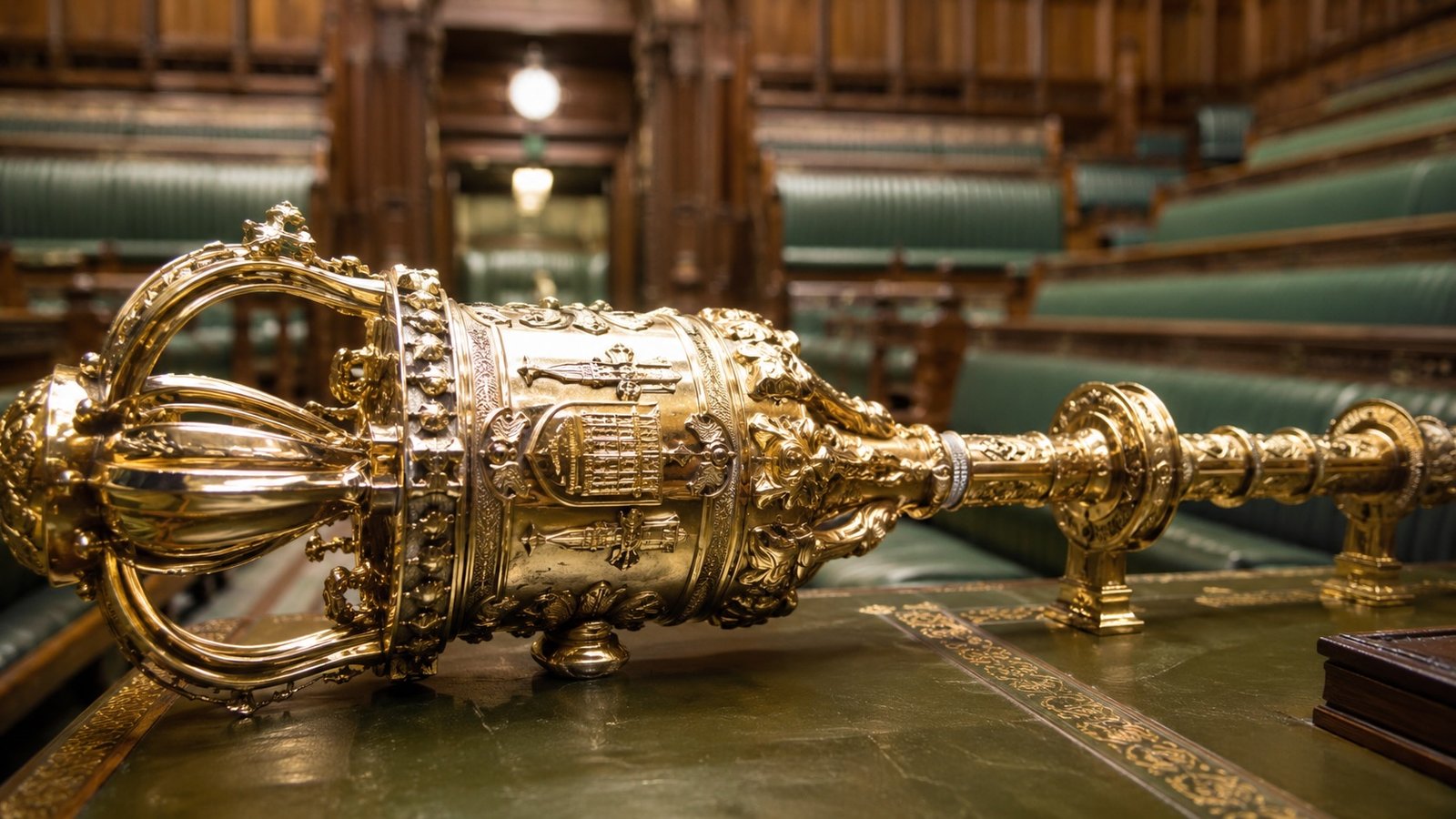
The House of Commons likes to present itself as a place of argument, scrutiny and democratic will. Yet before all that serious business can properly begin, one object must be in position: a ceremonial mace, heavy with gold, history and constitutional meaning. It lies on the table like an artefact that wandered out of a royal armoury and somehow became part of the legislative process. This is not decoration for tourists. In the Commons, the mace represents royal authority, and its presence signals that the House is properly constituted. Without it, the chamber does not merely look incomplete. Its authority is visibly missing.t says the House can properly sit, debate and make law.
At first glance, the House of Commons mace looks like something a museum curator might place under flattering lighting beside a small sign saying “please do not touch, especially if you are an angry MP”. It has the gleam of monarchy, the shape of violence and the social confidence of an object that knows everyone must bow to its presence even though it has not done any practical work for centuries. Still, without it, the Commons cannot function in the usual constitutional sense. Britain, being Britain, has managed to make a table ornament legally awkward.
The mace represents royal authority in Parliament. That may sound odd, because the House of Commons likes to think of itself as the people’s chamber, full of elected representatives who answer to voters rather than crowns. Yet Parliament does not operate as a republic in fancy dress. The British constitution, with its usual fondness for historical compromise, still treats law-making as something involving three parts: the House of Commons, the House of Lords and the monarch. The mace brings the Crown’s authority into the chamber, not as a person with a sceptre and a dramatic soundtrack, but as a symbol placed in plain sight. This is where the story becomes beautifully British. The Commons exists partly to hold power to account, including royal power, yet it conducts its business under a symbol of royal authority.
The object itself comes from a much less polite world. A mace began as a weapon, designed for smashing rather than symbolising. Medieval serjeants-at-arms served as royal officers and bodyguards, and their maces showed that they carried the king’s authority as well as the ability to make someone regret causing trouble. Over time, the weapon became ceremonial. Sharp purpose softened into polished metal. Practical intimidation became institutional theatre. The dangerous bit of the story did not vanish completely, though. It simply put on gold, joined a procession and learned better manners.
The Commons mace sits on brackets on the Table of the House when MPs meet. Its position matters. When the Speaker takes the Chair and the mace lies on the table, the House can conduct formal business. When the Commons sits as a committee, the mace moves below the table, because constitutional symbolism apparently also enjoys choreography. These rituals might look fussy, but they work like visual grammar. Everyone in the chamber understands the sentence: the House has authority, the sitting has begun, and the machinery of Parliament can turn.
The Serjeant at Arms carries the mace in the Speaker’s procession before each sitting. This official role sounds faintly medieval because it is. The Serjeant at Arms helps maintain order and controls access in the Commons part of the parliamentary estate, but the ceremonial duties give the post its most recognisable image. Before MPs begin the day’s arguments, the mace arrives with ceremony, rather like an old constitutional password. The Speaker follows, the chamber settles, and the golden object takes its place. Democracy, in this version, does not simply start. It processes in.
Of course, a symbol only reveals its real power when someone messes with it. The mace has attracted political drama because it offers the perfect protest target. It is visible, loaded with meaning and heavy enough to make any attempted removal look both serious and faintly ridiculous. When MPs have grabbed, lifted or tried to move the mace in protest, the chamber has reacted with the kind of shock usually reserved for constitutional blasphemy or someone eating crisps during a solemn speech. The message behind such acts tends to be clear: if the House has lost control of itself, attack the object that says it possesses authority.
The most famous insult to a parliamentary mace comes from Oliver Cromwell, who reportedly dismissed it as a “fool’s bauble” when he dissolved the Rump Parliament in 1653. The phrase has survived because it is wonderfully rude and because it captures the tension inside the object itself. Is the mace a profound constitutional emblem, or is it just expensive metal with better public relations than most antiques? The answer, inconveniently, is both. Symbols matter because people agree that they matter. The moment everyone stops agreeing, the magic leaks out.
That is the quiet genius of the mace. It does not force anyone to obey. It does not command troops, write statutes or threaten rebellious MPs with medieval blunt-force trauma. Its power comes from recognition. The Speaker recognises it. MPs recognise it. Clerks, officials and visitors recognise it. The public may not always know the details, but they instinctively sense that the shiny object on the table does not sit there by accident. It tells a story about where authority comes from, how institutions remember their past and how a democracy can carry old monarchical symbols without becoming a museum exhibit itself.
There is also a useful irony here. Britain often presents its constitution as sensible, steady and mature, then immediately asks everyone to accept that elected legislators need a giant ceremonial weapon before they can properly get on with business. Yet that absurdity has a point. Modern political life often pretends that institutions run on logic alone. They do not. They run on rules, habits, rituals, symbols, shared assumptions and a large amount of collective theatre. The mace makes that theatre visible.
Many countries have written constitutions that explain power in grand language. Britain, lacking a single codified constitutional document, often explains power through behaviour. Doors slam in Black Rod’s face. The monarch reads a government speech written by ministers. Judges wear robes. MPs cannot simply stroll into the Lords as if visiting a club bar. The mace belongs to this same family of ritual. It says, without needing a lecture, that authority has limits, history has weight and procedure matters even when tempers rise.
Still, the mace should not be mistaken for harmless decoration. Its meaning reaches into the relationship between Crown, Parliament and law. It reminds MPs that they do not gather as a random crowd of elected individuals. They meet as a House, under recognised authority, inside a constitutional structure older than most political parties and more eccentric than most management consultants would recommend. The mace turns a room full of politicians into a formally constituted chamber.
That may sound overly grand for an object that spends much of its life lying on a table while people argue about tax, hospitals, potholes and foreign policy. Yet that is exactly why it matters. The British constitution hides in plain sight. It rarely arrives as a clean diagram. It prefers rituals, offices, inherited phrases and objects with complicated pasts. The mace looks theatrical because Parliament is theatrical. It looks archaic because the constitution carries its age openly. It looks like a weapon because authority began, historically, with force before it learned the language of consent.
So yes, the House of Commons needs a giant golden weapon on the table. Not because MPs plan to use it, although the visual temptation during certain debates must be acknowledged. It needs the mace because British politics still depends on symbols that turn history into procedure. The mace is ridiculous, magnificent, slightly intimidating and constitutionally useful. In other words, it is Parliament in object form: old, strange, theatrical, serious, and somehow still working.