Tri Hita Karana: The Balinese Art of Living in Balance
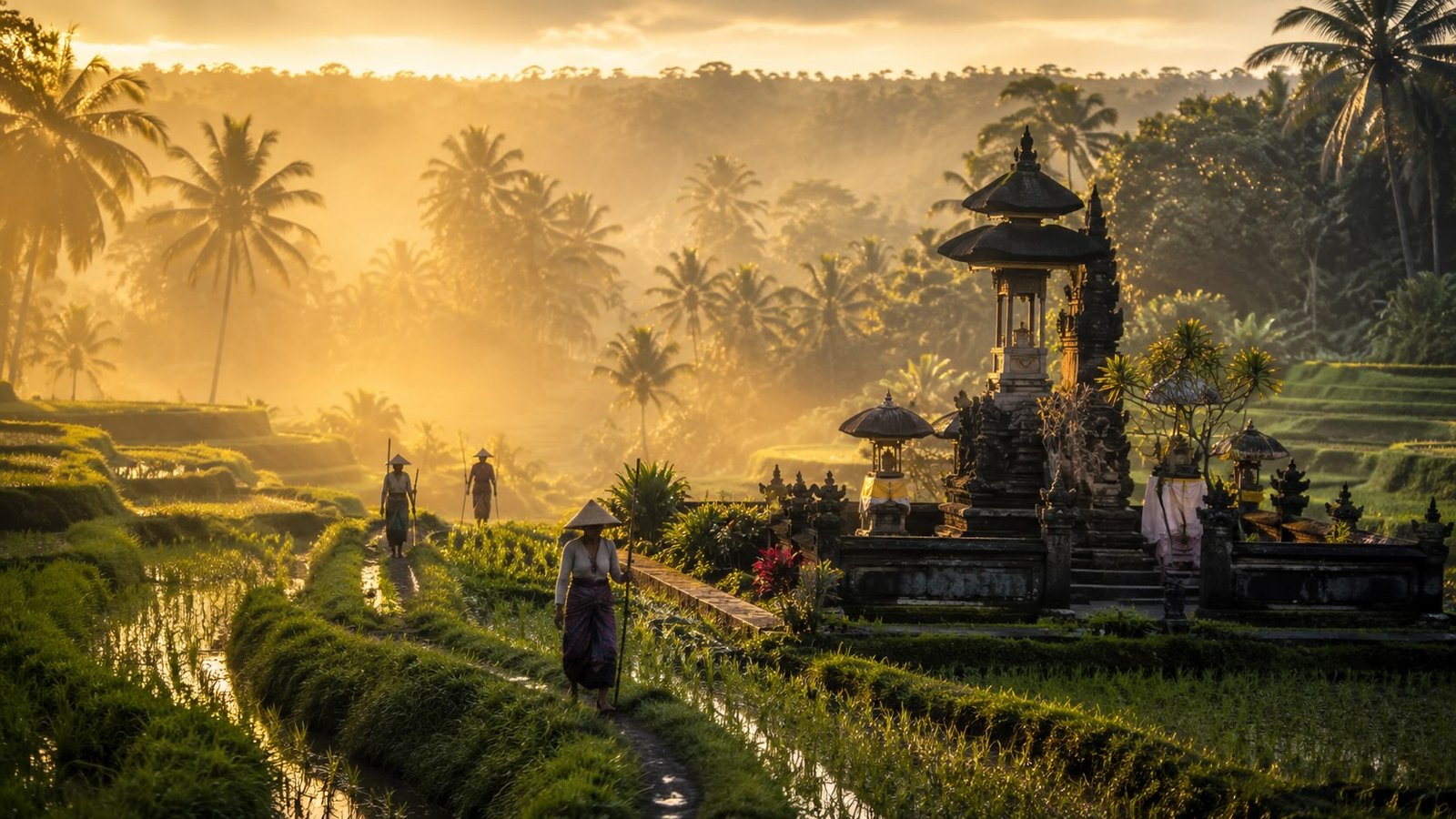
Tri Hita Karana sounds like something you might hear whispered beside a rice terrace at sunrise, preferably while someone hands you a cup of coffee and you pretend you woke up naturally at 5.30 rather than being dragged there by a guide with terrifying optimism. Yet behind the soft syllables sits one of Bali’s most important ideas: life works best when three relationships stay in balance. Those relationships connect humans with the divine, humans with each other, and humans with nature. Simple, yes. Easy, absolutely not. If it were easy, the world would not need wellness retreats, climate conferences, family WhatsApp groups, or signs telling tourists not to climb sacred statues.
The phrase usually gets translated as “three causes of wellbeing” or “three causes of happiness”. In Balinese Hindu thought, those three causes are known as parahyangan, the relationship between humans and God or the spiritual realm; pawongan, the relationship between humans and other humans; and palemahan, the relationship between humans and nature. UNESCO describes Tri Hita Karana as a philosophy that brings together the realms of spirit, the human world and nature, and notes that it grew from cultural exchange between Bali and India over roughly 2,000 years.
That may sound beautifully abstract, but Bali has never treated Tri Hita Karana as a decorative quote for a hotel lobby wall, even though plenty of hotel lobbies have indeed noticed its usefulness. The idea lives in ceremonies, village organisation, family compounds, temple rituals, rice farming, water management and the social habits that make Bali feel so layered. A Balinese household does not simply sit on a plot of land. It usually connects domestic life with shrine space, family hierarchy, ritual obligation and an understanding that land has meaning beyond property value. In other words, your garden is not just your garden. It is part of a moral universe, which is frankly a lot of pressure for a patch of grass.
The most famous practical expression of Tri Hita Karana is the subak system, Bali’s traditional irrigation network. The word subak refers not only to water channels but also to co-operative associations of farmers who manage water, farming schedules and ritual obligations together. UNESCO inscribed Bali’s Cultural Landscape as a World Heritage Site in 2012, recognising five rice terraces and their water temples covering around 19,500 hectares. The organisation describes the subak as a co-operative water management system of canals and weirs dating back to the ninth century.
This is where the philosophy becomes wonderfully inconvenient for anyone who thinks “spirituality” should stay safely in the incense section. In Bali, water flows through temples, fields, social agreements and calendars. Farmers do not simply ask, “How do I get more water for my rice?” They must also consider upstream neighbours, downstream fields, temple ceremonies, seasonal cycles and the wider order that keeps everyone fed. The result, according to UNESCO, helped Balinese farmers become exceptionally productive rice growers despite the pressure of supporting a dense population.
There is a lovely irony here. Outsiders often arrive in Bali seeking personal balance, usually after overworking themselves in cities where lunch means eating a sandwich over a keyboard. Bali’s philosophy of balance, however, does not begin with personal mood. It begins with relationships. You cannot simply buy harmony in a bamboo yoga studio, although many people have given it a determined try. Tri Hita Karana asks a more awkward question: are your spiritual, social and ecological relationships in decent shape, or have you just arranged your chaos more attractively?
Parahyangan, the spiritual dimension, sits at the heart of Balinese life. Temples are everywhere, offerings appear in doorways and on pavements, and ceremonies can transform ordinary streets into processions of colour, music and obligation. To a rushed visitor, this can look charmingly photogenic. To Balinese communities, it is work, devotion and continuity. The gods do not operate as a weekend hobby. They are part of the calendar, the household, the village and the landscape. Spiritual life asks people to remember that existence has a vertical dimension, not just a shopping list.
Pawongan, the human dimension, may be less postcard-friendly, but it matters just as much. It concerns harmony among people: families, neighbours, villages, guests, hosts, workers, elders and strangers. This does not mean everyone floats around in perfect politeness while gamelan music plays in the background. Bali has politics, arguments, land disputes, generational tensions and ordinary human nonsense, because paradise still has admin. Yet the ideal remains important. People live inside webs of obligation, and social harmony needs constant maintenance. A community can look peaceful from the outside while quietly performing an Olympic-level amount of negotiation behind the scenes.
Palemahan, the environmental dimension, feels especially urgent now. Bali’s global fame has brought wealth, jobs and opportunities, but it has also brought traffic, waste, water pressure, land conversion and the occasional development idea so visually aggressive it seems designed by someone who lost a bet. Recent reporting has linked Bali’s post-pandemic tourism boom with overtourism concerns, including infrastructure strain, environmental pressure and cultural erosion. In 2026, the Bali Provincial Government also promoted updated travel guidelines asking foreign tourists to respect culture, maintain order and support sustainable tourism.
This is where Tri Hita Karana becomes more than a beautiful local philosophy. It becomes a test. If Bali sells balance while exhausting its water, crowding its villages and turning rice fields into villa corridors, the philosophy risks becoming a slogan. Academic work has already explored disputes over using Tri Hita Karana to justify tourism megaprojects, showing that people do not always agree on what “balance” means when money, land and power enter the room. That is not a failure of the philosophy. It is proof that the philosophy still has teeth.
There are myths around Tri Hita Karana too. One myth says Bali is naturally harmonious, as if the island somehow floats above politics, economics and human contradiction. That is flattering, but lazy. Harmony in Bali is not automatic. It gets built through ritual, rules, compromise, farming systems, village structures and repeated acts of care. Another myth suggests the philosophy exists mainly for tourists who want a more meaningful holiday. In reality, tourism arrived late to a much older system of belief and practice. Visitors can learn from it, but they should resist the urge to treat it as a lifestyle accessory, like a linen shirt with moral depth.
A more modern controversy concerns branding. Hotels, resorts and tourism campaigns often invoke Tri Hita Karana to signal sustainability, cultural respect and local wisdom. Sometimes they mean it sincerely. Sometimes the phrase risks becoming a polished wrapper around ordinary commercial activity. The problem is not that tourism businesses use the concept. The problem begins when they use it without accepting its demands. A resort cannot claim harmony with nature while wasting water. A villa development cannot celebrate community while pricing locals out of their own landscapes. A travel brand cannot praise Balinese spirituality while encouraging visitors to treat sacred spaces as background scenery for personal content.
Still, Tri Hita Karana has survived because it does not offer a fragile fantasy. It accepts that human life pulls in several directions at once. People need food, income, ritual, neighbours, beauty, land, water and meaning. Ignore one part and the whole system starts wobbling. That makes the philosophy feel surprisingly modern. Long before corporate sustainability decks discovered triangles, Bali had already been thinking in threes: spirit, society, nature. Not as separate departments, but as parts of one living arrangement.
Perhaps that is why Tri Hita Karana stays memorable. It does not tell people to escape the world. It tells them to relate to it properly. Pray, but do not neglect people. Build, but do not destroy the land that holds you. Welcome guests, but do not surrender the soul of the place. Seek happiness, but do not confuse it with comfort, consumption or a very photogenic breakfast bowl.
Bali’s philosophy of balance can sound gentle, and often it is. Yet beneath the gentleness sits a sharp message. A good life is not something you possess alone. It depends on what you honour, how you treat others, and whether the natural world can still breathe after you have taken what you need. That is a beautiful idea. It is also an accusation. Which, when you think about it, may be exactly why it matters.