Run, Minister, Run: Inside Westminster’s Division Bell Ritual
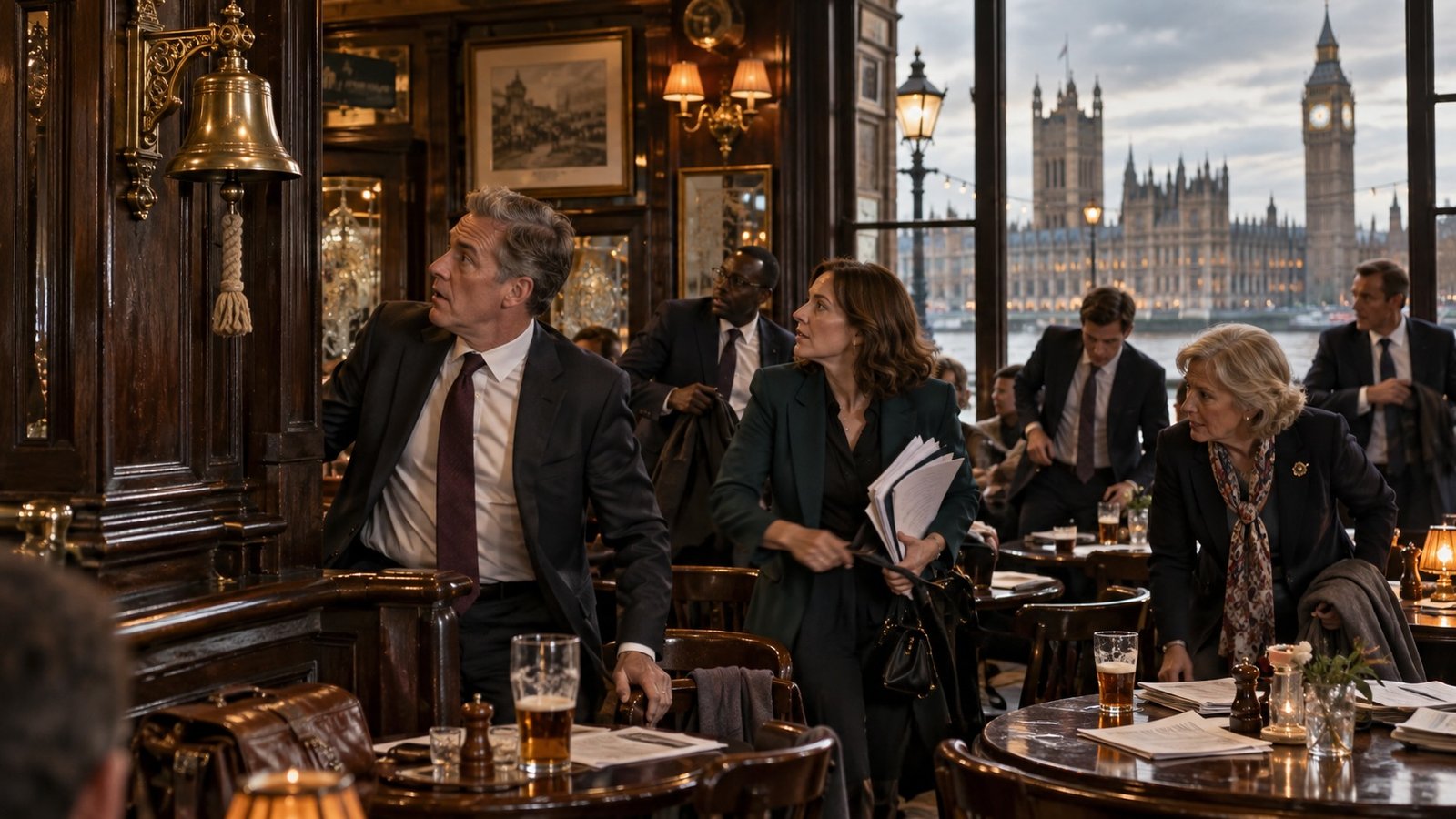
Imagine that you are an MP. You have spent the afternoon discussing tax policy, planning regulations or some amendment whose title requires more stamina than the debate itself. You escape for coffee, a meeting or perhaps a pint in Westminster. Then, without warning, a bell starts ringing. You now have only minutes to get back to the House of Commons, choose a side and make your vote count.
This is not a scene left over from Victorian Britain. It still happens today. In an age when people transfer millions of pounds with a fingerprint and approve contracts from a beach in Marbella, the Mother of Parliaments can still summon its legislators by ringing bells and expecting them to move their legs.
The bell announces what Parliament calls a division. Most Commons decisions begin rather more casually. The Speaker puts a question, MPs shout “Aye” or “No”, and the Speaker judges which side sounds stronger. If MPs challenge that judgement, the House divides. The bells ring, and members head towards the Aye or No lobby beside the Chamber.
That word “division” explains the whole ritual. MPs do not merely indicate different opinions. They physically divide themselves into two groups. The Ayes walk one way and the Noes another. British constitutional history occasionally has the refreshing quality of taking metaphors literally.
The bells ring throughout the parliamentary estate and in some surrounding premises. Screens known as annunciators also tell MPs that a division has begun. Commons and Lords bells sound differently, which saves a peer from sprinting unnecessarily because the elected House has decided to argue about something.
For the first division in a sequence, MPs currently normally get ten minutes to reach the lobbies. Subsequent divisions generally give them eight. Once that period expires, the doors close. An MP who turns up too late cannot simply explain that the queue at the coffee machine was unusually constitutional that afternoon.
The famous eight minutes did not descend from Magna Carta or emerge from some mysterious medieval calculation. Parliament increased the allowance in 1975 after MPs started occupying the Norman Shaw buildings on Victoria Embankment, farther from the Chamber. Before that, they had less time. Practical geography, rather than ancient ceremony, helped create what now feels like sacred tradition.
Older parliamentary practice could look even more charmingly mechanical. At one point clerks measured the voting interval with a large hourglass. Today an electronic timer does the job, so Westminster has conceded at least this much territory to modern technology.
The most entertaining extension of the system lies outside Parliament. A handful of Westminster pubs have division bells. St Stephen’s Tavern, almost opposite Parliament, still has its historic bell. The Westminster Arms also has one, while other political watering holes have long shared the tradition. Their purpose has always seemed admirably realistic: legislators may occasionally require summoning from places that sell beer.
This creates one of the great visual jokes of British democracy. A bell rings in a pub, MPs abandon conversations, coats appear, glasses remain unfinished and elected representatives hurry towards Parliament. Tourists could reasonably assume something terrible has happened. In fact, Britain may simply be deciding an amendment to a bill about local government finance.
Yet the physical voting system serves a more serious purpose than providing Westminster with eccentric local colour. Walking through the lobbies forces MPs into the same space. Backbenchers can corner ministers. Ministers encounter colleagues they might otherwise avoid. MPs from different factions talk to one another. A few minutes spent queuing can become an improvised lobbying session.
That helps explain why electronic voting has repeatedly failed to sweep away the ritual. Efficiency sounds attractive, but efficiency changes behaviour. Give every MP a voting button at their desk and Parliament could process divisions much faster. It would also remove one of the few moments when hundreds of politicians must physically cross paths.
The Commons has modernised the mechanics without abandoning the walk. MPs now tap their parliamentary passes on electronic readers inside the division lobbies to record their names. Tellers still count the MPs passing through, and their count determines the official result. Westminster has therefore created a typically British compromise: digital technology, but with compulsory walking.
Covid briefly showed that another system could work. In May 2020 MPs cast remote votes electronically through Parliament’s MemberHub system. They received notifications electronically and could vote from outside Westminster. The experiment proved that Parliament could conduct remote divisions when circumstances demanded it.
It did not, however, settle whether Parliament should do so permanently. The temporary system disappeared, physical divisions returned, and the argument survived. Supporters of electronic voting point to the time Parliament spends processing votes. Critics argue that physical voting encourages contact, scrutiny and accountability. Sometimes institutional inefficiency produces useful human interaction.
That debate has become particularly relevant again. The House of Commons Procedure Committee launched an inquiry into electronic voting and continues to examine alternatives to the present system. Parliament therefore finds itself considering a wonderfully twenty-first-century question: should elected representatives still need to walk somewhere in order to vote?
Technology itself occasionally provides ammunition for the traditionalists. In April 2026 the Commons pass-reader system suffered a failure and officials temporarily returned to paper division procedures. Democracy survived. More importantly for lovers of Westminster irony, the episode demonstrated that the supposedly old-fashioned part of the system can sometimes provide the backup for the modern one.
There are other myths worth clearing away. The bell itself does not cast the vote, obviously, and hearing it does not mean every MP must vote. Members can abstain, they can have legitimate reasons for absence, and proxy arrangements exist in certain circumstances. Nor must an MP have sat through the debate before voting. Parliamentary democracy has never required everyone to hear every speech, perhaps because even Parliament recognises limits to human endurance.
The division bell therefore survives somewhere between constitutional procedure, social mechanism and Westminster theatre. It belongs to a political culture that loves technology while remaining suspicious of anything that makes politics too frictionless. The ritual wastes time, creates inconvenience and occasionally sends grown adults running through corridors.
Strangely, those may also count among its virtues. A Parliament where voting requires physical presence makes politics tangible. Decisions happen because people walk into one lobby rather than another, where colleagues can see them doing it. In a digital world of invisible clicks and remote approvals, the division bell still demands something wonderfully concrete: when the moment comes, get up, show up and choose a side.
Post Comment
You must be logged in to post a comment.