Montgolfier Balloon: The Day Humanity Finally Left the Ground
For most of human history, flying belonged to birds, gods and people with an unhealthy confidence in homemade wings. Then, during a few extraordinary months in 1783, two French papermakers turned a bag of heated air into something that changed the relationship between humanity and the sky. Joseph-Michel and Jacques-Étienne Montgolfier did not build an aeroplane, understand aerodynamics or even completely understand why their balloon rose. Nevertheless, they created the first practical hot-air balloon and helped begin the age of human flight.
The brothers came from Annonay in southern France and belonged to a prosperous family of papermakers. There were sixteen children in the family, which perhaps explains why inventing a flying machine seemed like a reasonable way of getting some peace. Joseph, the more imaginative of the two, reportedly watched smoke and sparks rising up a chimney in 1782 and wondered whether the mysterious force carrying them upwards could lift something considerably larger. His initial interest may even have had a military angle: he contemplated whether soldiers might somehow fly over the apparently impregnable British-held fortress of Gibraltar.
He began experimenting with lightweight bags. Paper burned beneath one small contraption sent it towards the ceiling, which was encouraging, although Joseph misunderstood what he had found. The Montgolfiers thought smoke contained a special lifting substance, sometimes described as “Montgolfier gas”. They therefore burned combinations such as straw and damp wool because thick, dirty smoke looked particularly promising. In reality, the smoke contributed almost nothing useful. The heated air inside the balloon became less dense than the cooler surrounding atmosphere and produced lift. The brothers had found the right answer using the wrong explanation, something science has managed surprisingly often.
On 4 June 1783, the Montgolfiers staged a public demonstration at Annonay. Their large paper-and-fabric balloon rose dramatically above the town before drifting away. Nobody travelled inside it, but that hardly mattered. The spectacle proved that humans could build an object capable of lifting itself into the atmosphere without wings. News travelled rapidly to Paris, where scientists, aristocrats and entrepreneurs immediately realised that something astonishing had happened.
The Montgolfiers also acquired competition remarkably quickly. Parisian physicist Jacques Charles began developing another balloon, although he chose hydrogen rather than heated air. On 27 August 1783, Charles and the Robert brothers launched the world’s first hydrogen balloon from the Champ de Mars. Benjamin Franklin, then representing the United States in France, watched among the spectators. The balloon eventually descended outside Paris, where startled villagers reportedly attacked the mysterious object with agricultural implements. Humanity had invented aviation, and humanity’s first reaction to an aircraft landing nearby was apparently to stab it.
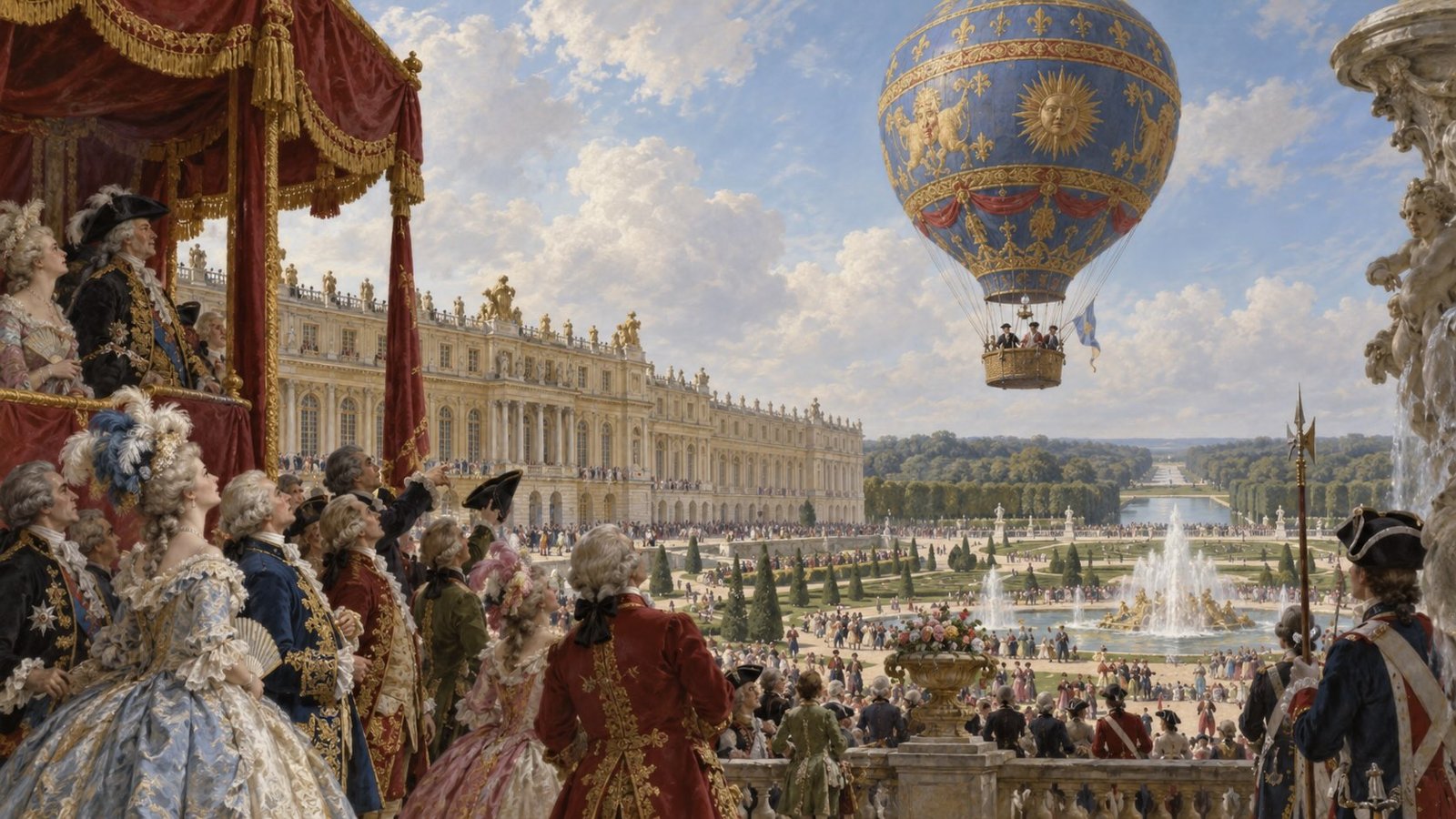
The Montgolfiers now needed a better demonstration. Versailles offered precisely the sort of audience an ambitious eighteenth-century inventor wanted: Louis XVI, Marie Antoinette, the royal court and thousands of spectators. On 19 September, a magnificent decorated balloon rose carrying three passengers — a sheep, a duck and a rooster. Scientists wanted to know whether living creatures could survive at altitude. The choice was oddly sensible. A sheep offered a rough physiological comparison with humans, a duck already knew something about altitude, while the rooster provided another ground-dwelling bird for comparison.
After about eight minutes, the balloon came down safely and its passengers survived. The sheep apparently emerged in sufficiently good condition to enjoy royal favour afterwards. Aviation therefore reached an important milestone: sheep could fly. Humans immediately began asking the obvious follow-up question. If farm animals could survive the journey, why should people remain on the ground?
Louis XVI reportedly considered sending condemned prisoners on the first human flight. Jean-François Pilâtre de Rozier had other ideas. A physicist and enthusiastic experimenter, he wanted the honour himself and eventually secured permission. During October he conducted tethered ascents, initially alone and later with another passenger. These experiments gradually demonstrated that people could stand beneath an enormous fabric envelope, keep a fire burning directly below it and rise into the sky without immediately becoming either dead or roast.
Then came 21 November 1783. Pilâtre de Rozier and François Laurent, Marquis d’Arlandes, climbed aboard a large Montgolfier balloon at the Château de la Muette on the western edge of Paris. Unlike previous human ascents, this time no ropes connected them to the ground. The balloon rose and drifted across Paris for roughly 25 minutes. The two men travelled several miles before landing safely outside the densely built centre. For the first time in recorded history, human beings had made a sustained free flight in a machine.
The journey hardly resembled today’s serene champagne-and-sunrise balloon excursion. The men had to keep feeding the fire while sparks threatened the fabric above them. At one point they reportedly used wet sponges to deal with small burns in the envelope. Nor could they steer properly. Their revolutionary aircraft possessed essentially two controls: make the air hotter and rise, or let it cool and descend. Everything horizontal remained largely negotiable with the wind.
Remarkably, the hot-air triumph almost immediately faced technological competition. On 1 December, barely ten days later, Jacques Charles and Nicolas-Louis Robert made the first crewed hydrogen-balloon flight. Their machine remained airborne for more than two hours and travelled much farther than the Montgolfier flight. Hydrogen balloons could stay aloft longer and required no open fire, although filling a huge bag with an extremely flammable gas introduced a different category of excitement.
Paris became obsessed. Balloon images appeared on clothes, jewellery, furniture, wallpaper, clocks, fans, snuffboxes and almost anything else capable of carrying a fashionable motif. A wave of “balloonomania” swept through society. People talked about atmospheric gases and flying machines at dinners and salons. For a generation already living through scientific and political upheaval, the balloon became proof that apparently impossible things could suddenly become possible.
That cultural reaction matters almost as much as the engineering. Before 1783, the idea of human flight largely belonged to mythology, fantasy and speculative science. By December, Parisians could simply look upwards and see people travelling through the atmosphere. The psychological barrier disappeared astonishingly quickly. Humanity had spent thousands of years dreaming about flight and only a few months turning it into public transport for aristocrats, scientists and adventurous farm animals.
The story also contains a darker footnote. Pilâtre de Rozier later attempted to cross the English Channel using a hybrid aircraft combining hydrogen and hot air. The obvious problem involved placing highly flammable hydrogen near a fire. In June 1785 his balloon caught fire and crashed, killing Rozier and his companion Pierre Romain. The man who had become one of the first humans to fly also became one of aviation’s first fatalities.
Modern hot-air balloons therefore look familiar for a reason. Their materials, burners and safety systems have improved enormously, but the underlying idea remains essentially Montgolfier’s: heat a large volume of air, make the aircraft lighter than the atmosphere around it, and let buoyancy do the rest. The Montgolfier brothers misunderstood part of the science, could barely control their machine and initially filled the sky with smoke from burning wool. Yet on that extraordinary sequence of days in 1783, they demonstrated something far more important than technical perfection. The sky was no longer a boundary. It had become somewhere people could go.