For centuries, pistachios were considered a luxury fit for royalty. Today, they appear in everything from Italian gelato and Turkish baklava to chocolate bars, croissants and expensive coffees of questionable necessity. Few foods have travelled quite so successfully from ancient Persian orchards to the modern supermarket. And few have managed to remain fashionable for so long while requiring quite so much effort to get out of their shells.
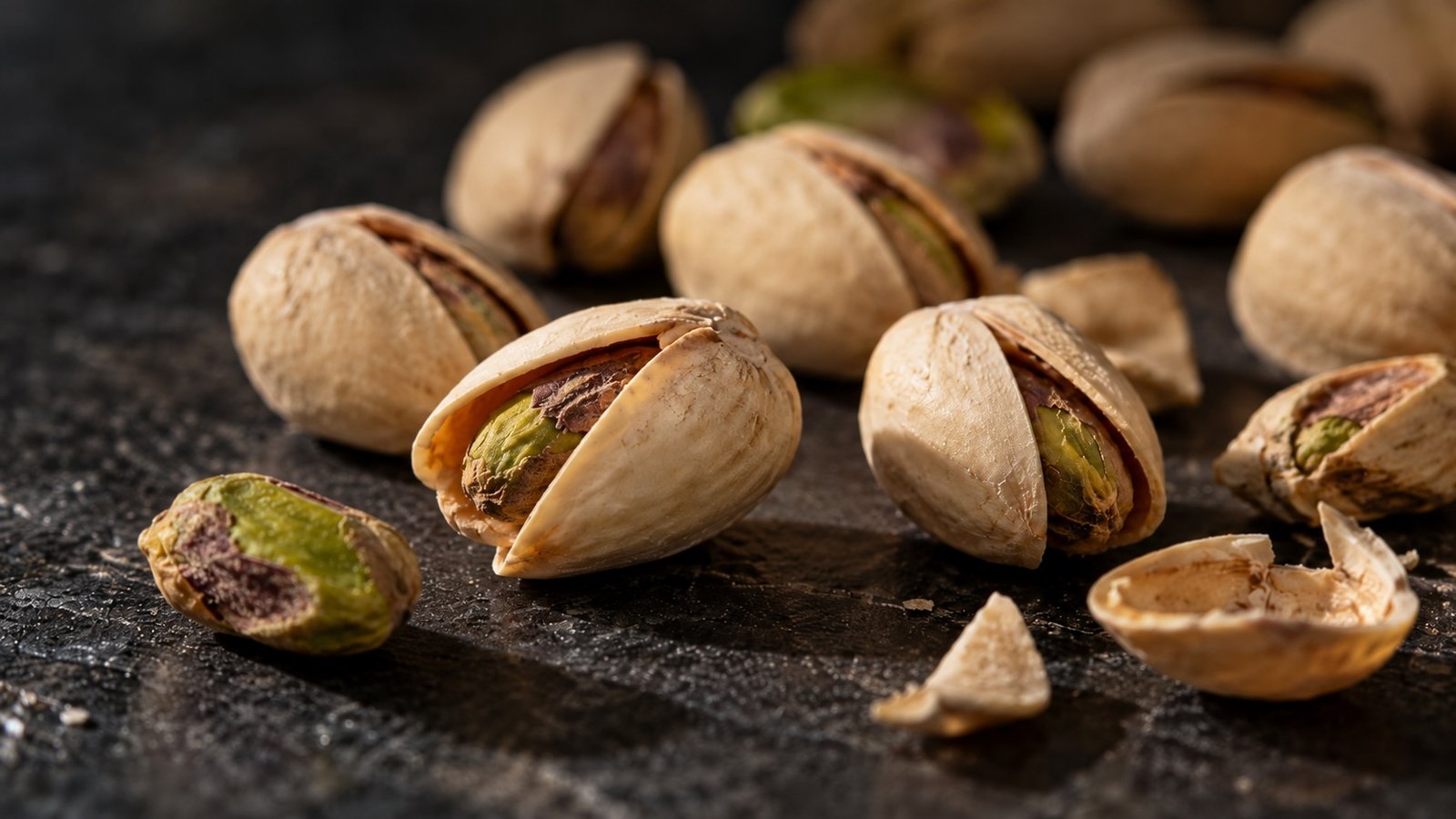
The pistachio has another surprise: botanically speaking, it is not a true nut at all. It is the seed of a fruit, closely related to cashews and mangoes. Its familiar green colour comes from natural pigments, while its distinctive flavour depends on a combination of oils and aromatic compounds. Behind that modest shell lies a history involving emperors, merchants, agricultural ingenuity and, more recently, a global obsession with green desserts.
The pistachio tree, Pistacia vera, originated in the dry regions of Central Asia and the Iranian plateau. People were eating its seeds thousands of years before anyone thought of putting them into ice cream. Archaeological evidence places pistachios among the foods consumed in prehistoric settlements, while cultivation developed over many centuries in regions where hot summers and relatively cold winters suited the trees. Ancient Persia became particularly associated with pistachios, which could be dried, stored and transported over long distances. That made them valuable in a world where fresh food often had a rather limited travelling career.
The pistachio’s association with luxury also produced some entertaining stories. One frequently repeated legend claims that the Queen of Sheba reserved the entire pistachio harvest for herself and her court. It is a good story, although reliable historical evidence is conspicuously absent. What is documented is that pistachios travelled westwards in antiquity. The Roman naturalist Pliny the Elder credited Lucius Vitellius with bringing the tree from Syria to Italy in the first century AD. The Romans had acquired another expensive delicacy, presumably to accompany their already considerable collection of expensive delicacies.
From the Mediterranean, pistachios became embedded in several culinary traditions. Persian cooks used them in rice dishes, sweets and elaborate combinations of fruit, meat and nuts. Across the Middle East, pistachios became familiar ingredients in pastries and confectionery. In the Ottoman world, they found a particularly comfortable home in baklava, where finely chopped nuts were layered between delicate sheets of pastry and drenched in syrup. In the Turkish city of Gaziantep, pistachio cultivation became so closely associated with local identity that the regional nut acquired protected geographical status in the European Union.
Italy developed its own pistachio culture, particularly around Bronte on the slopes of Mount Etna in Sicily. Here, pistachio trees grow on volcanic terrain, producing nuts prized for their flavour and colour. The protected Bronte green pistachio has become an expensive speciality, appearing in everything from pastries to savoury sauces. Its reputation has also encouraged a thriving trade in products claiming some connection to Bronte, making careful reading of ingredient labels a sensible precaution. A jar of green spread may contain considerably more sugar and vegetable fat than pistachio.
The colour itself deserves attention. Pistachios owe their green appearance partly to chlorophyll, the same pigment responsible for the colour of leaves, alongside yellowish carotenoid pigments. Their shade varies with variety, maturity and processing. A naturally green pistachio is therefore perfectly ordinary, although the almost fluorescent green found in some commercial desserts may owe rather more to food colouring than to agriculture. Real pistachio paste is often a muted green or greenish brown, which can be disappointing to anyone expecting their gelato to resemble a freshly painted tennis court.
Even the familiar shell has a story. As the seed develops, its hard inner shell generally splits naturally, producing the characteristic opening that makes pistachios relatively easy to eat. Not every shell cooperates. Some remain stubbornly closed and must be separated during processing. Meanwhile, premature splitting of the outer hull creates opportunities for insects and fungi to damage the crop. Research published by the University of California, Davis, in 2026 examined how changes in cell walls contribute to this problem. Apparently, even a pistachio’s packaging requires considerable scientific attention.
Growing pistachios is not particularly straightforward either. The trees are dioecious, meaning male and female flowers grow on separate plants. Farmers need male trees to provide pollen, carried by the wind to female trees that produce the crop. Pistachios also tend towards alternate bearing, producing heavier harvests in some years and lighter ones in others. They tolerate dry conditions better than many fruit trees, but commercial production still requires careful water management. The popular image of a hardy desert tree effortlessly producing valuable nuts is somewhat optimistic.
For much of the twentieth century, Iran remained strongly associated with the international pistachio trade. Then California developed into a major competitor. Commercial American production expanded rapidly, helped by agricultural research, mechanisation and extensive orchards in the San Joaquin Valley. By 2025, the United States had produced a record 1.58 billion pounds of pistachios, according to the US Department of Agriculture. American growers had transformed a speciality crop into a major agricultural export, while Iran and Turkey remained important producers with their own established varieties and markets.
The American pistachio industry also contributed one of the nut’s strangest chapters: the era of red pistachios. Older consumers may remember bright red shells that left their fingers looking as though they had been handling theatrical blood. The colouring was largely cosmetic, used to conceal staining and imperfections associated with traditional harvesting and processing methods. As technology improved and cleaner shells became commercially available, the practice declined. The pistachio had finally become respectable enough to appear in public without make-up.
Its nutritional reputation has helped its popularity. Pistachios provide protein, fibre, unsaturated fats and several vitamins and minerals, including vitamin B6. They also contain carotenoid compounds such as lutein and zeaxanthin. Like other nuts, they are energy-dense, so a modest handful is a more realistic everyday portion than an entire family-sized packet. Salted varieties can contribute substantial sodium, while pistachio-flavoured confectionery should not automatically inherit the nutritional virtues of its principal marketing ingredient. A pistachio croissant remains a croissant, however persuasive the green filling.
In recent years, pistachio has acquired a new identity as a fashionable flavour. Pistachio cream, pistachio lattes, pistachio tiramisu and elaborate chocolate bars have multiplied across cafés, bakeries and social media. The Dubai-style chocolate trend, combining pistachio filling with crisp shredded pastry, helped turn an established Middle Eastern flavour combination into an international commercial phenomenon. Manufacturers discovered that pistachio could command premium prices, particularly when presented as an indulgent speciality rather than an ordinary ingredient.
This modern enthusiasm has created an amusing contradiction. For centuries, pistachios were expensive partly because they were difficult to grow, harvest and transport. Today, sophisticated agriculture produces them on an enormous scale, yet their reputation for luxury survives. The nut has become both a mass-market snack and a premium flavour, depending largely on whether it arrives in a plastic packet or beneath a carefully arranged dusting of edible decoration.
Perhaps the most revealing detail is that pistachios have never needed much reinvention. Ancient Persians appreciated their flavour, Mediterranean confectioners found endless uses for them, and modern food companies have merely expanded the possibilities. The packaging, prices and culinary fashions have changed dramatically. Inside the shell, though, remains essentially the same small green seed that people were enjoying thousands of years ago. The only genuine technological disappointment is that we still occasionally encounter one that refuses to open.