There are glamorous nuts and there are sensible nuts. Pistachios arrive dressed in green. Macadamias carry the aura of tropical luxury. Almonds somehow acquired a gym membership and became milk. The pecan, meanwhile, looks like a small brown brain and spends much of its public life buried beneath sugar in a pie. Yet this modest nut has a far more interesting biography than its appearance suggests. It fed Indigenous communities, travelled with settlers, became an agricultural industry and even caused Americans to argue about how to pronounce its name.
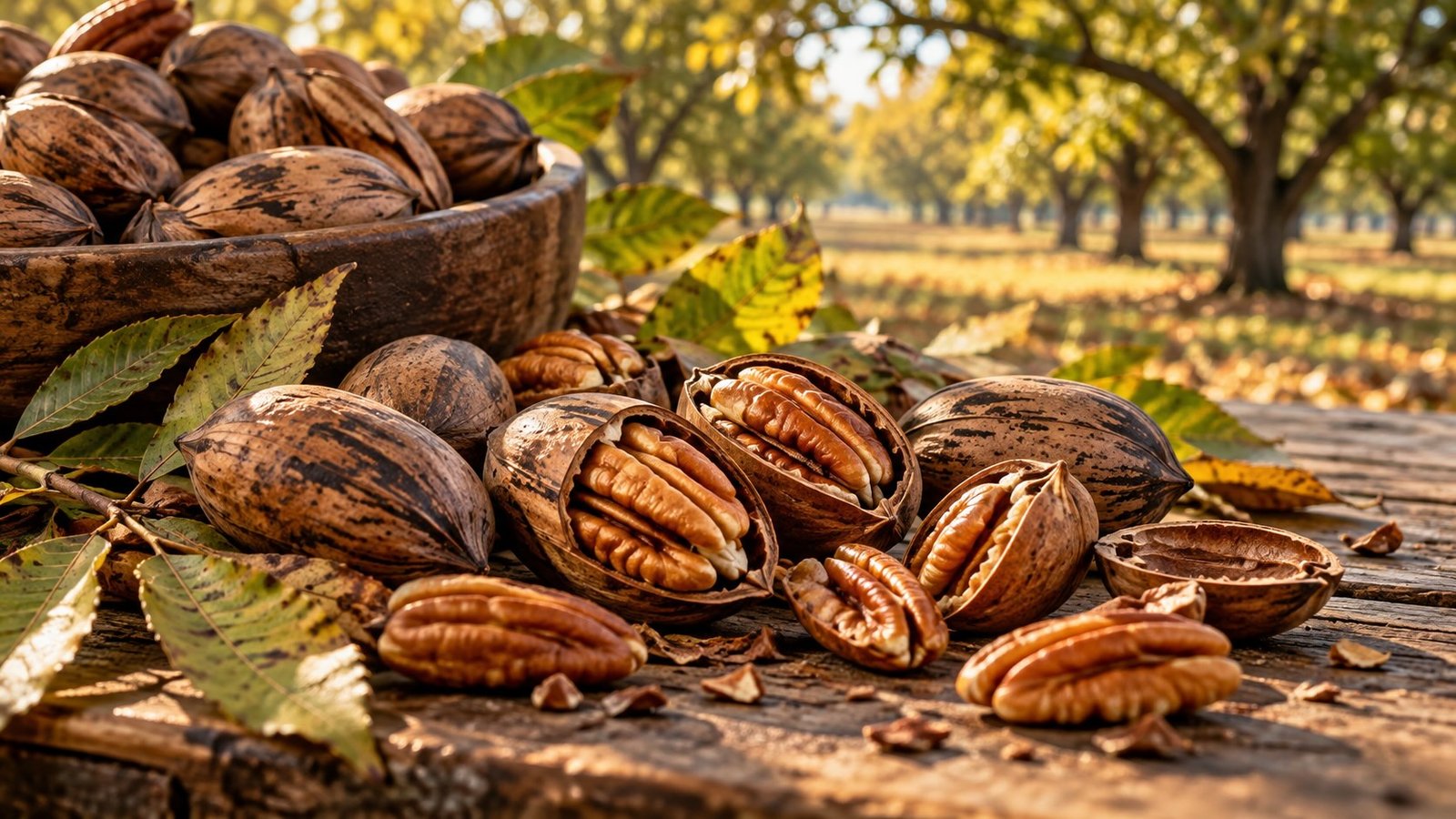
The pecan tree, Carya illinoinensis, belongs to the walnut family and grows naturally in North America. Its historic range followed river valleys across a broad part of what became the United States and northern Mexico. Long before anybody thought of arranging pecans decoratively on pastry, Indigenous peoples gathered them as an important seasonal food. Pecans offered several useful advantages. They contained plenty of energy, travelled reasonably well and required no farmer patiently standing beside a field with a hoe.
The English word “pecan” probably comes through French from an Algonquian word associated with nuts that required cracking with a stone. That description feels refreshingly practical. No botanical poetry, no romantic references to woodland spirits. Here is a nut. You need a rock.
Early European explorers quickly noticed the importance of pecans. Álvar Núñez Cabeza de Vaca, travelling through North America during the sixteenth century, described communities whose seasonal movements connected closely with nut harvests. Pecans could provide food for months. People also traded them. Consequently, the pecan already belonged to a sophisticated food economy centuries before commercial American orchards appeared.
European settlers soon developed their own enthusiasm. Spanish colonists and Franciscan missionaries planted documented pecan groves in northern Mexico during the early eighteenth century. By the late eighteenth century, trees had appeared much farther east. George Washington grew pecans at Mount Vernon, while Thomas Jefferson planted them at Monticello. The founding fathers apparently found time between revolution, constitution writing and political quarrelling to appreciate a decent nut.
However, growing a pecan tree from a particularly excellent pecan creates a problem. The offspring may not reproduce the qualities of its parent reliably. Plant a wonderful nut and nature may reward your optimism with a rather ordinary tree. Commercial growers therefore needed reliable propagation through techniques such as grafting.
That change helped transform pecans from wild harvest into organised agriculture. Growers could select trees for large kernels, thinner shells, flavour, productivity and other useful characteristics, then reproduce those qualities more predictably. During the nineteenth and early twentieth centuries, improved varieties spread through nurseries and orchards. Eventually, the US Department of Agriculture established breeding programmes aimed at developing better cultivars.
Even so, pecan trees retain a little agricultural independence. They often show “alternate bearing”, producing a large crop one year and a smaller one the next. Weather, pests, nutrition and management complicate matters further. Anyone imagining an orchard as a passive collection of trees quietly manufacturing money may therefore wish to reconsider.
Then there is the shell. Commercial varieties often favour thinner shells because customers understandably prefer eating nuts to conducting minor engineering projects. Wild pecans can be smaller and harder to crack, yet enthusiasts sometimes argue that they offer a richer flavour. This creates the familiar food dilemma: convenience versus character. Humanity has spent centuries solving this problem and generally concludes that it wants both.
Texas developed a particularly strong relationship with the pecan. The state officially adopted the pecan tree as its state tree in 1919. Later, it also designated the pecan as its official “health nut”, proving that government can occasionally display a sense of humour. Texas law even contains provisions concerning people who knock pecans from trees without permission. Apparently cattle rustling was not the only rural activity requiring legislative attention.
Georgia became another great centre of commercial production, while pecans also spread through other southern states and into countries including Mexico, South Africa and Australia. Yet the pecan remains unusually connected with North American identity. Unlike almonds, walnuts and pistachios, which have deep Old World histories, pecans tell a story rooted firmly in the Americas.
Of course, modern marketing likes to turn every edible plant into a superfood. Pecans have not escaped. Fortunately, there is some genuine science beneath the promotional enthusiasm. They contain mostly unsaturated fats, along with fibre, minerals and various plant compounds. Recent research has linked regular pecan consumption with improvements in several blood-lipid measures, particularly LDL cholesterol and triglycerides.
Still, eating pecans does not grant immortality. Research has produced much less convincing evidence for dramatic effects on body weight, blood pressure or blood sugar. A handful of pecans can make a sensible replacement for less nutritious snacks. A handful coated in caramel, chocolate and whipped cream belongs to a somewhat different scientific category.
Another pecan controversy requires no laboratory at all. How should we pronounce the word? Depending on where you stand in America, you may hear something resembling “pee-can”, “puh-kahn” or variations between them. Regional loyalties can become surprisingly fierce. Linguistically, however, there is no single pronunciation capable of marching across the continent and arresting all the others. The safest approach involves listening to the locals and copying them.
Curiously, the pecan also provides a lesson in how food history gets simplified. We often describe crops as though somebody “discovered” them, cultivated them and created an industry. Pecans resist that tidy narrative. Indigenous communities knew and used them long before Europeans appeared. Settlers adopted existing knowledge and resources. Horticulturists later improved selected trees. Scientists developed breeding programmes. Modern growers then turned all that accumulated experience into an international business.
And after several centuries of migration, botany, commerce and linguistic disagreement, where does the pecan achieve its greatest popular fame? In a pie.
Perhaps that is appropriate. Pecan pie transforms a nutritious wild food into a spectacular mixture of nuts, sugar, syrup, eggs and butter. It is American culinary history in miniature: take something native, commercialise it, sweeten it considerably and serve a generous portion at Thanksgiving.
Yet try a good pecan on its own and the historical baggage disappears. The flavour is buttery, slightly sweet and more complex than its wrinkled exterior promises. Somewhere inside that small brown shell sits a story stretching from ancient North American river valleys to modern orchards and supermarket shelves.
Not bad for something whose ancestors apparently required a rock before breakfast.