
In 1894, London supposedly received one of the most alarming predictions in its history. Within fifty years, every street in the capital would be buried beneath nine feet of horse manure. That is nearly three metres of dung, enough to swallow pedestrians, obscure shop windows and make the morning commute an unusually intimate encounter with the digestive system of a horse. The prediction was allegedly published in The Times, giving it the respectability that only a serious British newspaper can lend to an impending catastrophe. There is just one problem. Nobody has ever found the article.
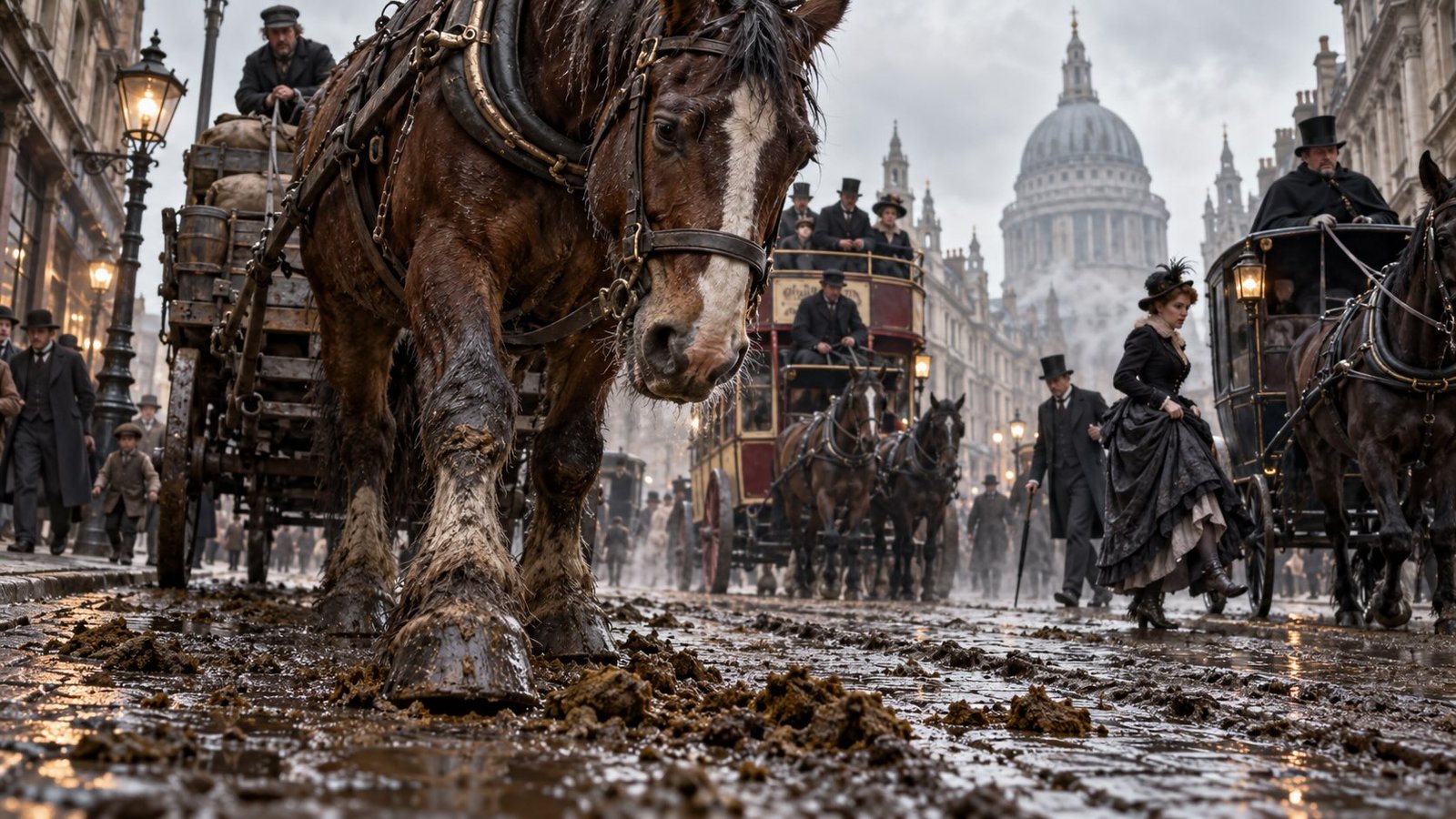
The manure, on the other hand, was entirely real. Victorian London depended on horses in much the same way modern London depends on engines, electricity and people prepared to work for delivery companies. Horses pulled buses, taxis, fire engines, delivery carts, brewery wagons and almost anything else that needed moving. They carried passengers to railway stations, transported goods from the docks and delivered coal to homes. The city’s economy ran on horsepower in the original, considerably smellier sense of the word. And unlike a modern engine, a horse continued producing emissions even when parked.
By the end of the nineteenth century, London’s streets accommodated an enormous equine workforce. Around 1900, the capital had thousands of horse-drawn buses and cabs, alongside countless commercial vehicles. Contemporary estimates suggest that public passenger transport alone required tens of thousands of horses. A single omnibus needed several teams working in shifts because animals could not pull a heavy vehicle through London traffic all day without rest. Behind every apparently simple journey lay a complicated operation involving stables, feed, water, veterinary attention and, inevitably, someone with a shovel.
A working horse might produce roughly 7 to 16 kilograms of manure daily, depending on its size, diet and workload. Multiply that by tens of thousands of animals and the result becomes an impressive municipal responsibility. Add urine, discarded bedding and the occasional dead animal, and Victorian street cleaning begins to look like a profession requiring considerable personal commitment. Londoners could avoid certain unpleasant neighbourhoods, but they could not avoid the horses. The animals were everywhere because almost everything the city consumed had to travel at least part of its journey behind one.
The consequences were particularly unpleasant in summer. Manure dried, crumbled beneath hooves and wheels, and became part of the dust circulating through London’s streets. Rain transformed it into a less airborne but equally objectionable substance. Flies flourished around animal waste and other urban refuse, adding another potential route for spreading disease in a city already struggling with sanitation. Horse manure was hardly London’s only public health problem, but it made a substantial contribution to the general atmosphere. The famous London fog may have attracted poets and painters; the material under their boots was less likely to inspire artistic enthusiasm.
Victorian London even had people whose job was to help pedestrians negotiate the mess. Crossing sweepers cleared paths through muddy and dirty streets, often earning small tips from those who preferred their shoes and clothing relatively clean. Poor children were among those performing this work. It was an occupation made possible by the extraordinary combination of urban wealth and urban filth: respectable citizens could pay someone else to remove the unpleasant consequences of the transport system that served them. In certain respects, the business model has proved remarkably durable.
Yet horse manure was not simply rubbish. For centuries, it had been a valuable agricultural commodity, particularly for market gardeners cultivating vegetables for London’s expanding population. Stable waste could be collected and sold as fertiliser, creating an early form of urban recycling. The city imported hay and oats, fed them to horses, and sent part of the resulting waste back towards the countryside. This arrangement worked rather well when demand for manure kept pace with supply. Unfortunately, as London’s horse population and transport activity expanded, the economics became less attractive. An abundant resource has a habit of turning into a disposal problem when everyone has more of it than they want.
There was another awkward complication. Removing manure often required carts pulled by horses, which produced additional manure while collecting the original supply. Delivering fodder to the horses also required transport, frequently involving still more horses. The system was not literally doomed to multiply waste forever, but it contained a rather splendid contradiction. London needed horses to keep the city functioning, then needed further labour, vehicles and infrastructure to manage the consequences of keeping so many horses. Victorian transport was renewable in the biological sense, although its environmental credentials would have struggled under closer examination.
The situation was serious enough without the famous nine-foot prediction. That particular story appears to have acquired its modern popularity through a 2004 essay by historian Stephen Davies, entitled The Great Horse-Manure Crisis of 1894. Davies described an alleged warning in The Times that London’s streets would disappear beneath manure within half a century. The claim spread enthusiastically through articles, books and lectures, becoming a favourite illustration of how technological progress can solve problems that seem impossible. Unfortunately, the original newspaper warning has never been identified. In 2018, The Times itself examined the attribution and found no evidence that it had published the prediction.
The legend contains another appealing episode. According to the familiar version, the world’s first international urban planning conference met in New York in 1898, became overwhelmed by the manure problem and abandoned its proceedings because nobody could propose a solution. It is an excellent story, particularly for anyone who has attended a conference and wondered whether abandoning it might be the most productive outcome. Unfortunately, convincing contemporary evidence for this dramatic collapse is also lacking. The historical problem was genuine; the spectacular institutional surrender seems to belong to later storytelling.
What actually happened was less theatrical and considerably more interesting. Cities did not wait helplessly for the motorcar to rescue them. Electric trams, underground railways, improved public transport and increasingly effective motor vehicles gradually reduced dependence on horses. London already had an underground railway from 1863, initially operated by steam locomotives, while electric traction expanded around the turn of the century. Motor buses and taxis then accelerated the transition. It was not a single miraculous invention but a combination of technologies, investment and changing economics that made the horse less essential.
The transition also took time. Commercial horses continued working in London well into the twentieth century, particularly where established delivery routes and short journeys still made economic sense. Businesses had invested heavily in animals, stables and equipment, and replacing them required money. The arrival of the motor vehicle did not instantly make every horse obsolete, just as the appearance of electric cars has not persuaded every petrol-powered vehicle to disappear overnight. Technology rarely consults the timetable preferred by people writing about it.
There was, of course, a small catch. The automobile removed one highly visible form of pollution and eventually helped create another. Exhaust fumes, noise, traffic congestion and carbon emissions replaced many of the old problems, while introducing some entirely new ones. Early motorists could reasonably celebrate the prospect of cleaner streets without imagining that future generations would regard their vehicles as an environmental menace. A horse’s emissions were unpleasant but biodegradable; the consequences of burning fossil fuels were rather less obvious to contemporary observers.
The most entertaining aspect of London’s manure crisis may therefore be the way the story itself has developed. A genuine Victorian sanitation problem became a supposedly precise prediction, then a cautionary tale about foolish experts who could not imagine technological progress. The invented detail proved so memorable that it survived repeated attempts to correct it. In 1894, London struggled to dispose of what its horses produced. More than a century later, we are still struggling to dispose of what people have written about it.