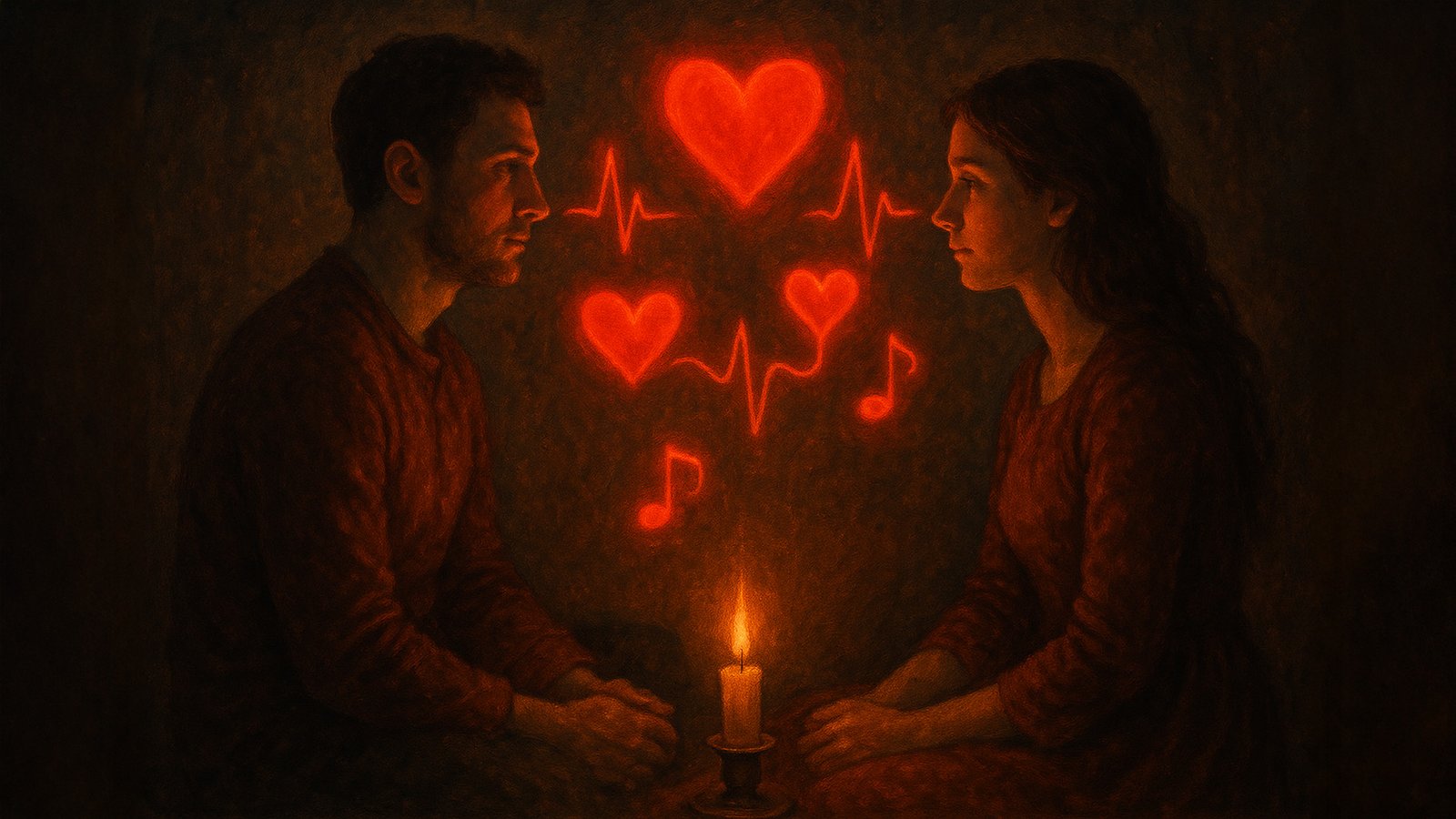
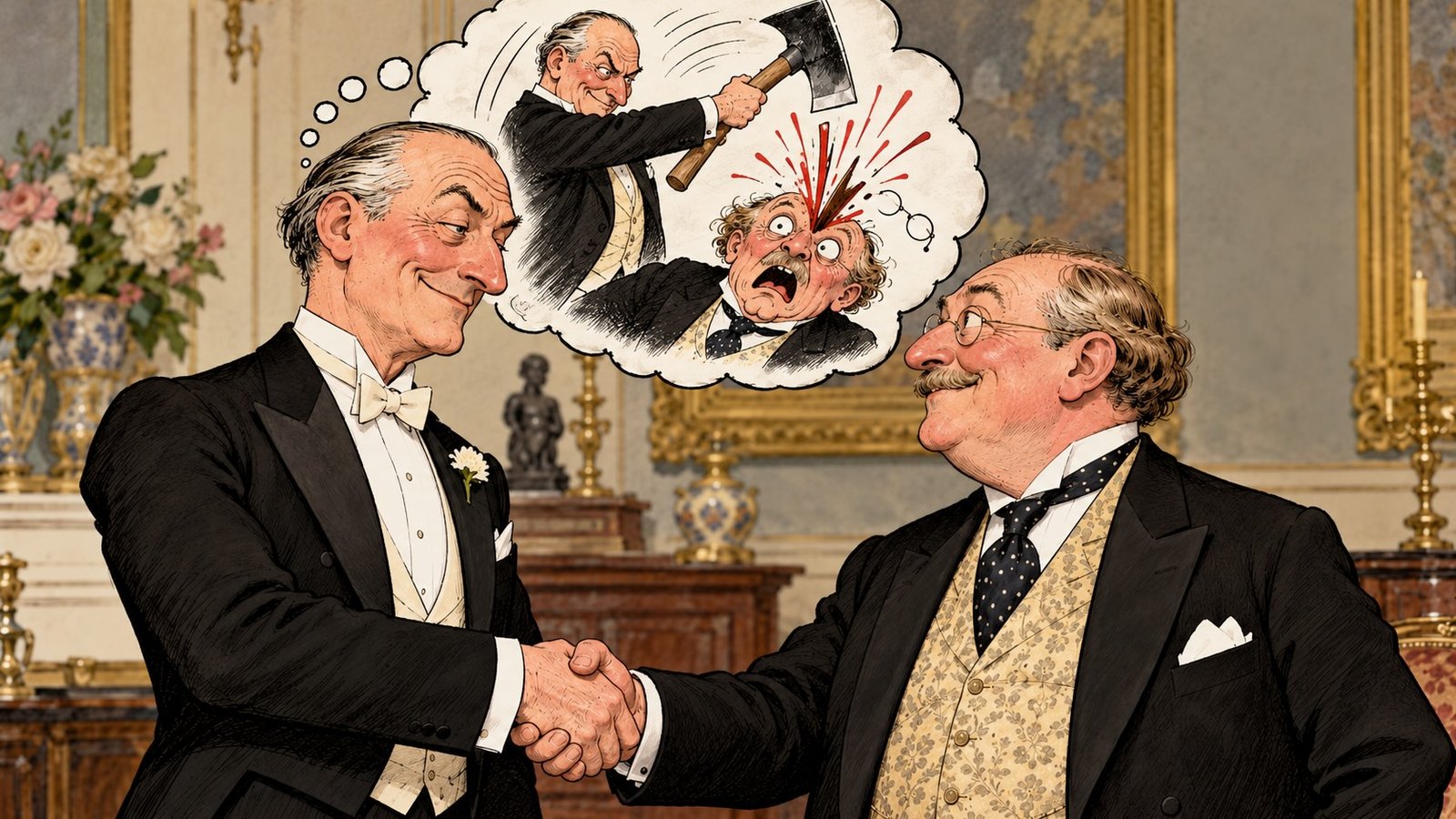
Imagine discovering, over your morning coffee, that everyone can hear your thoughts. Not just the sensible ones. Everything. Your opinion of your manager’s leadership style, which is kinder in public than in private. Your honest view of the neighbour’s garden ornaments. That passing irritation at the person blocking the train door. Within an hour, offices would become tribunals, family WhatsApp groups would turn volcanic, and several dinner parties would die on the spot. We like to think society rests on trust, kindness and shared values. It probably rests just as heavily on the small miracle that most thoughts never make it past the lips.
That is what makes an Interessia poll on X unexpectedly revealing. Asked, “If everyone could read your thoughts for one day, what would worry you most?”, readers did not put secret desires first. They did not put fears and insecurities first either. The biggest group, 31 per cent, chose “My opinions of others”. Next came “Nothing to hide” with 28.9 per cent, then “My fears and insecurities” at 22.5 per cent, and finally “My secret desires” at 17.6 per cent. It is only an online poll, self-selected and far from scientific, but it still exposes a rather awkward truth about what people think is socially dangerous.
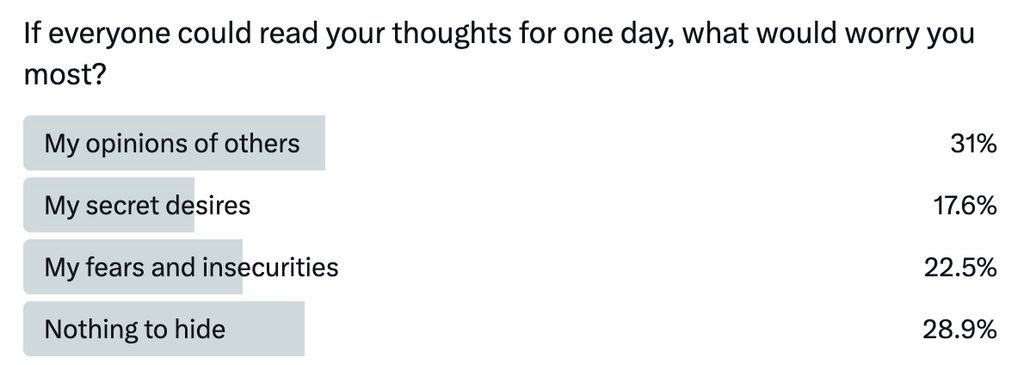
The result suggests that many people are less alarmed by their private longings than by their unfiltered judgments of other human beings. That makes sense. A secret wish may embarrass you. A frank opinion can ruin lunch. Your colleague might recover from learning that you dream of moving to Sicily and opening a wine bar. Learning that you consider him a tiresome fool with presentation slides from hell is harder to smooth over. In that sense, modern civilisation may depend less on honesty than on selective silence. Politeness is not always noble, but it does keep the furniture from flying through the air.
Psychologists have long known that people manage social life with a surprising amount of everyday dishonesty. In a well-known 1996 study, Bella DePaulo and her colleagues asked participants to keep diaries of their lies. College students reported about two lies a day, while adults from a community sample reported about one. These were not usually grand frauds. They were small adjustments, omissions and diplomatic edits. Some protected the speaker, others spared the listener. There is, of course, a difference between lying and tact. Saying a dreadful presentation was brilliant is one thing. Deciding not to announce that it was dreadful is another. Society survives on both.
Then there is the almost heroic 28.9 per cent who claimed they had “Nothing to hide”. One admires the confidence, even if one suspects it has not been tested under laboratory conditions. Having nothing to hide is not quite the same as wanting one’s inner life displayed like supermarket fruit. Privacy is not an admission of guilt. It is often just a preference for not turning one’s mind into a public utility. Besides, thoughts are a disorderly business. They arrive half-formed, contradictory and occasionally ridiculous. Anyone who insists they would be entirely comfortable broadcasting them all day may be either unusually serene or blessed with a memory that omits awkward moments.
That matters because the mind produces unwelcome material without asking permission. In the late 1970s, Stanley Rachman and Padmal de Silva found that intrusive, unwanted thoughts were common even among people without psychiatric illness. Many participants reported thoughts that were upsetting, absurd or entirely out of character. In other words, the brain does not behave like a polished press officer. It behaves more like a badly supervised intern: energetic, impulsive and inclined to send the wrong message at the worst moment. A passing image or hostile flash does not mean a person endorses it. Mind-reading would destroy that distinction in about five minutes.
Another psychological problem lies in what researchers later called the illusion of transparency. In 1998, Thomas Gilovich, Kenneth Savitsky and Victoria Medvec showed that people tend to overestimate how clearly others can read their internal states. We often imagine our nerves, embarrassment or dishonesty are obvious, when in fact other people notice far less than we think. This is one of the more merciful features of ordinary life. The anxious speaker believes the whole room can see panic. Usually it cannot. Universal mind-reading would abolish that protection. Every private tremor would become public property, and fragile confidence would have a very short career.
The 22.5 per cent worried about their fears and insecurities may therefore be the most realistic group of all. Private weakness can be harder to reveal than private desire. Secret longing is sometimes glamorous, or at least entertaining. Insecurity is rarely so obliging. It is one thing to admit you fancy quitting your job and buying a boat. It is another to expose the suspicion that you are not very good at your job, or that your friends merely tolerate you. Those thoughts are not scandalous, just painfully human. A world with open minds might produce greater sympathy. It might also produce the fastest collapse in professional self-confidence since the invention of annual appraisals.
As for the smallest group, the 17.6 per cent who feared exposing secret desires, they may have benefited from one useful distinction: wanting something is not the same as doing it. Human beings think all sorts of things they never act on. That gap between impulse and behaviour is not hypocrisy. It is one of the basic mechanisms of adulthood. Strip it away, and society becomes far less able to distinguish fantasy from intention, irritation from malice, or doubt from conviction. Complete honesty sounds morally uplifting until one imagines a board meeting, a wedding reception or Christmas lunch conducted under telepathic conditions. Suddenly hypocrisy starts to look less like vice and more like municipal infrastructure.
The funniest thing about the poll is also the bleakest. People seem to suspect that what would damage them most is not lust, greed or terror, but their opinion of other people. We spend years discussing authenticity, openness and the virtue of saying what we really feel. Then one hypothetical question appears, and the collective answer is essentially: absolutely not, thank you. That may be the most sensible response of all. The human mind is an extraordinary instrument, but it is not a finished speech. It is a rehearsal room, a scrap paper bin and a complaint department. Civilisation works because the walls are soundproof.