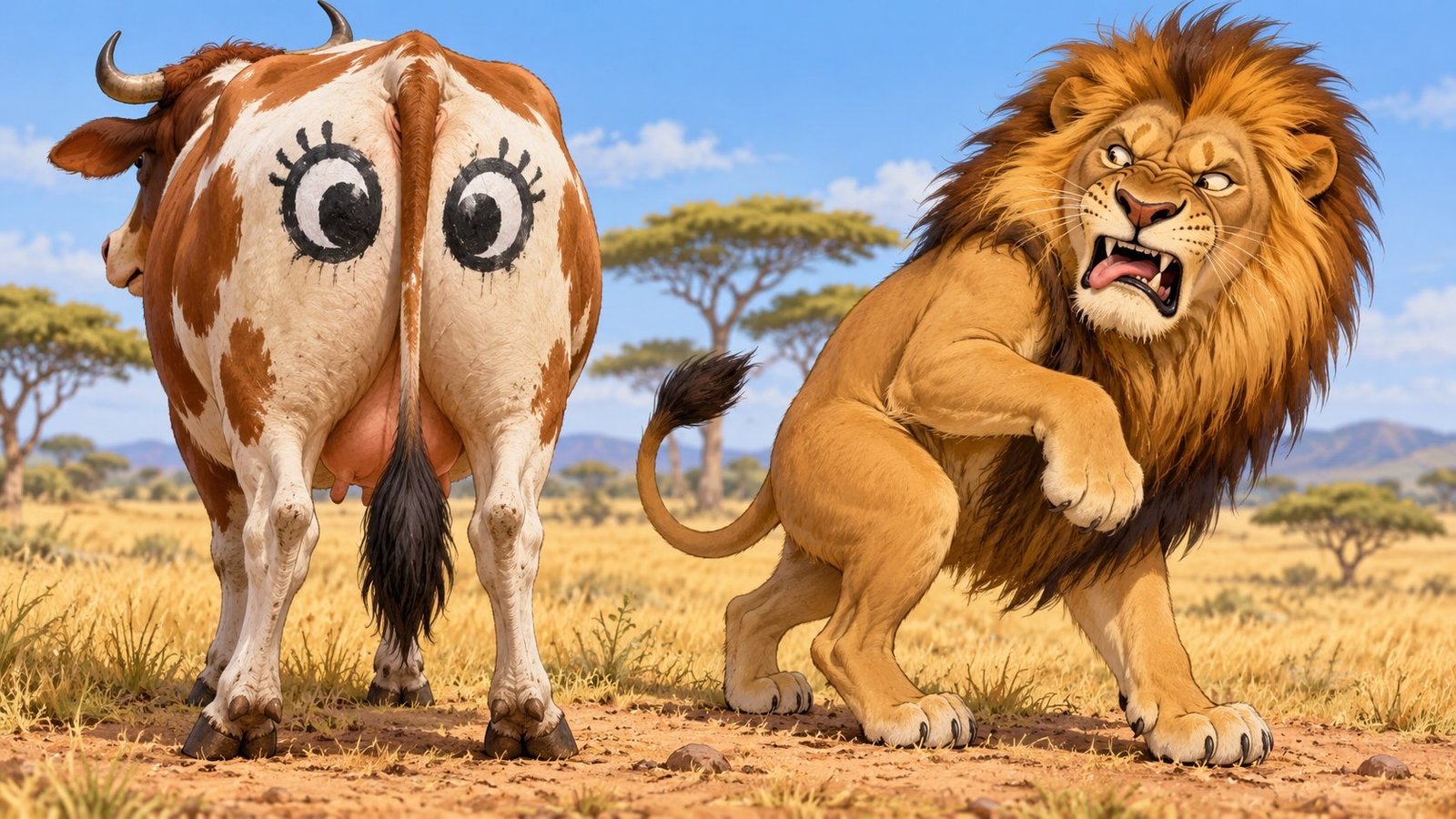
In Botswana, scientists discovered something rather embarrassing for the king of the jungle. A lion can apparently lose interest in its dinner because somebody painted two eyes on a cow’s backside. No electric fences, expensive surveillance equipment or armed guards were required. Just acrylic paint, a stencil and a cow willing to become an unconventional work of art. During a four-year experiment, lions and leopards killed none of the 683 cattle marked with artificial eyespots. Meanwhile, 15 unpainted animals met a considerably less fortunate end. For one of nature’s most formidable hunters, being outwitted by livestock wearing theatrical make-up is hardly flattering.
The experiment took place between 2015 and 2018 near Botswana’s Okavango Delta. Here, cattle farmers share their surroundings with some particularly troublesome neighbours. Lions and leopards attract tourists, but farmers tend to take a less enthusiastic view when these animals eat their cattle. For a small-scale farmer, losing even one cow can mean a serious financial setback. The traditional response to repeated attacks often involves killing predators. This creates an awkward conservation dilemma. Protecting wildlife sounds admirable until the wildlife starts eating somebody’s livelihood.
Researchers from the University of New South Wales and Botswana Predator Conservation decided to try something different. Rather than remove the predators, they wanted to change how predators perceived their prey. Their reasoning was simple. Lions and leopards often rely on surprise when hunting. They approach their targets quietly, hoping to attack before the intended victim notices them. Once the prey detects the approaching hunter, the advantage disappears. The predator may then decide to look for an easier meal. Could painting eyes on cows convince lions that their intended victims had already spotted them?
The researchers painted large, contrasting eyespots on the cattle’s rumps, placing one on each side. These markings created the appearance of a cow watching whatever approached from behind. Imagine a lion creeping towards a grazing cow. Everything appears perfectly normal until the lion notices two large eyes staring back at it. Suddenly, the supposedly unsuspecting animal seems rather more alert than expected. The cow, meanwhile, remains blissfully unaware of its remarkable new surveillance capabilities.
To test the idea, the scientists worked with 14 cattle herds and divided participating animals into three groups. Some received artificial eyespots, others had simple crosses painted on their rumps, and the rest remained unmarked. The crosses served an important purpose. Perhaps predators avoided the painted eyes because they resembled a watchful gaze. Alternatively, maybe any strange marking would make a lion suspicious. Scientists prefer testing such possibilities rather than assuming that a lion possesses a sophisticated understanding of bovine facial anatomy.
The researchers monitored 2,061 cattle across the three groups. Their findings appeared in the scientific journal Communications Biology in August 2020. Of the 683 cattle with painted eyespots, lions and leopards killed none during the monitored periods. Among 543 animals displaying crosses, predators killed four. Of the 835 unmarked cattle, 15 fell victim to lions or leopards. The corresponding mortality rates were zero, approximately 0.7 per cent and 1.8 per cent. The differences were statistically significant, with eyespots providing the strongest apparent protection.
The scientists also fitted selected animals with GPS trackers. This allowed them to check whether painted cattle simply avoided dangerous areas. They found no meaningful differences in travel distances or nights spent outside protective enclosures. The animals encountered broadly similar risks, yet their outcomes differed. There was one complication. Almost all the recorded attacks came from lions. Only one involved a leopard, so the researchers could not confidently establish whether eyespots deterred both species equally.
The most obvious explanation involves what scientists call the detection hypothesis. Ambush predators prefer victims that have not noticed them. A pair of eyes facing the approaching hunter could signal that the element of surprise has disappeared. Continuing the attack might require considerably more effort. This does not necessarily mean lions consciously believe cows have developed eyes on their backsides. Instead, eye-like patterns may trigger a response that makes the predator hesitate. The crosses suggest another possibility: unfamiliar visual patterns might discourage predators even when they do not resemble eyes.
Perhaps a lion approaching an unusually decorated cow simply decides that something looks wrong. Predators cannot afford endless experiments with unfamiliar animals. Hunting consumes energy and carries risks. When a perfectly ordinary cow stands nearby, investigating one with mysterious markings may seem unnecessary. The researchers could not establish precisely which explanation was correct. Both apparent detection and visual novelty might contribute to the effect. Whatever the mechanism, the results suggest that a lion’s hunting decisions can respond to surprisingly simple visual signals.
Nature has experimented with misleading eyespots long before anyone thought of painting cattle. Butterflies and moths provide some of the best-known examples. Many species display large circular markings on their wings. When threatened, some suddenly reveal these patterns, potentially startling approaching birds. Scientists still debate why they work. Some eyespots may resemble the eyes of dangerous animals, while others simply create an unexpected visual signal. Certain markings might even redirect attacks towards less vulnerable body parts.
Some small owls possess eye-like markings on the backs of their heads. These create the impression that the bird is watching in two directions. Humans have experimented with a related idea. In the Sundarbans, the mangrove region shared by India and Bangladesh, some forest workers have worn face masks on the backs of their heads. They hoped the artificial faces would discourage tigers from approaching unnoticed. Reliable scientific evidence of the masks’ effectiveness remains limited, however. The Botswana experiment offered something stronger: a systematic comparison of animals with different markings and no markings at all.
Before farmers rush to transform their cattle into four-eyed creatures, several limitations deserve attention. The researchers did not paint entire herds, so they could not establish whether the trick would remain effective if every cow displayed eyespots. Predators might simply redirect their attention towards unmarked animals. Alternatively, lions might eventually become accustomed to the markings. Three cattle also died in spotted hyena attacks, one from each treatment group. These deaths provided no evidence that eyespots protected against hyenas, which often hunt differently from ambush predators.
The paint required regular maintenance, too. The patterns generally remained clearly visible for around 24 days, and researchers reapplied them approximately every four weeks. They suggested using eyespots periodically during periods of greater predation risk. This might help prevent predators from becoming familiar with the trick. Painting eyes on cows should therefore complement proper enclosures, herding and other livestock protection measures rather than replace them.
Still, the potential benefits extend beyond individual cattle. Farmers who repeatedly lose animals to predators may become less willing to tolerate lions and leopards nearby. Reducing these losses could therefore help protect the predators themselves. Artificial eyespots offer an unusually inexpensive approach, particularly in places where sophisticated equipment is impractical. The method needs further testing across different environments and over longer periods, but its simplicity is certainly appealing.
Perhaps the most amusing part of the experiment is that the cattle did absolutely nothing differently. They continued grazing, wandering and generally conducting themselves with the limited enthusiasm for strategic planning characteristic of cows. The psychological adjustment, if the researchers’ interpretation is correct, happened entirely in the predator. For millions of years, lions have relied on the element of surprise. In Botswana, somebody discovered that a little paint could make them wonder whether the surprise was on them.