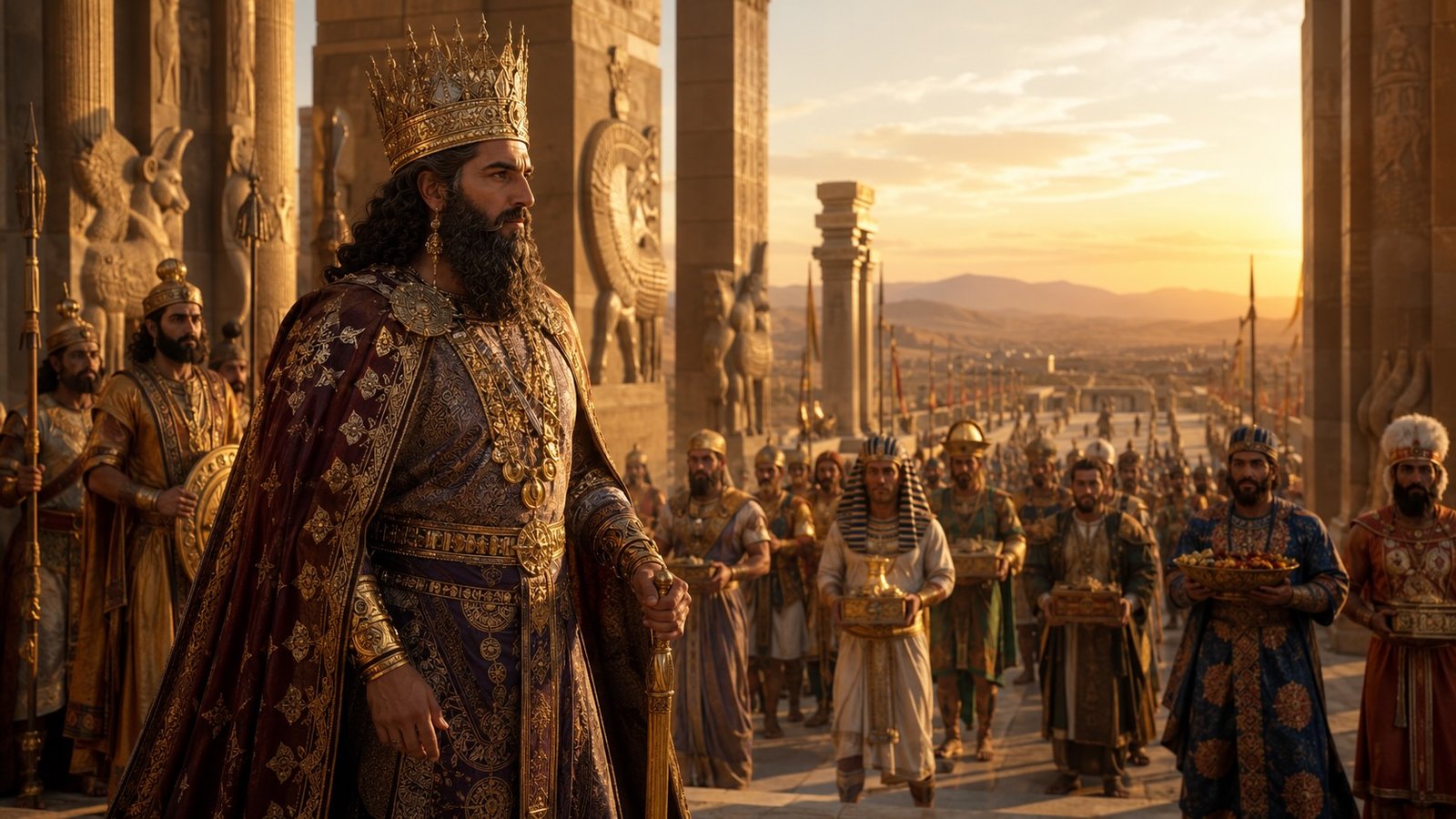
Being the grandson of Genghis Khan must have made family expectations rather uncomfortable. Build a successful career, conquer a few kingdoms, perhaps found a dynasty, and somebody could still point out that Grandfather had created the largest contiguous land empire the world had ever seen. Kublai Khan nevertheless managed something Genghis himself had failed to achieve. He conquered all of China. Then, with almost perfect imperial logic, he decided that this was insufficient.
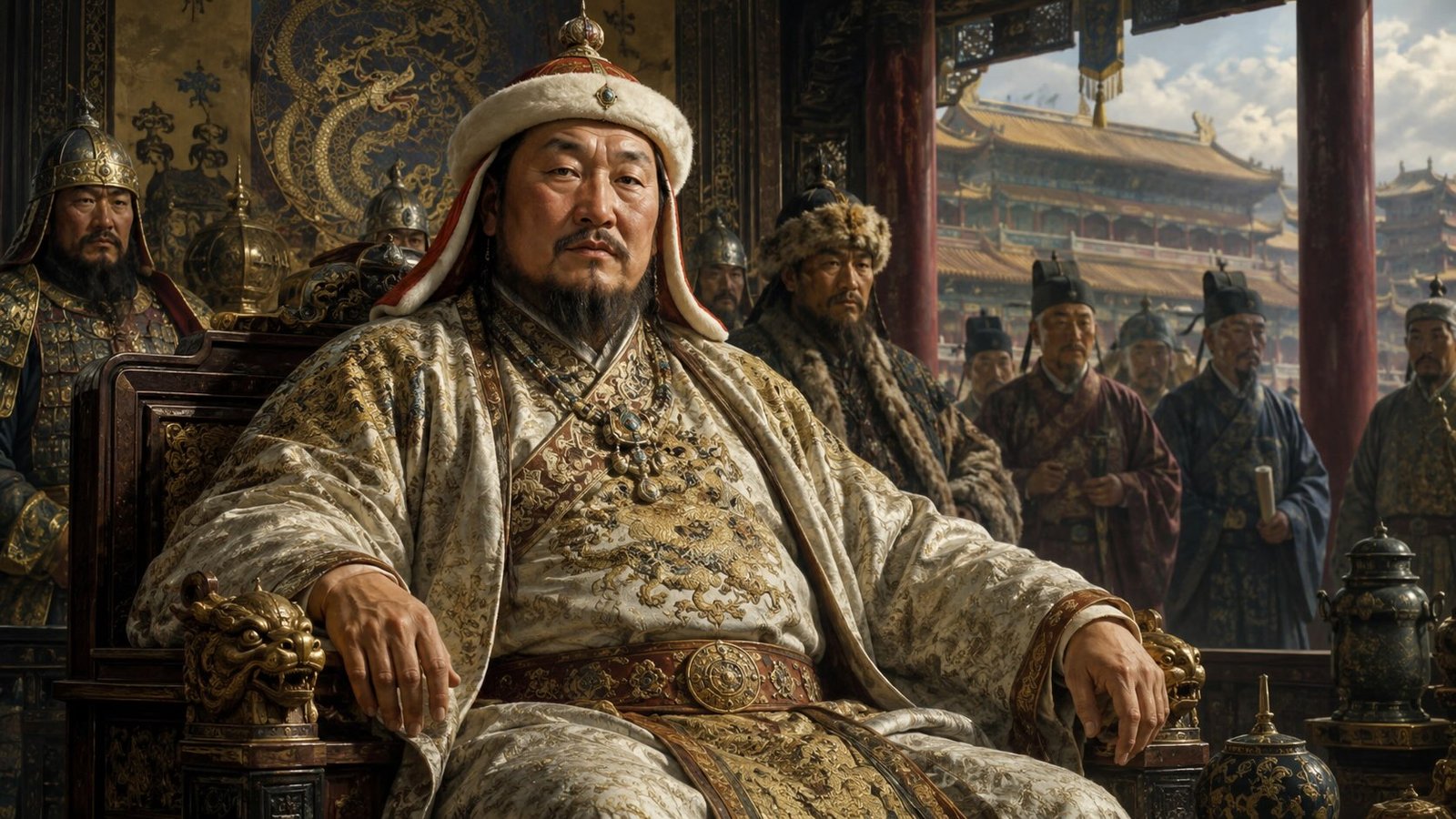
Kublai was born in 1215, only a few years after Genghis Khan had united the Mongol tribes. His father Tolui was Genghis’s youngest son, while his mother Sorghaghtani Beki became one of the most formidable political figures of the Mongol age. She educated her sons carefully, cultivated alliances and helped four of them become major rulers. Kublai therefore grew up inside a family where politics meant considerably more than arguing about inheritance.
By Kublai’s adulthood, Mongol armies already controlled northern China. Southern China, however, remained in the hands of the wealthy and sophisticated Song dynasty. The problem was obvious. Mongol cavalry could move across grasslands with terrifying efficiency, but rice paddies, great rivers, fortified cities and enormous populations required rather different skills. China could not simply be treated as an unusually large extension of the steppe.
Kublai understood this better than many Mongol princes. He surrounded himself with Chinese advisers and became interested in taxation, agriculture, Confucian political ideas and administration. This was not sentimental admiration. A conquered farmer who continued producing grain and paying taxes was more valuable than a dead farmer standing beside a burnt field. For a Mongol prince, this amounted to quite advanced economic thinking.
Then came the family crisis. Kublai’s elder brother Möngke became Great Khan in 1251 but died during the conquest of southern China in 1259. Kublai and another brother, Ariq Böke, both claimed supreme leadership. The resulting civil war lasted until 1264, when Ariq Böke surrendered. Kublai had won, but the victory concealed a larger failure. The enormous Mongol Empire was becoming less a single state and more a collection of family-controlled territories that increasingly ignored one another.
Kublai turned towards the prize he could control: China. In 1271 he formally proclaimed the Yuan dynasty and adopted the language and symbolism of Chinese emperorship. His main capital became Dadu, on the site of modern Beijing, while Shangdu served as his celebrated summer capital. Centuries later, Samuel Taylor Coleridge transformed Shangdu into the romantic “Xanadu”, giving Kublai the unusual distinction of influencing both Chinese history and the naming of luxury hotels.
The Song still controlled southern China, and defeating them required a long war. The Mongols adapted brilliantly. They recruited engineers, built siege machines, created naval forces and used troops from many parts of their empire. Xiangyang, a strategically vital fortified city, finally fell in 1273 after years of siege warfare. The Song capital surrendered in 1276, although resistance continued for another three years.
In 1279 the last major Song forces were defeated at the naval Battle of Yamen. The final Song emperor, still a child, died during the catastrophe. Kublai had now achieved what generations of northern conquerors had attempted: he ruled a politically unified China. The grandson of a nomadic steppe chief had become emperor of one of the world’s largest agricultural civilisations.
Yet Kublai did not simply turn himself into a conventional Chinese emperor. His regime remained unmistakably Mongol. Mongols enjoyed privileged status, while Central and Western Asians often held influential administrative positions. Chinese subjects occupied different legal and social categories, with people from the former Southern Song territories generally receiving the least favourable treatment.
At the same time, Kublai enthusiastically used Chinese institutions whenever they worked. He rebuilt roads, improved communications and supported agriculture. Merchants benefited from the Mongol appetite for international trade, while the famous relay network allowed officials and authorised travellers to move across huge distances. China became deeply connected to commercial routes stretching through Central Asia towards the Middle East and Europe.
Money provided one of the period’s more remarkable experiments. The Yuan government promoted paper currency on a vast scale. Marco Polo later marvelled that the emperor could effectively transform pieces of paper into money and persuade everyone to accept them. Modern economic historians view the Yuan monetary system as more sophisticated than this magical description suggests, although later fiscal pressures and excessive issuance created serious inflationary problems.
Marco Polo, of course, is difficult to remove from any story about Kublai. According to his famous account, the young Venetian reached Kublai’s court with his father and uncle and spent many years travelling through territories controlled by the Great Khan. His descriptions of Chinese cities, commerce, paper money and imperial wealth astonished European readers.
Some sceptics have argued that Marco Polo never reached China, partly because contemporary Chinese records do not mention him and because his book omits certain famous Chinese customs. Yet several details in his account correspond closely with information unlikely to have circulated casually in medieval Europe. Scholars continue arguing about exactly what Polo saw and what role he played, but the idea that his entire journey was invented remains far from proven.
Kublai’s court itself helps explain why an Italian merchant could plausibly find a place there. Mongol rulers operated across an extraordinary cultural network. Persians, Chinese, Tibetans, Koreans, Central Asians, Muslims, Buddhists and Christians appeared throughout their domains. Kublai supported Tibetan Buddhism particularly strongly, yet he generally tolerated several religions. An empire stretching across Eurasia had little practical reason to demand spiritual uniformity.
Unfortunately, possessing China encouraged another imperial habit: looking at neighbouring countries and wondering why they were not already paying tribute.
Japan proved the most famous example. Kublai demanded submission. The Japanese government declined. In 1274 he sent an invasion force across the sea from Korea. The campaign failed. Rather than interpret this as useful market feedback, Kublai prepared a much larger second attempt in 1281.
Japanese defenders had spent the intervening years constructing coastal defences and preparing for another attack. Fighting proved fierce, while the enormous Yuan fleets faced serious logistical difficulties. Then a powerful storm devastated much of the invasion force. Japanese tradition remembered the storm as the kamikaze, the “divine wind”.
The later myth suggests that Japan simply waited while heaven destroyed the Mongols. Reality was less convenient. Japanese troops resisted hard, the invading forces struggled to establish themselves securely, and the fleet combined ships and soldiers from several recently conquered territories. The typhoon transformed a difficult campaign into a disaster, but it did not single-handedly defeat an otherwise unstoppable invasion.
Kublai nevertheless continued exploring opportunities for imperial disappointment. Yuan armies campaigned in Vietnam, where heat, disease, supply problems and local resistance repeatedly frustrated them. Campaigns in Burma produced more complicated results, while an expedition to Java in 1293 ended unsuccessfully. The Mongols had created perhaps history’s finest system for moving armies across continental grasslands. Tropical jungles and ocean crossings declined to cooperate.
These wars cost enormous sums. They also revealed the limits of Kublai’s adaptation. He had conquered southern China precisely because he understood that traditional Mongol warfare needed to change. Yet later he repeatedly projected military power into environments where ships, climate, disease and logistics reduced the advantages that had made Mongol armies terrifying.
Meanwhile, Kublai’s claim to rule the entire Mongol world had become increasingly theoretical. The Golden Horde dominated much of Russia and the western steppe. The Ilkhanate ruled Persia and neighbouring lands. The Chagatai Khanate controlled much of Central Asia. Their rulers belonged to the same dynasty, exchanged diplomats and sometimes cooperated, but they also fought one another and pursued their own political interests.
So did Kublai really “lose an empire”? Not in the dramatic sense. When he died in 1294, he still ruled China and the Yuan dynasty survived until 1368. However, the unified Mongol Empire of Genghis Khan had effectively fractured during his reign. Kublai gained China while losing any realistic possibility of commanding the entire Mongol world.
That trade may actually explain his importance. Genghis Khan showed how rapidly a brilliant military system could conquer territory. Kublai faced the harder question of what to do with millions of conquered people afterwards. He became administrator as well as warrior, patronised trade, experimented with money, borrowed Chinese political traditions and ruled through an extraordinarily multicultural elite.
Yet success also encouraged overconfidence. China became his greatest achievement and, perhaps, his greatest temptation. Once he had conquered the seemingly unconquerable, Japan, Vietnam and Java probably looked like unfinished business rather than warnings.
Kublai Khan therefore left behind a wonderfully contradictory legacy. He was simultaneously Mongol khan and Chinese emperor, destroyer and administrator, cultural outsider and founder of a Chinese dynasty. He conquered an empire grander than almost any ruler could imagine, then discovered that even the Mongols eventually reached places where the world simply refused to surrender.