
Imagine inheriting the largest empire the ancient world had yet seen. It stretched from the Indus Valley to the Aegean Sea, from the deserts of Egypt to the mountains of Central Asia. Millions of people spoke different languages, worshipped different gods and followed different customs. Somewhere, inevitably, a governor complained about taxes.
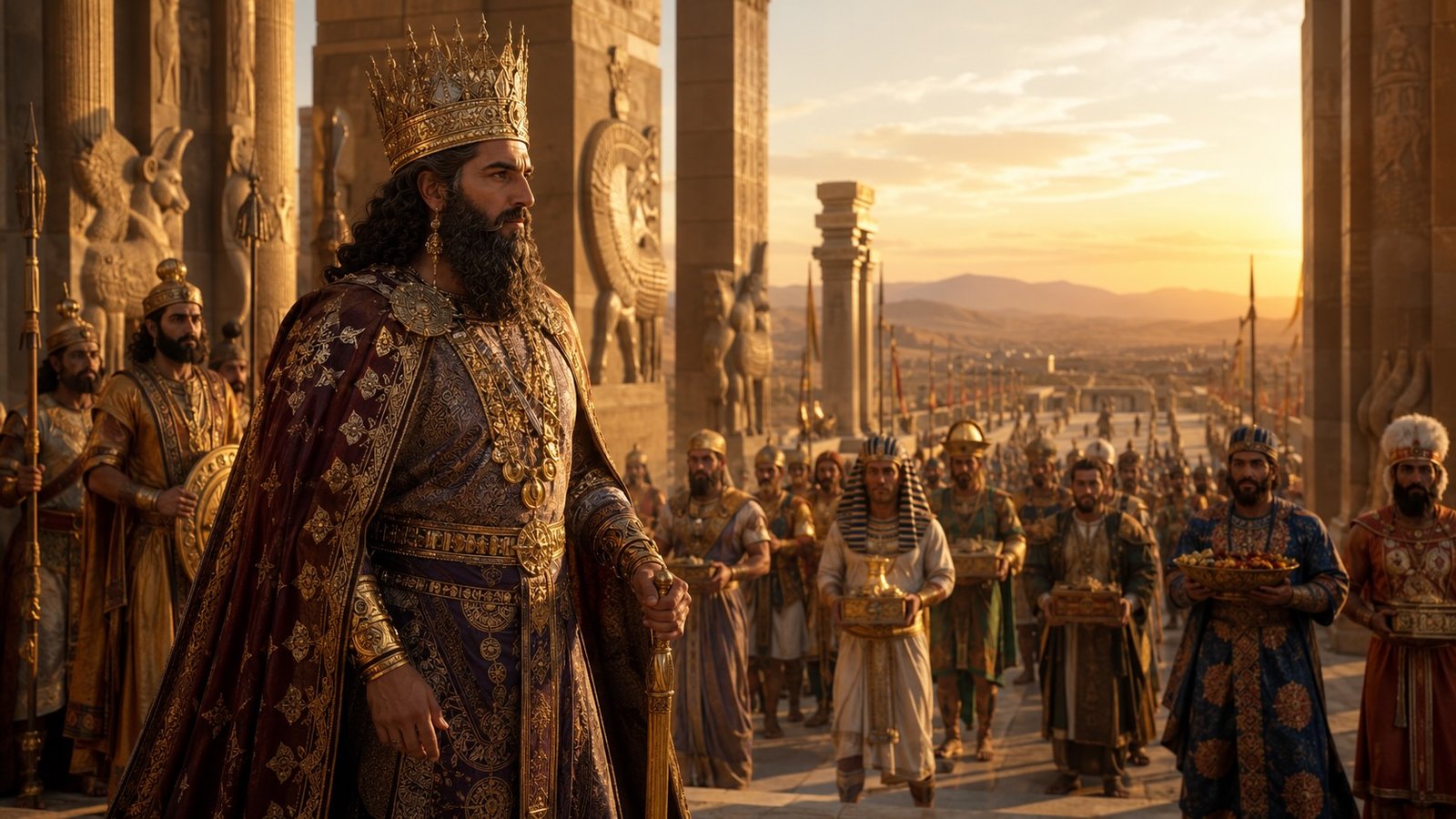
That was the world Xerxes inherited from his father, Darius I, in 486 BCE. Greek history remembers him mainly as the furious Persian king who invaded Greece, lost at Salamis and returned home in disappointment. Yet Greece formed only a small and particularly troublesome corner of his enormous political universe.
To understand Xerxes, we must step outside the Greek battlefield. He was not simply the villain waiting behind Leonidas in a film script. He was the King of Kings, ruler of an imperial system that had already mastered something modern governments still find difficult: controlling a huge, culturally varied territory without insisting that everyone become identical.
Xerxes was born around 518 BCE, the son of Darius and Atossa. His mother mattered enormously because she was the daughter of Cyrus the Great, founder of the Persian Empire. Xerxes therefore combined the bloodlines of the empire’s founder and its great organiser. His elder half-brother Artobazanes could claim seniority, but Xerxes had the stronger dynastic pedigree.
Royal succession in ancient Persia did not involve a tidy constitutional procedure, a televised debate or even a discreet conversation with an executive recruitment firm. Darius chose Xerxes, perhaps because of Atossa’s influence and certainly because Xerxes connected the ruling family directly to Cyrus.
The new king inherited a political machine of astonishing scale. The empire consisted of provinces commonly called satrapies, governed by officials who collected tribute, raised troops and maintained order. Royal roads connected distant regions, while messengers carried commands across territories that now belong to more than twenty modern countries.
Persian rule usually allowed local traditions to continue. Egyptian priests remained Egyptian priests, Babylonian officials kept writing on clay tablets, and Greek cities continued arguing with one another as though political disagreement were an Olympic event. The king demanded loyalty, taxes and military support, but he did not normally demand cultural uniformity.
However, tolerance had limits. Egypt rebelled shortly before or around Xerxes’ accession, and the king responded with force. Babylon also experienced serious unrest during his reign. Older accounts presented Xerxes as destroying Babylonian temples and carrying away a sacred statue of the god Marduk, although modern historians debate how much evidence supports that dramatic picture.
The uncertainty reveals a wider problem. Most surviving narrative information about Xerxes comes from Greek writers, especially Herodotus. They wrote from societies that had fought Persia and celebrated their resistance as a defining national achievement. Asking them for a neutral portrait of Xerxes resembles asking rival football supporters to write each other’s club histories.
Persian inscriptions present a very different man. There Xerxes appears as a legitimate ruler chosen by the supreme god Ahuramazda. He calls himself a great king, king of many peoples and king of the earth. This was imperial language, naturally, but it also expressed a political ideal: order stood on one side, while rebellion and falsehood stood on the other.
At Persepolis, Xerxes continued the monumental programme begun by Darius. He completed or expanded the Apadana audience hall, worked on royal palaces and built the Gate of All Nations. Even the name carries confidence. Delegations entering the complex passed through a ceremonial gateway that transformed imperial administration into architectural theatre.
Reliefs showed representatives of subject peoples bringing gifts to the king. They do not appear as beaten captives. Instead, they wear distinctive clothing and carry products associated with their regions. The message was subtle but unmistakable: the empire contained many identities, yet all participated in a single political order centred on the Persian throne.
Then came Greece. Darius had attempted to punish Athens for supporting the Ionian Revolt but suffered defeat at Marathon in 490 BCE. Xerxes inherited the unfinished conflict. After years of preparation, he launched a vast expedition in 480 BCE, assembling troops and ships from across the empire.
Herodotus claimed that Xerxes commanded more than two million soldiers. Ancient authors enjoyed enormous numbers in much the same way modern headlines enjoy the phrase “record-breaking”. The real army was almost certainly much smaller, although still huge by the standards of the period. Supplying it required roads, depots, fleets, engineers and impressive coordination.
Xerxes ordered bridges built across the Hellespont, allowing his army to cross from Asia into Europe. According to Herodotus, a storm destroyed the first bridges, so the king commanded the sea to receive three hundred lashes. The story perfectly suits the Greek image of an arrogant despot trying to punish nature itself. Whether it happened remains impossible to prove.
At Thermopylae, Persian forces defeated the famous Spartan-led defence after discovering a path around the Greek position. Later storytelling turned the battle into a simple clash between free Greeks and enslaved Persians. Reality looked less convenient. Greek communities fought on both sides, and the Persian army included many peoples with different political arrangements.
Xerxes captured Athens, whose population had largely evacuated. His forces burned major buildings on the Acropolis, an act remembered as barbaric destruction by the Greeks. Yet warfare in the ancient world rarely rewarded restraint, and the Athenians later answered by supporting the destruction of Xerxes’ own palace complex at Persepolis under Alexander.
The crucial setback came at Salamis, where the narrower waters favoured the Greek fleet. Persian numbers became less useful, coordination broke down and the Greeks won a decisive naval victory. Xerxes returned to Asia, leaving Mardonius to continue the campaign. Persian forces lost again at Plataea in 479 BCE.
For Greece, these victories became a civilisation-saving epic. For the Persian Empire, they represented a failed campaign on its western frontier, not immediate imperial collapse. Xerxes continued to rule for roughly fifteen more years. The empire remained wealthy, powerful and administratively functional.
His personality remains hidden behind competing performances. Herodotus gives us a king who could behave cruelly, change his mind, listen to advisers and suddenly weep over the shortness of human life. Persian monuments show a composed guardian of divine order. Modern popular culture often replaces both portraits with a pierced giant wearing very little practical armour.
None offers an uncomplicated photograph of the man. Still, a plausible Xerxes emerges between them: proud, deeply conscious of his legitimacy, capable of enormous organisation and ruthless when challenged. He was neither an incompetent fool nor an invincible superhuman. Instead, he was an imperial monarch carrying the expectations of Cyrus and Darius on his shoulders.
In 465 BCE, Xerxes was assassinated in a palace conspiracy, probably involving the court official Artabanus. His son Artaxerxes I eventually secured the throne. The violent ending may tempt us to see failure, yet assassination formed an occupational hazard for ancient monarchs rather than a reliable performance review.
Xerxes deserves to be remembered for more than one invasion. He ruled a sophisticated empire at or near the height of its power, completed some of its most impressive monuments and maintained a system that survived him by more than a century. Greece gave him his fame, but Persia gave him his real significance.
Perhaps that is the great irony of Xerxes. The ruler of the world’s largest empire became a supporting character in somebody else’s national story. Once we look beyond Thermopylae, he appears not as the king who failed to conquer Greece, but as the king who already ruled almost everything around it.