How Broadway Became Broadway
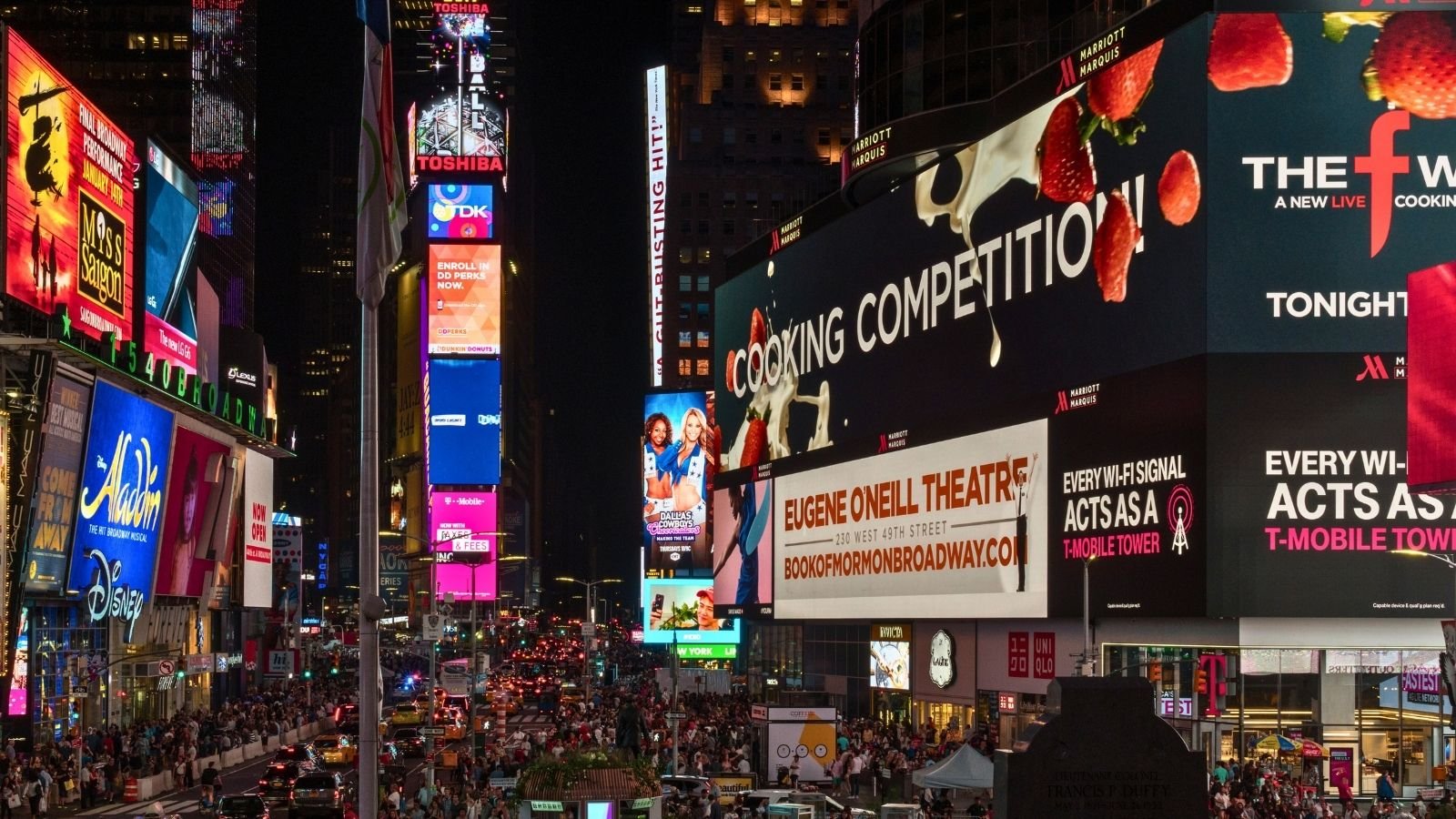
Broadway is a street, a neighbourhood, an industry, a dream factory and, occasionally, an extremely efficient machine for turning several million dollars into absolutely nothing. Few places have managed to compress art, commerce, ambition, tourism, celebrity and financial panic into such a small patch of city. Even more strangely, most Broadway theatres are not actually on Broadway. Geography, as theatre producers discovered long ago, matters considerably less than branding.
The story starts well before Times Square had enormous screens selling trainers, streaming services and things nobody quite remembers asking for. Broadway itself follows part of an old route through Manhattan that existed before New York became New York. Theatre gradually gathered around the street during the nineteenth century as the city expanded northwards. Earlier theatrical districts had centred farther downtown, but audiences, money and fashionable society kept moving uptown, and the theatres followed them.
By the late nineteenth century, the theatrical centre had reached the area around Union Square and Madison Square. Then another migration began towards Longacre Square, the slightly unromantic name once given to the neighbourhood we now know as Times Square. The arrival of electric lighting helped transform it. The first decades of the twentieth century produced enormous illuminated signs, theatres, restaurants and hotels, creating a spectacle outside the theatres almost as extravagant as anything happening inside them. “The Great White Way”, Broadway’s famous nickname, referred to the extraordinary glow produced by electric advertising and theatre lights.
Longacre Square became Times Square in 1904 after The New York Times moved its headquarters there. The theatres multiplied around it. Broadway had found the setting that still defines it: a strangely theatrical cityscape where buildings advertise fantasies several storeys high and thousands of people arrive every evening to sit quietly in dark rooms.
Yet Broadway did not initially mean what it means today. Early twentieth-century entertainment mixed musical comedy, operetta, melodrama, vaudeville, revue and spectacle. The Ziegfeld Follies, beginning in 1907, offered lavish costumes, chorus girls, comedy and stars rather than the tightly integrated narrative expected from later musicals. Producers understood something that Hollywood, Las Vegas and modern streaming platforms would also learn: audiences enjoy stories, but they enjoy spectacle rather a lot too.
The musical slowly changed. Jerome Kern and Oscar Hammerstein II’s Show Boat, which opened in 1927, treated songs, characters and serious themes as parts of the same dramatic structure. Then Rodgers and Hammerstein’s Oklahoma! arrived in 1943 and helped establish another important principle: songs and dancing should advance the story rather than interrupt it.
This period became Broadway’s celebrated golden age. Rodgers and Hammerstein, Irving Berlin, Cole Porter, George and Ira Gershwin became household names. Leonard Bernstein joined them among the defining figures of American musical culture.
Shows such as My Fair Lady, West Side Story, Guys and Dolls and The Music Man pushed the musical further. They combined memorable songs with stronger characters, sharper storytelling and greater dramatic ambition.
However, the romantic version of Broadway history tends to forget how brutally commercial the place always was. A Broadway production needs a theatre, unionised performers and technicians, designers, musicians, marketing, insurance and enough money to continue paying everybody while waiting for audiences to appear. Every evening is effectively a small industrial operation disguised as effortless entertainment. When the curtain rises, nobody in the audience should be thinking about payroll. The producer certainly is.
Broadway also has a wonderfully misleading name. Today the label generally refers to professional productions presented in large theatres, traditionally those with at least 500 seats, principally in Manhattan’s Theatre District and at Lincoln Center. Smaller professional theatres fall into the Off-Broadway category, while still smaller and more experimental venues became known as Off-Off-Broadway. The distinction concerns the theatrical ecosystem rather than simply whether a building stands on Broadway itself.
In fact, only a handful of Broadway theatres have entrances directly on Broadway. Many of the famous houses sit on West 44th, 45th, 46th, 47th and neighbouring streets. There is even a Broadway Theatre, which at least has the decency actually to stand on Broadway. Theatre nomenclature rarely rewards excessive logic.
The business model creates a peculiar Darwinian environment. A successful production can run for decades. A failure can disappear before tourists have finished reading the poster. Cats opened in 1982 and ran for eighteen years. The Phantom of the Opera opened in 1988 and continued until 2023, becoming the longest-running Broadway production in history. The Lion King, Wicked, Chicago and The Book of Mormon built similarly durable commercial lives.
This longevity changed the district. Earlier Broadway constantly replaced shows with new productions. Modern megamusicals can occupy valuable theatres for years or decades. A theatre housing a successful long-running show starts to resemble an oil well with singing.
Then there is the curious Broadway paradox: the more local the institution appears, the more international its audience becomes. Broadway forms part of New York tourism almost as naturally as Central Park or the Empire State Building. Before the pandemic, annual attendance had reached nearly 14.8 million in the 2018–19 season. Broadway then closed completely in March 2020, something almost unimaginable in an industry built around the principle that the show must go on.
When Broadway reopened, the question was not merely whether people still liked musicals. It was whether an industry dependent on commuting workers, international tourists, packed indoor spaces and expensive tickets could recover. It did. Audiences returned, although attendance and individual productions continued to fluctuate. The recovery demonstrated something deeper about Broadway: people do not go merely to consume a story. They go because theatre offers something streaming cannot reproduce — several hundred strangers watching real people attempt the same impossible performance together, tonight and only tonight.
That distinction explains why Broadway survived cinema, radio, television, home video, streaming and repeated predictions of its death. Each technological revolution appeared to offer a cheaper, easier substitute. None quite replaced the psychological effect of sitting inside a theatre when the orchestra begins.
Broadway also has a long tradition of absorbing whatever threatens it. Rock music produced Hair. Pop spectacle helped shape modern megamusicals. Film properties became stage musicals. Disney entered Broadway with Beauty and the Beast and later transformed The Lion King into one of theatre’s biggest international franchises. Hip-hop, meanwhile, arrived spectacularly with Hamilton, which opened on Broadway in 2015 after beginning at the Public Theater Off-Broadway. Like many successful productions before it, Hamilton proved that supposedly experimental material can become mass entertainment if audiences decide they want it badly enough.
That path from Off-Broadway experimentation to Broadway success matters. A Chorus Line, Rent, Avenue Q, In the Heights, Hamilton and other major shows developed outside Broadway before transferring to larger theatres. Broadway therefore behaves less like a single creative institution than the visible summit of a much larger theatrical ecosystem. Small venues test ideas; regional theatres develop productions; investors assess risk; critics and audiences intervene; and eventually something may reach Times Square wearing a considerably more expensive costume.
Naturally, myths surround the place. One says Broadway success depends mainly on reviews. Reviews matter, but word of mouth, stars, marketing, tourism and advance ticket sales can matter just as much. Another assumes a sold-out show must be enormously profitable. Not necessarily. Weekly operating costs can be spectacular, and producers must first recover the production’s capital investment.
Perhaps the biggest myth is that Broadway represents pure artistic glamour. Backstage it contains contracts, loading schedules, ticket algorithms, understudies, accountants, insurance policies and people worrying about whether Tuesday’s matinee will sell. The glamour works precisely because audiences never see most of that machinery.
And that may explain the Broadway phenomenon better than any famous song. Broadway sells something modern life increasingly struggles to provide: an event that cannot quite be paused, copied or experienced later in exactly the same way. Someone forgets a line, a prop misbehaves, an understudy becomes extraordinary, an audience laughs where yesterday’s audience remained silent.
Outside, Times Square continues flashing advertisements into the night. Inside, however, Broadway still relies on an ancient arrangement: performers enter a room, strangers gather to watch them, the lights go down and everybody agrees to believe something improbable for a few hours.
For an industry so obsessed with innovation, Broadway’s greatest trick may therefore be remarkably old-fashioned. It keeps persuading millions of people to leave their homes.