Romance among emus begins with a rather important reversal of expectations. The female does much of the pursuing, she competes for access to desirable males, and she produces deep booming calls that can carry across the Australian landscape. The male, meanwhile, has good reason to consider his options carefully. If everything goes well, he will soon spend nearly two months sitting on a pile of enormous green eggs while his partner may wander off and start another relationship.
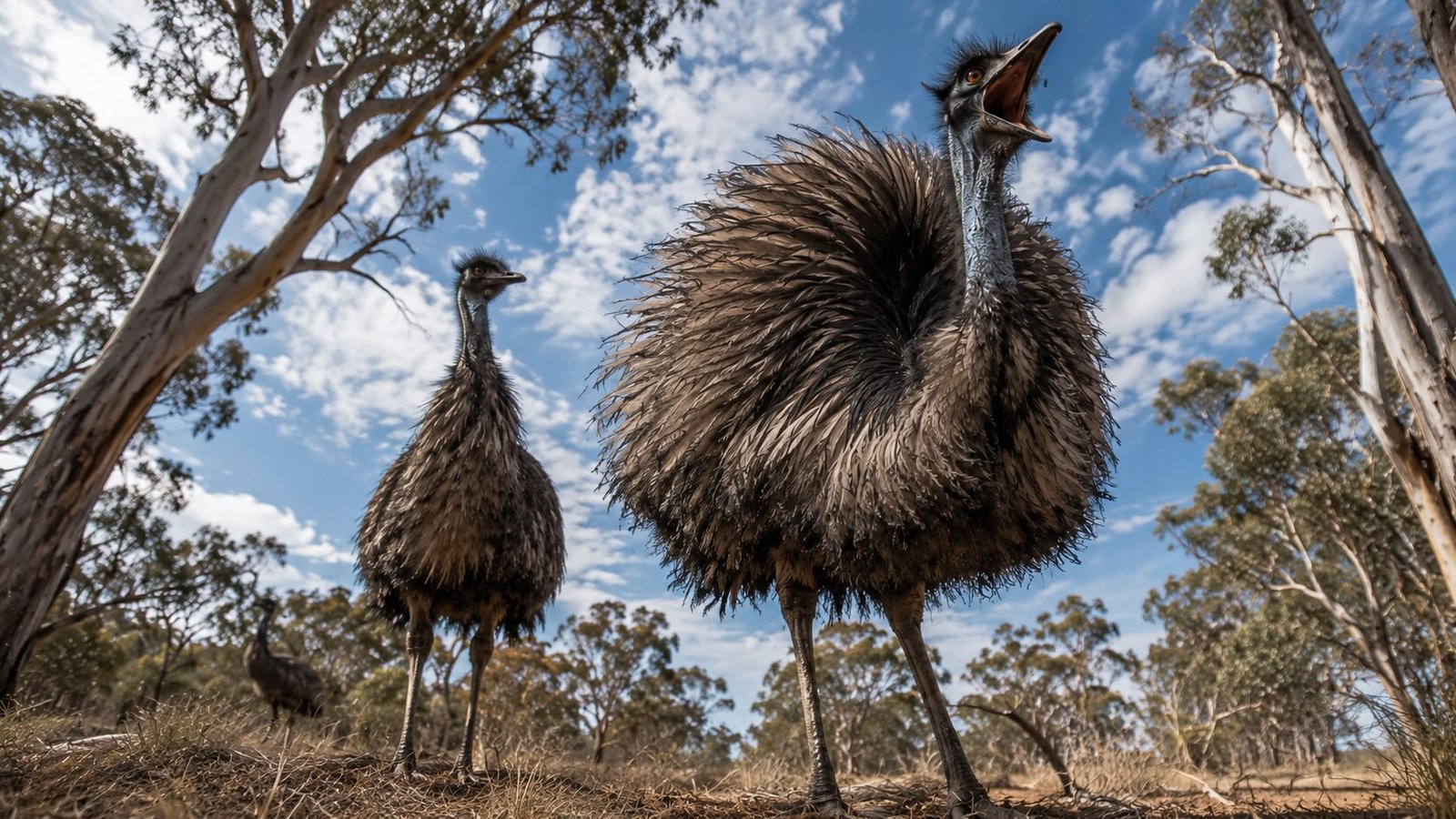
At first, though, an emu couple can look surprisingly conventional. During the breeding season, a male and female may remain together for several months. They walk around together, feed together and establish something resembling a pair bond. Research on captive emus found that more than 70 per cent of birds could actually be described as socially monogamous.
So the popular image of every female emu casually abandoning a procession of heartbroken husbands exaggerates matters considerably. Nevertheless, emu courtship has its own rules, and females usually take the more active role in forming and maintaining the pair. They strut, puff out their feathers and direct much of their attention towards the male. Females can even guard a chosen partner from competing females, which makes sense when one remembers what the male is eventually expected to contribute. He is not merely a brief romantic interest. He is potentially about to become the entire childcare department.
The soundtrack makes the whole affair stranger. Female emus possess a specialised inflatable neck sac that allows them to produce an extraordinarily low booming or drumming sound. It can travel for considerable distances, while males generally make quieter grunting noises. If humans followed the same system, dating would involve women standing several fields apart making noises resembling distant bass drums while men listened politely and assessed their prospects. It may not sound particularly romantic, but for emus it seems to work perfectly well. Females also tend to be larger than males, which is unusual enough to attract evolutionary interest. In many familiar bird species, males compete vigorously while females choose between them. Think of peacocks dragging enormous decorative tails around simply to impress somebody.
Emus have shifted part of that competitive pressure towards females because males provide something exceptionally valuable: virtually all the parental care. A female therefore has good evolutionary reasons to secure a male willing to sit on her eggs and raise the resulting chicks. Eventually, the male prepares a rough nest on the ground. Nobody would mistake it for architectural extravagance, because grass, leaves, bark and twigs form little more than a broad platform. Soon afterwards, however, the female begins producing one of the emu’s most remarkable features.
An emu egg can measure roughly 13 centimetres long and weigh around half a kilogram. Fresh eggs have a magnificent dark bluish-green colour, while their shells contain several layers that become progressively paler towards the inside. An intact clutch of perhaps five to fifteen eggs looks more like a collection of polished decorative stones than a nursery. The female normally lays one egg every few days, and producing such enormous eggs requires substantial energy. Females lose weight during the laying period, and recent research has confirmed that this loss relates closely to clutch size. Bigger reproductive effort therefore carries a bigger physiological bill. Producing an impressive collection of green eggs is not cheap, even by emu standards.
Then the domestic arrangements change abruptly. Once the male begins incubating, his priorities transform, and he becomes defensive towards other emus. He may even chase away the female who produced the eggs. She no longer has any necessary role at the nest. In some cases she leaves, finds another male and breeds again, creating a mating system known as sequential polyandry. One behavioural study found this pattern in about 15 per cent of females observed. That certainly does not make every female emu a serial partner collector. It does show, however, that a female can increase her reproductive output by persuading more than one male to take responsibility for different clutches.
The irony becomes even better when we look at males before incubation. They are not necessarily models of romantic exclusivity either. Behavioural research has found males courting females other than their established partners, while extra-pair copulations occur often enough to make the emu mating system considerably messier than a simple story of promiscuous females and faithful fathers. Genetics made things messier still. Researchers examined 106 chicks from 18 emu nests and compared their genetic profiles with those of the adults associated with each nest.
More than half of the chicks, 51 per cent, had not been fathered by the male incubating them. Eleven per cent did not belong genetically to the female observed as his partner either, while around eight per cent appeared to represent brood parasitism. Their genetic profiles matched neither adult associated with the nest. Somewhere along the way, another emu had apparently contributed eggs to somebody else’s childcare arrangements, which makes the phrase “our children” biologically ambitious. So picture the male now. He has settled onto perhaps ten enormous eggs, and he will remain there for roughly eight weeks. He cannot know with certainty which chicks will be genetically his, and some may belong to neither member of the pair that established the nest.
Evolution has not equipped him with a paternity-testing laboratory. Instead, it has equipped him with an overwhelming desire to sit, and sit he does with impressive commitment. During incubation, the male enters an extraordinary physiological state. He largely stops eating and undergoes a prolonged fast while living from accumulated body reserves. Older observations recorded males losing as much as eight kilograms during the process. Recent hormonal research helps explain what happens inside him. Testosterone drops sharply after incubation begins, while prolactin, a hormone strongly associated with parental behaviour in birds, rises dramatically.
In other words, fatherhood changes him not merely behaviourally but chemically. The strutting, sexually active bird becomes an incubating machine with a radically different hormonal profile, and his entire biology appears to shift towards parenting. Around 55 days later, the eggs finally hatch. Out come small cream-coloured chicks decorated with dark brown longitudinal stripes, and they look nothing like miniature adult emus. Adult emus resemble walking haystacks with powerful legs. The chicks, by contrast, look almost carefully designed, and their stripes provide camouflage while they move through grass and scrub.
Their developmental independence explains why the emu’s unusual parenting system works. Emu chicks are precocial, which means they can walk soon after hatching and quickly begin feeding themselves. Dad therefore does not need to spend his days catching insects and delivering meals into permanently open mouths. Instead, he provides protection, warmth and guidance, which is quite enough when you are supervising a group of rapidly moving striped children. He takes this responsibility seriously. The male keeps the chicks together, defends them aggressively and guides them through their environment for months. At night, young birds can shelter beneath his feathers, while during the day they follow him like a striped kindergarten class on a particularly adventurous school trip.
Male emus have also been reported accepting stray youngsters into their broods under some circumstances. This sounds impossibly charitable until we remember that the nesting male may already be raising genetically unrelated chicks anyway.
Natural selection does not require him to conduct genealogical interviews at the door. If an extra chick can be protected without imposing too great a cost, accepting it may simply be less troublesome than checking everybody’s credentials.
It would be tempting to describe the whole system as a reversal of human gender roles. That comparison is amusing, but biologically it misses what makes emus genuinely interesting.
Evolution does not start with a social convention and decide to rebel against it. Different reproductive strategies evolve because, under particular ecological circumstances, they successfully produce surviving offspring.
For emus, enormous energy-intensive eggs, mobile chicks and competent male carers create an unusual opportunity. A female can invest heavily in producing eggs and then, sometimes, reproduce again while the male converts his stored body fat into weeks of incubation and childcare.
Neither sex therefore deserves the simplistic reputation that popular accounts sometimes give it. Female emus are not irresponsible mothers skipping merrily away from their obligations, and male emus are not tragic husbands left holding somebody else’s babies.
Both follow reproductive strategies shaped over millions of years. The system looks eccentric mainly because we insist on translating it into human family language, where phrases such as “faithful husband”, “absent mother” and “adopted child” carry meanings that emus have never agreed to recognise.
Still, from a human perspective, the arrangement remains wonderfully difficult to resist. She booms, she courts, he builds, and she lays enormous green eggs. He then sits on them for eight weeks while she may find somebody else, and half the chicks might not even be genetically his.
Eventually the eggs hatch, Dad gets up, and a small procession of striped chicks follows him across the Australian landscape. Nature could have designed something simpler, but fortunately for anyone writing about emus, it did not.