Ku Klux Klan: When Hate Became Respectable
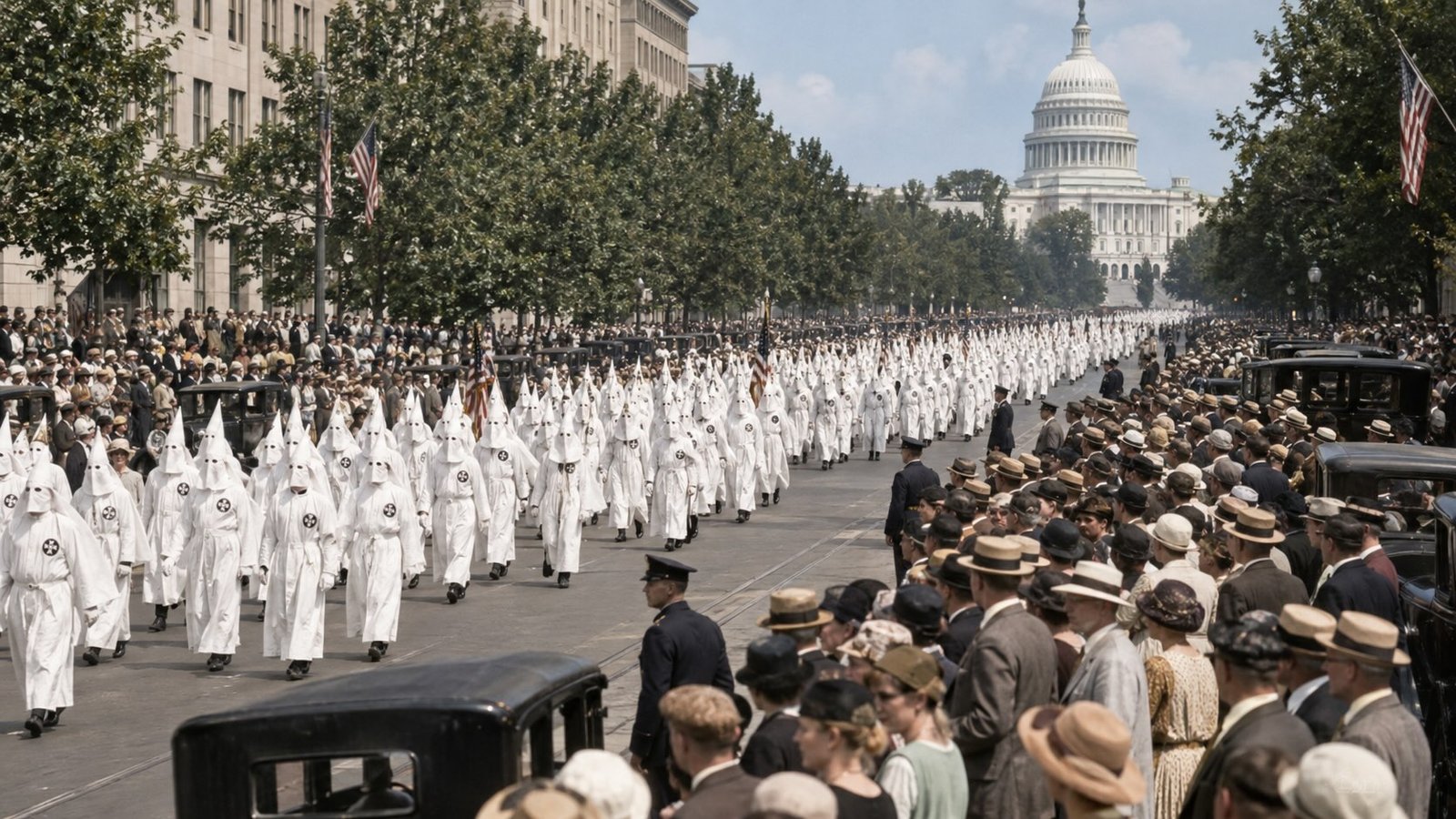
Mention the Ku Klux Klan and a familiar picture appears almost automatically: white robes, pointed hoods, burning crosses and shadowy gatherings somewhere in the American South. The image feels so established that the Klan can look like an ancient American institution. It was nothing of the sort. The organisation first appeared after the Civil War, repeatedly collapsed, reinvented itself and borrowed many of its supposedly timeless traditions surprisingly late.
The original Klan emerged in Pulaski, Tennessee, in late 1865 or early 1866. Six former Confederate officers reportedly started it as a secret social fraternity. Even its peculiar name contained an element of undergraduate-style playfulness, combining the Greek “kyklos”, meaning circle, with “clan”. What began with passwords, costumes and horseplay soon acquired a much more sinister purpose.
America had just abolished slavery, and Reconstruction promised citizenship and political rights to formerly enslaved people. Black men voted, held public office, served on juries and built political organisations. To many former Confederates, this represented an intolerable overturning of the racial order they had fought to preserve. The Klan supplied a brutally practical response: terrorism.
Members attacked Black voters, politicians, teachers and community leaders. They also targeted white Republicans who supported Reconstruction. Masks served less as theatrical decoration than as protection from identification, while night raids magnified fear. The objective was straightforward: political power could theoretically belong to Black citizens, but exercising it might bring armed men to your house after dark.
The federal government eventually reacted aggressively. Congress passed the Enforcement Acts of 1870 and 1871, allowing federal authorities to prosecute intimidation and protect voting rights. President Ulysses S. Grant gained powers to use federal force against organisations conspiring to deny constitutional rights. For a time, the campaign worked, and the first Klan largely disappeared as an organised movement.
Here comes the first great Klan myth: that the organisation simply continued underground until the twentieth century. It did not. There was no uninterrupted secret empire quietly waiting in forests for several decades. Instead, America created a second Klan, and one of the people indirectly responsible was a film director.
D. W. Griffith’s 1915 film The Birth of a Nation presented Reconstruction through an openly racist fantasy. Black Americans appeared as dangerous and incompetent, while Klansmen became heroic horsemen rescuing civilisation. The NAACP protested against the film, and some cities censored or banned parts of it, but enormous audiences still watched it. Hollywood had demonstrated that historical propaganda could sell extremely well when packaged as entertainment.
That same year, William Joseph Simmons founded a new Klan near Atlanta. This organisation borrowed the old name but transformed it into something closer to a mass-membership business. It offered rituals, uniforms, hierarchy, belonging and the delicious feeling that the member possessed secret knowledge unavailable to ordinary mortals. Modern marketing departments might recognise the formula.
Many supposedly ancient Klan traditions actually belong to this period. The spectacular burning cross, for example, became closely associated with the twentieth-century organisation rather than the original Reconstruction Klan. Elaborate titles such as Imperial Wizard, Grand Dragon and Exalted Cyclops added another layer of theatre. For an organisation obsessed with defending supposedly traditional American civilisation, it developed a leadership structure that sounded remarkably like rejected characters from a fantasy novel.
The second Klan also expanded its collection of enemies. Black Americans remained central targets, but the movement attacked Catholics, Jews, immigrants and anyone else who failed its definition of white Protestant America. Immigration, rapid urbanisation and social change gave the organisation an enormous pool of anxieties from which to recruit.
Another myth therefore collapses. The Klan was not simply a collection of poor Southern farmers. During the 1920s it became a national movement, particularly strong in states such as Indiana, Colorado and Oregon. Membership estimates vary, partly because the Klan loved exaggerating its own popularity, but historians generally accept that several million Americans joined at its peak.
That scale becomes easier to understand when looking at photographs from Washington in 1925. Thousands of Klansmen marched openly along Pennsylvania Avenue towards the Capitol. They were not skulking anonymously through woodland. The Library of Congress still holds photographs of the procession and even of the Klan’s Washington headquarters.
This may be the most uncomfortable part of Klan history. Extremism looks reassuringly simple when extremists stand outside normal society. During the 1920s, however, Klansmen included shopkeepers, businessmen, ministers, policemen and politicians. Joining could function almost like entering a particularly unpleasant civic association. People recruited friends and neighbours, paid membership fees, attended ceremonies and participated in local politics.
The second Klan eventually damaged itself magnificently. Corruption, factional fighting and scandals undermined its moral posturing. Most notoriously, Indiana Klan leader D. C. Stephenson was convicted in 1925 following the abduction, rape and death of Madge Oberholtzer. An organisation that marketed itself as the guardian of Protestant morality suddenly faced an awkward branding problem.
Membership collapsed during the later 1920s, while the Depression made membership dues and ceremonial costumes rather less compelling household expenses. The national Klan finally dissolved in 1944, partly under financial pressure. Once again, however, the name proved easier to kill than the ideology.
During the civil-rights era of the 1950s and 1960s, various independent Klan organisations appeared across the South. They fought desegregation and Black voting rights through intimidation and violence. Bombings, murders and attacks connected to Klan members helped make the white hood a global shorthand for racist terrorism.
Yet there has never again been one unified national Klan. Today’s movement consists of small competing organisations that inherit the name, symbols and prejudices while frequently quarrelling among themselves. In 2024, two larger factions, the Old Glory Knights and Loyal White Knights, either disappeared or lost relevance, while newer factions emerged. The Southern Poverty Law Center still listed multiple Klan groups, but the movement occupies a far smaller position inside contemporary American white supremacism than it once did.
That does not mean the mythology has vanished. Klan leaflets still occasionally appear, including racist propaganda distributed in Kentucky in 2025. However, even organisations monitoring extremism describe these factions as small and struggling. Newer extremist movements often prefer different branding, online communities and less historically toxic imagery. Apparently even white supremacy occasionally decides that its corporate identity needs refreshing.
The story of the Ku Klux Klan therefore offers something more interesting than a catalogue of villains in peculiar costumes. It shows how extremism changes shape when circumstances change. The first Klan used terrorism to destroy Reconstruction. The second transformed racial resentment into a national membership movement. Later Klans reacted violently against civil rights, while today’s fragments compete in an extremist ecosystem that has largely moved beyond them.
Perhaps the most disturbing photograph is not a burning cross at midnight. It is a sunny Washington street filled with thousands of ordinary-looking spectators watching Klansmen march past. Terror becomes frightening in one way when it hides behind a mask. It becomes frightening in quite another when it no longer feels any need to hide.
Post Comment
You must be logged in to post a comment.