Waterloo: Tragedy, or the Price Europe Paid for Peace?
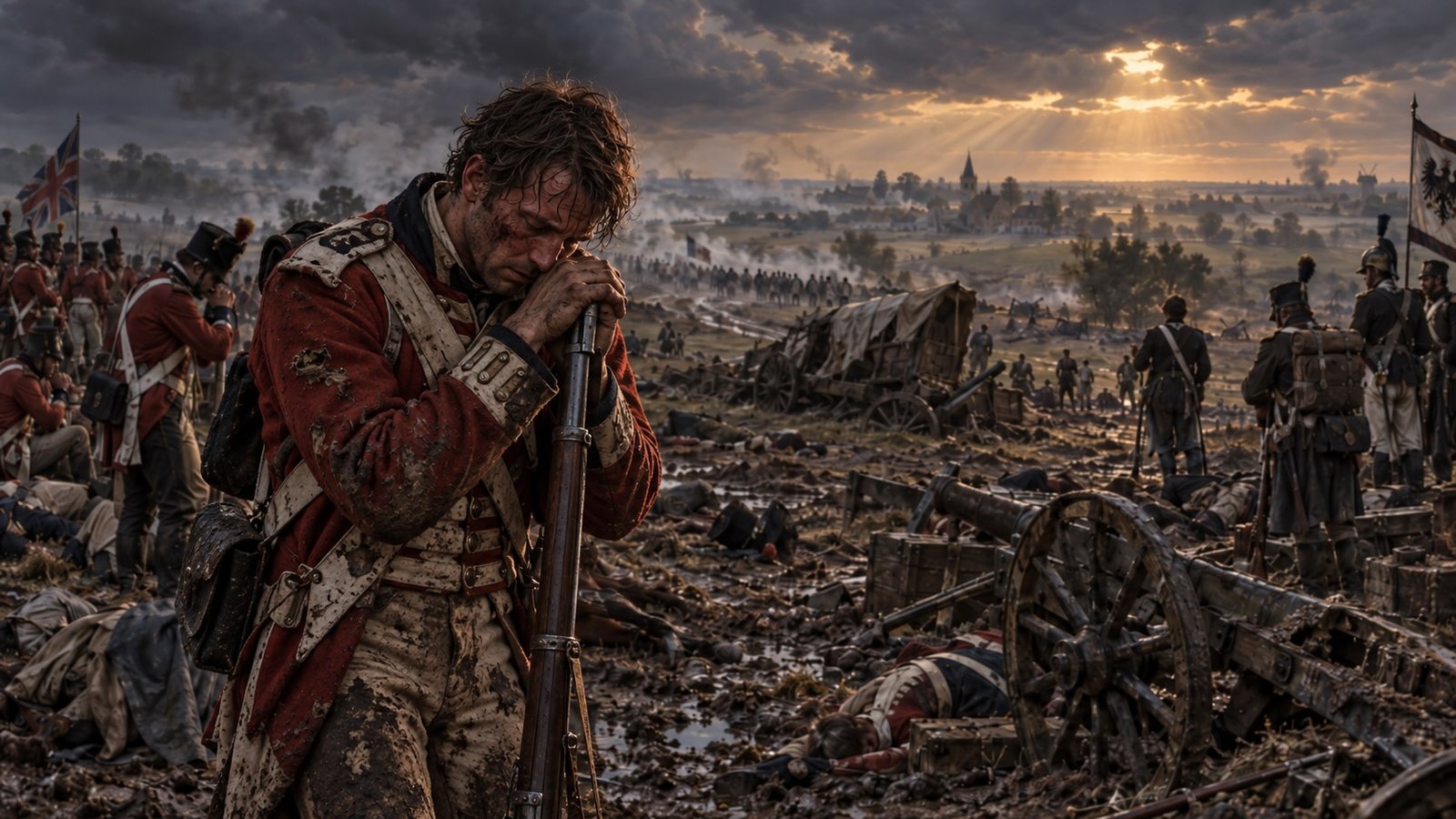
Waterloo has enjoyed more than two centuries of excellent marketing. For the British, it became a glorious victory. For the French, it became the ultimate national catastrophe. And for everyone else, it somehow ended up as the name of a railway station, a bridge, countless pubs and an ABBA song. Yet before all that branding began, Waterloo was simply a wet patch of Belgian countryside where tens of thousands of men spent 18 June 1815 attempting to kill one another.
Seen from ground level, there was very little glory about it. Cannonballs tore through formations, cavalry horses crashed into infantry squares, farm buildings burned and field hospitals filled with shattered bodies. Recent archaeology around Mont-Saint-Jean, Wellington’s principal field hospital, has uncovered amputated limbs, horses and the remains of a soldier buried after the battle. It is a useful corrective to all those splendid paintings of scarlet uniforms, raised swords and beautifully arranged smoke. So Waterloo was certainly a tragedy. The more interesting question is whether Napoleon’s defeat was one.
Three months earlier, Napoleon had achieved one of history’s most improbable political comebacks. Exiled to Elba after his first abdication, he escaped, landed in France with a small group of followers and began marching towards Paris. Troops sent to arrest him joined him instead. Louis XVIII left town, Napoleon returned to the Tuileries, and Europe collectively realised that the problem it thought it had solved had just walked back through the front door.
Britain, Prussia, Austria and Russia quickly made clear that they had no intention of accepting his return. Napoleon therefore faced an unpleasant piece of arithmetic. His enemies could ultimately field far more soldiers than France. His best chance was to move rapidly into what is now Belgium, separate Wellington’s Anglo-Allied army from Blücher’s Prussians and defeat them one at a time.
Initially, the plan worked rather well. On 16 June Napoleon defeated the Prussians at Ligny, although he failed to destroy them. On the same day Wellington held the crossroads at Quatre Bras. Had the Prussian army then retreated east towards its supply lines, Napoleon might have succeeded in keeping his enemies apart.
Instead, the Prussians moved northwards, remained connected with Wellington and performed one of the campaign’s most important feats: they reorganised after a major defeat and came back for another battle almost immediately. Blücher was seventy-two years old, had been trapped beneath his horse at Ligny and apparently regarded these details as administrative inconveniences.
The Waterloo of popular imagination tends to feature Napoleon on one side and Wellington on the other, almost like a heavyweight boxing match with 150,000 supporting actors. Reality was considerably more international. Wellington’s army contained British, Dutch, Belgian, Hanoverian, Brunswick and Nassau troops. The Prussians later became crucial to the result. Waterloo was not simply Britain defeating France. It was coalition warfare working better than Napoleon’s attempt to prevent coalition warfare from working at all.
Rain fell heavily before the battle and turned the fields into mud. Napoleon delayed his main attack while the ground dried, partly because soggy soil reduced the effectiveness of artillery. The weather later became one of several convenient explanations for his defeat. Marshal Ney was blamed. Marshal Grouchy was blamed. Bad communications were blamed. Mud was blamed. Napoleon’s post-Waterloo reputation acquired an interesting rule: victories demonstrated genius, while defeats required a committee investigation.
The battle itself unfolded through several savage struggles. French troops repeatedly attacked Hougoumont on Wellington’s right. Another fortified position, La Haye Sainte, sat dangerously close to the Allied centre. French cavalry launched enormous charges against infantry squares but failed to break them. Wellington’s basic strategy was hardly glamorous. He needed his army to remain standing until the Prussians arrived. They did…
By late afternoon, Napoleon faced the nightmare he had spent the entire campaign trying to avoid. Wellington remained in front of him while Blücher’s forces appeared on his right. French troops now had to fight in two directions. The Prussians attacked around Plancenoit, forcing Napoleon to divert men away from the main battle.
Meanwhile, the French finally captured La Haye Sainte, and for a brief period Wellington’s centre looked dangerously vulnerable. Perhaps this was the moment Napoleon could still have won. Instead, the pressure of the arriving Prussians consumed reserves and attention. As evening approached, Napoleon played his last card. The Imperial Guard advanced.
These were not ordinary soldiers. Their reputation carried enormous psychological weight across Europe, and French troops believed they represented the hardest core of Napoleon’s army. Yet Wellington had kept experienced infantry concealed behind the ridge. Heavy musket fire struck the Guard at close range. Their advance stalled, then broke.
For an army accustomed to believing that the Guard did not retreat, the sight was devastating. Panic spread through the French ranks. Wellington ordered a general advance, while the Prussians pursued the retreating army into the night. Napoleon’s final gamble had ended.
We naturally describe this as the end of an era, although even that requires qualification. The Congress of Vienna had already spent months constructing the post-Napoleonic European order. Waterloo did not invent that settlement. What it did was remove the man most capable of overturning it.
Three days later Napoleon abdicated again. This time nobody offered him a picturesque Mediterranean island close to France. The British eventually sent him to St Helena in the South Atlantic, where geography provided a rather more dependable security system.
For the ordinary people involved, none of this makes Waterloo less tragic. Tens of thousands were killed, wounded or captured. Families across Europe lost sons, husbands and fathers. Belgium inherited fields full of bodies. Soldiers who survived often carried wounds and memories for the rest of their lives. Calling such suffering the “price of peace” can sound suspiciously comfortable when spoken two centuries later from an armchair.
Yet something important did change after 1815. Europe did not become peaceful, democratic or particularly cuddly. Revolutions were suppressed, empires expanded and wars continued. Nevertheless, the great powers increasingly tried to preserve a balance rather than allow one state to dominate the continent. The resulting Concert of Europe created habits of diplomacy, consultation and collective management that helped prevent another continent-wide war on the Napoleonic scale for decades. That complicates the familiar question of who really “won” Waterloo.
Britain gained prestige. Wellington became a national hero. Prussia demonstrated its growing military importance. The Bourbon monarchy returned to France. European monarchs could finally stop wondering whether Napoleon might suddenly reappear with another army before breakfast.
France, however, did not disappear or get permanently crushed. The victors eventually recognised something that politicians occasionally rediscover after expensive wars: humiliating a major power can create another problem rather than solve the original one. France returned to the European diplomatic system and within a generation was again participating as one of its major powers.
Waterloo therefore sits in an awkward moral space. Napoleon was hardly a simple villain. His rule spread legal and administrative reforms, challenged old aristocratic structures and carried some principles of the French Revolution across Europe. Yet he also crowned himself emperor, censored opponents, pursued dynastic ambitions and fought wars that consumed enormous numbers of lives.
His enemies were hardly uncomplicated heroes either. Many fought Napoleon in defence of monarchies that had little interest in democracy or national self-determination. Waterloo was not liberty defeating tyranny. Nor was it reaction crushing progress. History, rather inconsiderately, refuses to arrange itself that neatly. Perhaps we should see Waterloo as two different events occupying the same field.
For the men who fought there, it was a human catastrophe. For Napoleon, it was the end of an extraordinary political experiment built around one individual’s ambition and talent. But for Europe, it closed a quarter-century in which revolutionary and Napoleonic wars had repeatedly redrawn borders and mobilised millions.
Was Waterloo a tragedy? Of course. Was Napoleon’s defeat a tragedy? That is much harder to argue. Perhaps Waterloo’s real irony is that one of the nineteenth century’s most brutal afternoons helped begin one of its more stable political periods. There are certainly better ways to create international order. Europe simply had not found one in time for 18 June 1815.
Post Comment
You must be logged in to post a comment.