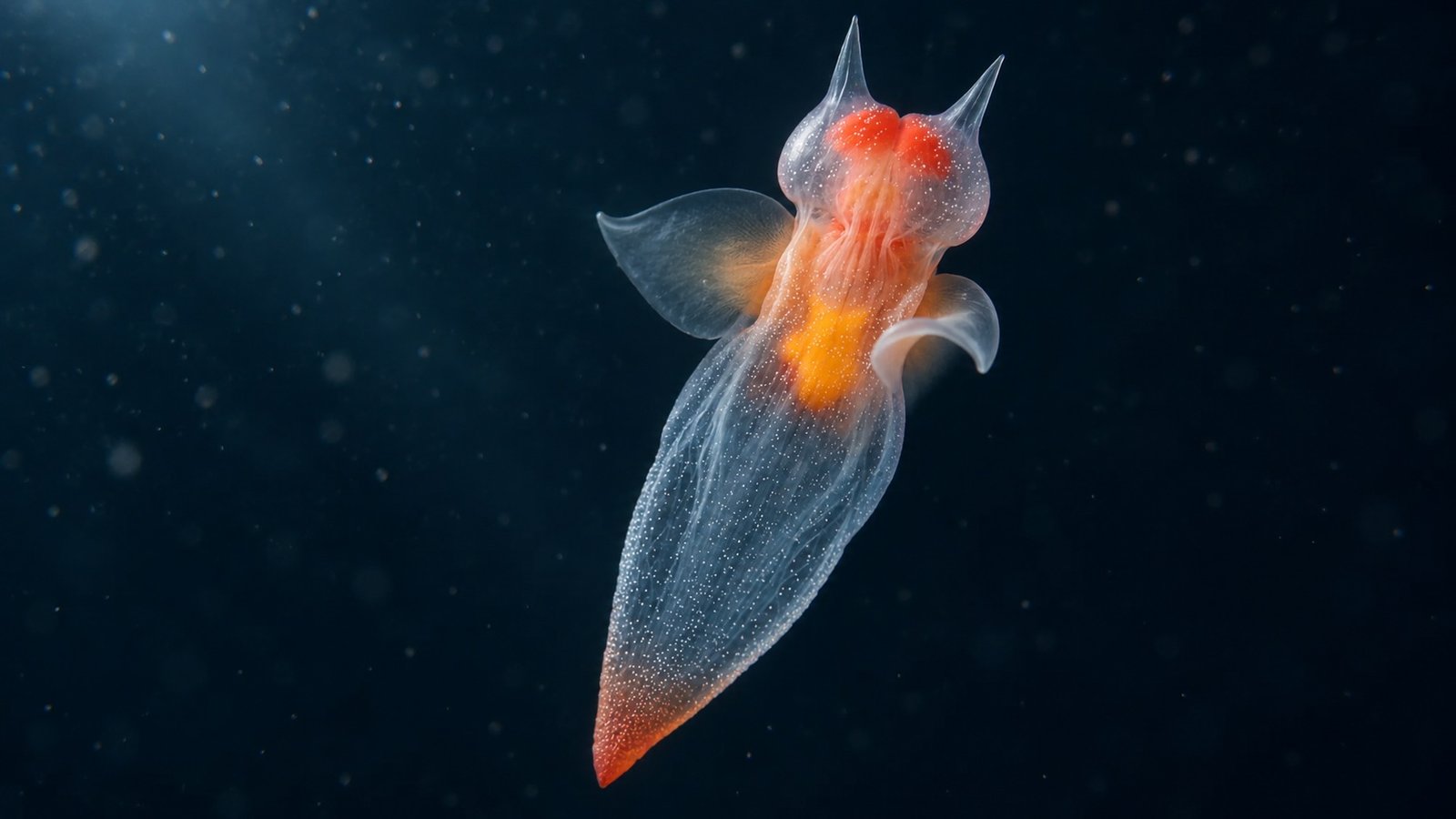
The sea angel has two almost invisible wings, both made from a snail’s foot. It hangs upright in open water, its body so clear that a warm fleck of colour shows through from inside. The wings open, fold and open again. For all that fluttering, the snail can seem to be going nowhere. Watch what happens when it stops. It sinks.
On a wet evening, a garden snail crossing a paving stone offers a view of what a snail’s foot usually does. The broad strip of muscle beneath its body sends waves of contraction from one end to the other, moving it over a film of mucus. The snail can pause with half its body in the flower bed and half on the path. The paving stone will wait.
The sea angel’s foot extends outwards into a pair of broad, flexible lobes. They sweep through water that offers nothing solid to push against. Imagine the sole of a shoe opening out into two oars. Then picture the oars bending with every stroke.
A northern sea angel, Clione limacina, is slightly denser than the water around it. Its usual stroke is just enough to hold it at roughly the same depth or carry it slowly upwards. Seen close up, the wingbeats seem almost leisurely. Pull back far enough to see how little distance the animal covers, and the scene looks different. The snail is doing the work of swimming to achieve the appearance of standing still.
Then there is the other stroke. In 2011, biologists Brett Szymik and Richard Satterlie used high-speed video to see what happened when a sea angel shifted from slow swimming to the faster pace it uses to hunt or get away. At ordinary speed, the change can look like a sudden flurry. Frame by frame, the wings tell a more interesting story. They beat faster, meet the water at a steeper angle and bend further. It is closer to breaking into a run than walking as fast as you can.
There is a change inside the wings, too. The fibres that keep them moving through long stretches of slow swimming are good at working without tiring. When the snail accelerates, it brings in a second set that can contract faster but tires sooner. The animal can spend much of its time fluttering in place and still have a burst of speed to spare. That comes in handy when dinner has wings of its own.
One of the northern sea angel’s prey is the sea butterfly, another swimming snail. Its coiled shell is easy to pick out beside the angel’s transparent body, but for a moment the family resemblance is there in the way the two move. Each has a pair of wings formed from the foot. The resemblance lasts right up to the point where the angel catches the butterfly and uses soft structures around its mouth to pull the snail from its shell. Whoever named them seems to have stopped watching just in time.
The sea butterfly has a trick of its own. In another experiment, researchers followed the motion of the water around its wings. Near the end of a stroke, the wings came together. As they peeled apart, they set the water moving in a way that helped lift the animal, much as some tiny insects use their wings to lift themselves in air. Seen with the naked eye, it is a flicker. Slowed down, it looks as though the snail is opening a very small book.
The sea angel’s wings are harder to sum up in one image. They can push against the water like oars, but they also flex and turn as they go. Calling them wings captures what the eye sees. Calling them parts of a foot tells us where they came from. Neither name quite prepares you for how soft they look, or how much work they can do before the snail seems to move at all.
Look down at the garden path the morning after rain and there may still be a silver line showing where a snail crossed. In open water, the sea angel’s passage is visible only for a moment. A little water curls away from each wingtip and the curl fades. The wings open again.