Pliny the Elder had already ordered a boat when the message from Rectina reached him. From Misenum, on the western side of the Bay of Naples, he had seen a cloud rise in a column and spread at the top like the crown of a pine tree. Its shape puzzled him, and he wanted a closer look. Rectina had a different reason for getting a boat into the bay. Her villa lay below the mountain, and the sea offered her only way out. Pliny had been about to set off in a light vessel. He now ordered larger warships launched and boarded one himself. There were other people along that stretch of coast who might need taking off.
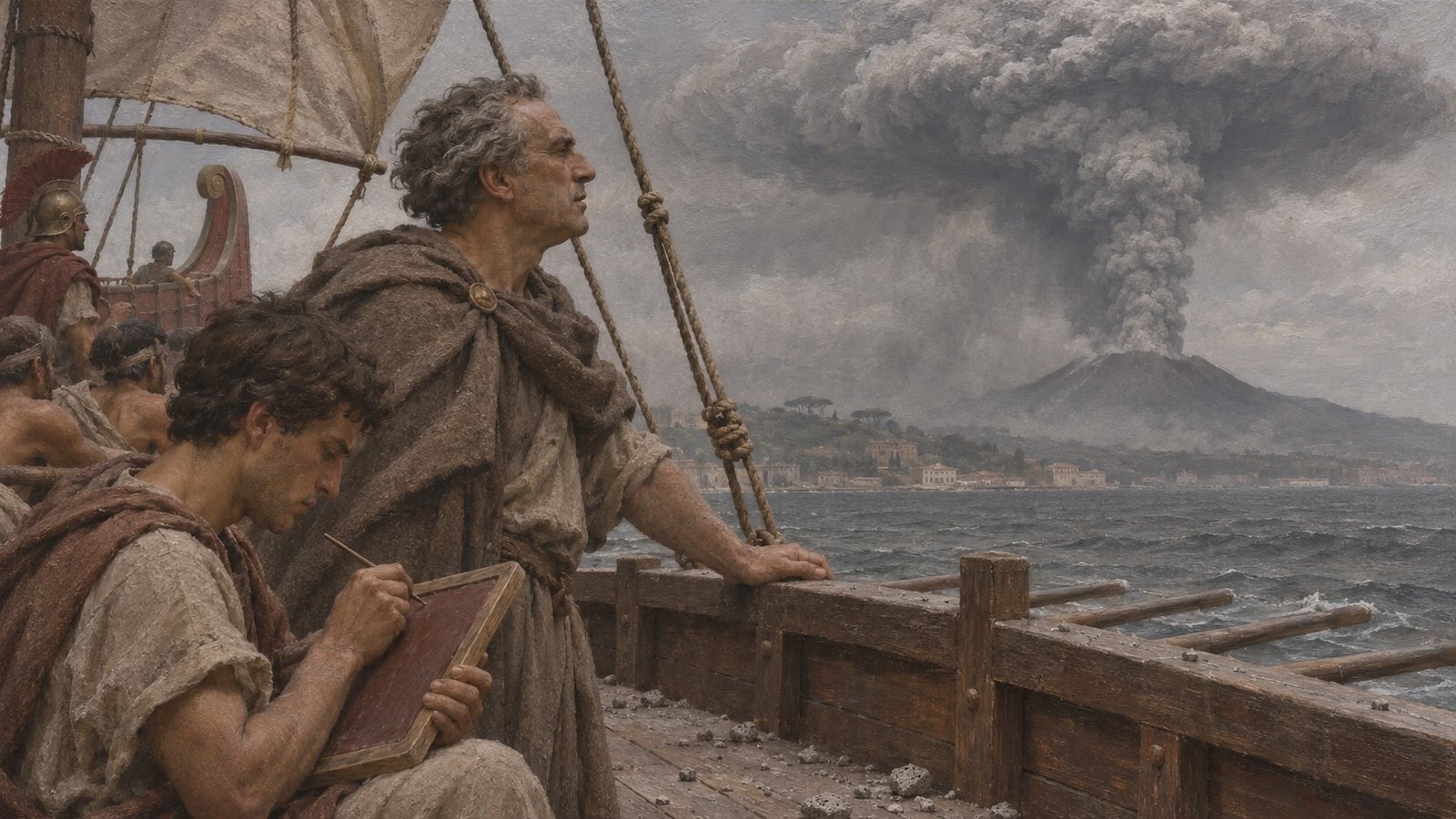
That change of plan comes from Pliny’s nephew, who was with him at Misenum that day in AD 79. The younger man had seen his mother draw his uncle’s attention to the cloud. He had also turned down an invitation to go along, saying he would prefer to study. His uncle had given him something to write, which makes the decision sound less like a young man’s instinct for self-preservation and more like an ordinary afternoon in the Pliny household. From across the bay, they could see the cloud clearly enough to compare it to a tree. They could not yet tell which mountain it came from.
Gaius Plinius Secundus was in his mid-fifties by then. Born at Comum, now Como, he had served in the Roman army in Germania and held financial posts under the emperor Vespasian, including one in Spain. At Misenum he commanded the Roman fleet. The same career that had taken him across the empire and given him material for his books now gave him the means to act on Rectina’s message. Plenty of people around the bay could see the cloud. Pliny could put ships and crews to sea.
His curiosity was a habit with practical arrangements of its own. On journeys a note-taker kept close by, wearing gloves in winter so that cold fingers would never hold up the work. In Rome, Pliny travelled in a litter because he could study while somebody else did the walking. At dinner, someone read aloud. Once, a guest asked the reader to repeat a passage he had mispronounced. Pliny established that the man had understood it perfectly well and reckoned the interruption had cost them upwards of ten lines. His nephew, who tells the story, seems to have admired him for this. The guest’s opinion has gone unrecorded.
The result of all that reading was the Natural History, the only one of Pliny’s works to survive. Its 37 books run from the heavens and the geography of the earth to medicines, painting and gemstones. In his preface to Titus, Pliny claimed to have gathered some 20,000 items from around 2,000 books, before adding material of his own. He supplied a guide to the contents and named his authorities so that readers could go straight to the bit they wanted. For a man who counted the cost of hearing the same passage twice, it was a considerate piece of design.
What caught his attention was often the moment when people tried to make nature do something for them. In his account of gold mining in Spain, he describes men cutting galleries into a mountain and bringing part of it down. They then used water carried along channels to wash the debris. Pliny invites us to picture the miners looking over the wreckage like conquerors. He follows that image with a dry observation. They still had no gold, and when they began digging they had no certainty it was there. He gives the engineering its due and leaves the reader to consider the judgement behind it.
On the bay, he seems to have carried on taking notes even after the purpose of the voyage changed. His nephew says that Pliny dictated what he saw as ash grew thicker and hotter and pumice fell around the ships. When the approach became difficult, the helmsman advised turning back. Pliny told him to make for his friend Pomponianus at Stabiae. The wind helped them reach it, but that same wind kept Pomponianus from putting to sea. He already had his luggage aboard. He was waiting for the weather to change.
At Stabiae, Pliny took a bath and ate dinner. His nephew says he seemed cheerful and allows for the possibility that he was putting it on to steady his friend. Later, the people in the house went outside with pillows tied over their heads to protect themselves from falling debris. Near the shore, Pliny needed help getting to his feet and collapsed. His nephew thought the fumes had impeded his breathing. He had stayed at Misenum, though, and what happened at Stabiae reached him through others. The precise cause of his uncle’s death remains uncertain.
Years later, the historian Tacitus asked the younger Pliny for an account. By then the nephew had every reason to give his uncle a fine last scene, and his letter has helped fix the image of a Roman commander sailing towards danger while others tried to get away. Yet the small interruption that set the course of the story is still there. The man who once begrudged a dinner guest ten lines put aside his plan for a closer look when a woman asked him for a boat. His observations from the crossing have vanished. We still know Rectina’s name. His nephew never tells us whether she got away.