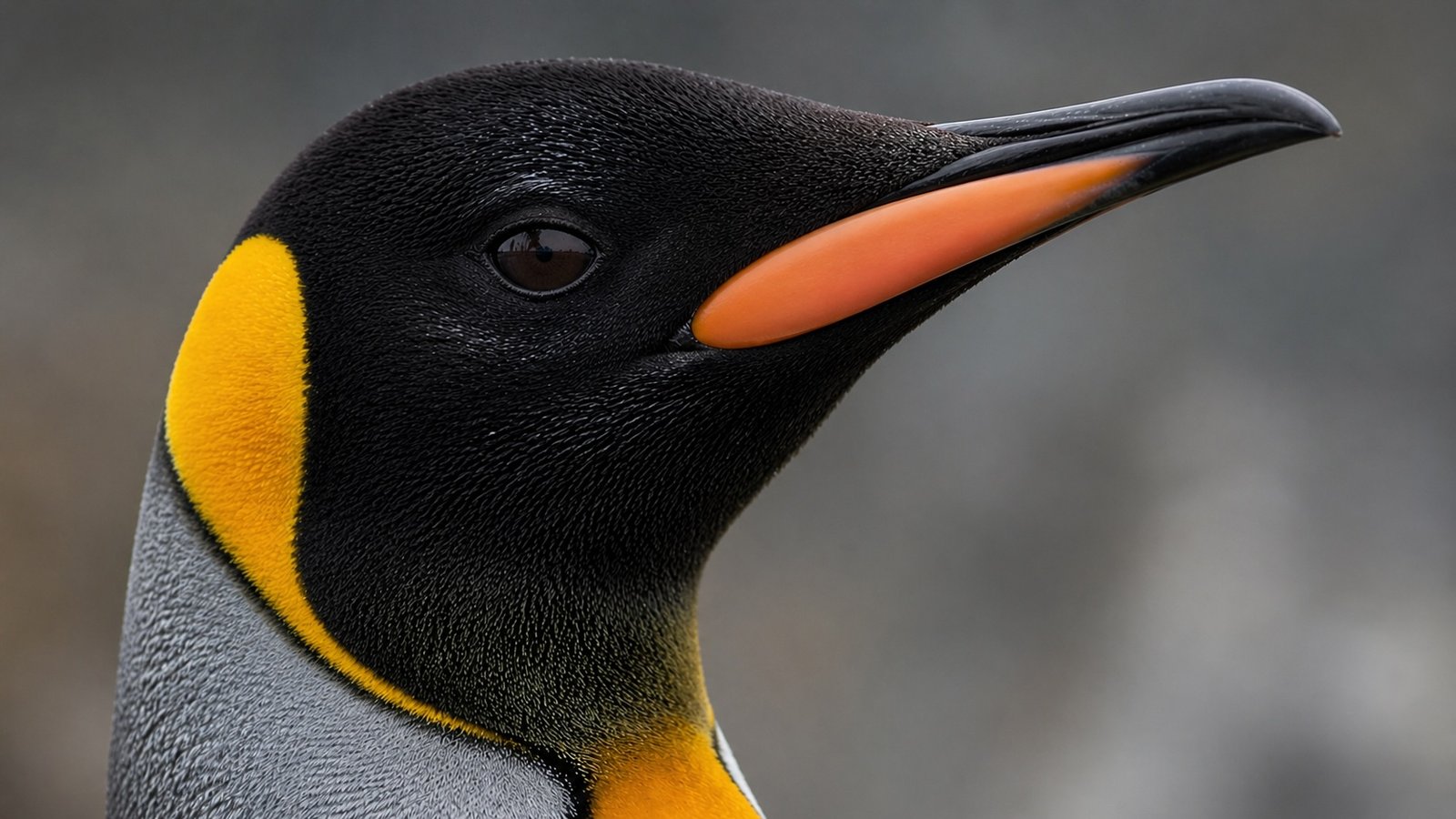
There is something faintly absurd about a bird that cannot fly yet carries itself like it owns the horizon. Slightly smaller and less extreme than its Antarctic cousin, the Emperor penguin, the king penguin occupies a kind of middle ground—less brutal, perhaps, but no less impressive. King penguins manage that contradiction with ease. They stand upright, impeccably dressed in black, white, and a precise flash of orange, as if they’ve just stepped out of a formal event no one told the rest of the animal kingdom about. Then they waddle, slightly awkwardly, across beaches that look as though they belong on another planet.
They live on subantarctic islands—South Georgia, the Falklands, Crozet—places defined by wind, cold light, and distance from everything else. These are not gentle environments, but they are not quite Antarctica either. That in-between turns out to be the whole point. Cold, nutrient-rich waters sit just offshore, packed with lanternfish and squid, while the land remains just mild enough to host enormous breeding colonies. Not dozens or hundreds, but tens and sometimes hundreds of thousands, gathered so densely that the shoreline seems to move.
At first glance, a colony feels chaotic. Birds call constantly, turning, bowing, edging past one another with small, deliberate steps. Yet the noise hides a system that works with surprising precision. Each adult carries a unique vocal signature. A returning parent can pick out its partner or chick purely by sound, even when surrounded by thousands of near-identical birds. What looks like confusion is closer to a crowded city running on audio recognition rather than sight.
The real transformation happens at sea. On land, king penguins look composed but slightly constrained. In water, they become efficient, streamlined machines. They dive routinely to depths approaching 300 metres, staying submerged for several minutes at a time, moving at speeds that can reach around 10 kilometres per hour. Their bodies are built for it: dense bones reduce buoyancy, powerful flippers drive them forward like wings repurposed, and a thick layer of blubber insulates against water that hovers just above freezing.
Down there, light fades quickly. Vision matters more than colour or display. King penguins hunt in dim conditions, tracking schools of lanternfish that rise and fall through the water column. Precision replaces spectacle. Every dive is a calculated effort, and success depends on conditions that remain, for now, just stable enough.
That phrase—just stable enough—quietly shapes everything. Small changes in ocean temperature can shift where prey gathers. When fish move further from the breeding islands, the consequences ripple back to shore. A feeding trip that once took a few days stretches into a week or more. For a chick waiting on land, that delay is not a minor inconvenience. It can be the difference between being fed and not being fed at all.
Breeding does nothing to simplify matters. King penguins operate on a cycle that feels almost deliberately inconvenient: roughly fourteen to sixteen months from egg to independence. That timing means they cannot breed every year in the neat, predictable way many birds do. Miss a window, and the entire cycle slips.
There is only ever one egg. No nest, no carefully arranged materials. The egg rests on the parent’s feet, balanced and covered by a fold of skin known as a brood pouch. It is a precarious arrangement that relies entirely on stability and patience. Parents take turns incubating, sometimes fasting for weeks while standing almost motionless against wind and cold.
When the chick hatches, the contrast is immediate. Instead of the sleek adult form, it appears covered in thick brown down, round and slightly awkward, more like a walking bundle of fur than a future diver of the Southern Ocean. The elegance comes later.
Feeding is a relay. One parent remains while the other heads out to sea, sometimes travelling vast distances to find reliable food. When they return, they carry partially digested fish in their stomach, transferring it directly to the chick. It is efficient, if not particularly glamorous. Timing again becomes everything.
Winter sharpens the stakes. As conditions worsen, parents must spend longer at sea. Chicks gather into crèches—dense groups that conserve warmth and reduce individual exposure. The strategy works, but not perfectly. Some will not survive the waiting. The system is resilient, not gentle.
Even basic processes carry risk. Once a year, adults undergo a full moult, shedding and replacing all their feathers at once. During that period, they cannot enter the water to feed. They are effectively grounded, living off stored energy until the new plumage grows in. It is a temporary vulnerability built into an otherwise highly efficient design.
Appearance, meanwhile, continues to do its quiet work. The orange patches near their ears are not decorative accidents. They play a role in mate selection, adding a visual layer to the already complex system of vocal recognition and behavioural display. Courtship involves posture, timing, and small, deliberate movements that reinforce pair bonds within a noisy, crowded space.
Despite all this activity on land, most of a king penguin’s life unfolds at sea. The iconic images—endless rows of upright birds against dramatic landscapes—capture only a fraction of their existence. The rest happens far from view, in cold, open water where efficiency matters more than appearance.
Climate change rarely arrives here with drama. There are no sudden collapses that announce themselves in a single moment. Instead, there are shifts. Ocean fronts move. Currents behave slightly differently. Feeding grounds drift further from shore. Over time, those small adjustments accumulate into something harder to ignore. Some colonies have already declined where food has become less accessible, while others remain stable for now, balanced on conditions that may not hold.
What stands out is not just their resilience, but the narrow margin within which it operates. King penguins succeed because enough variables line up at the right time: food availability, breeding timing, parental coordination. When those align, the system works remarkably well. When they don’t, the consequences spread quickly through the colony.
Spend enough time watching them, even through a screen, and the initial impression of formality begins to shift. The upright stance stops looking ceremonial and starts to feel practical. The measured steps across uneven ground make sense. Even the slightly comic waddle becomes part of a broader system tuned to two very different environments.
They are not rare, not hidden, not especially dramatic in the way predators tend to be. Entire colonies stretch across beaches in numbers that feel almost excessive. And still, they are easy to underestimate.
They do not rely on force or speed in the obvious sense. They rely on balance. Not perfect balance, but enough to survive in a place that offers very little margin for error. Quietly, efficiently, and with a precision that only becomes visible when you look closely, king penguins keep the system going.