The Penguin Empire of the Falkland Islands
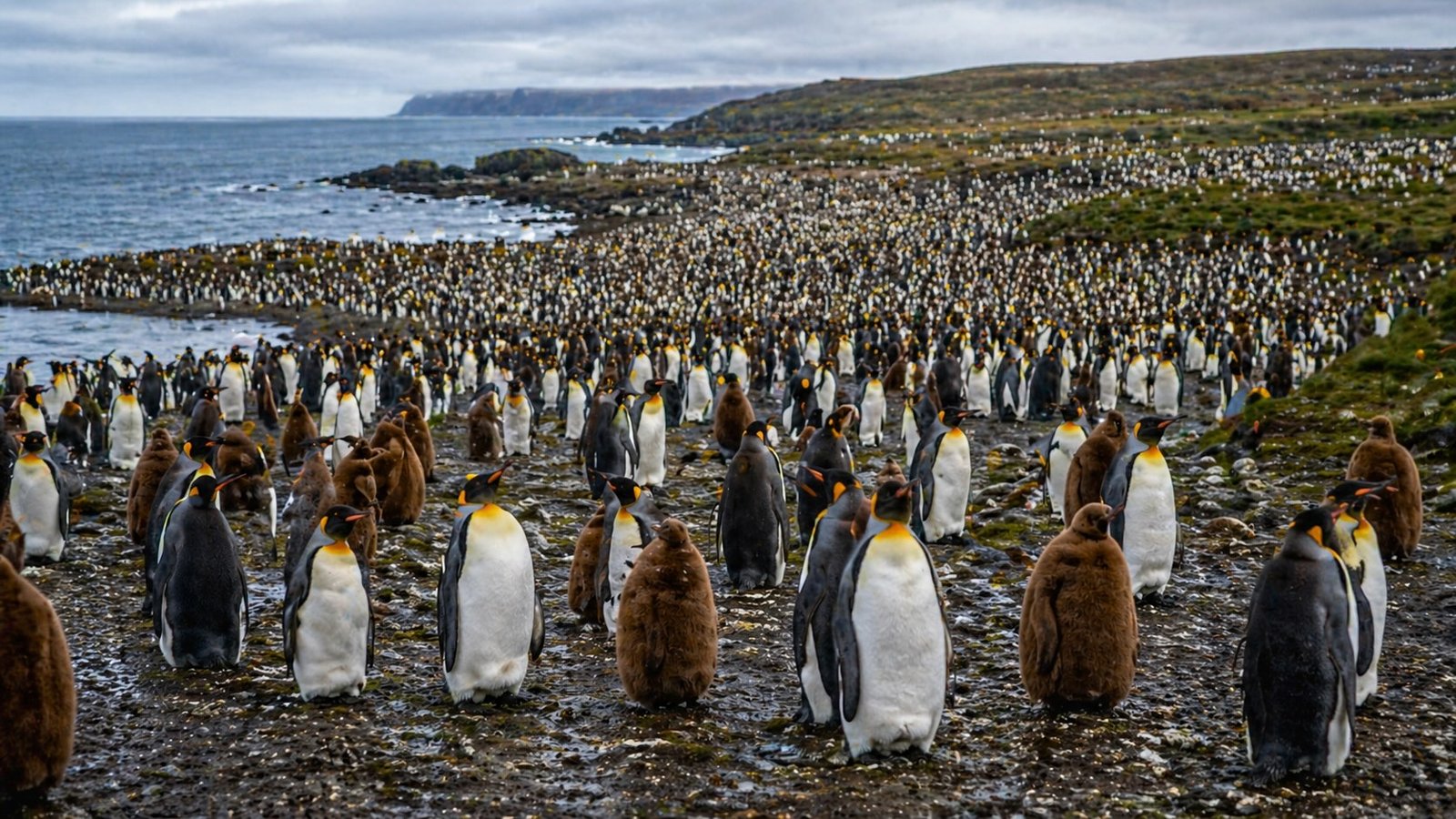
There is a moment, somewhere along the wind-cut edges of the Falkland Islands, when the landscape stops behaving like landscape. It starts moving. At first it looks like static—patches of black and white scattered across hills, beaches, and low cliffs. Then one shifts, then another, and suddenly the ground itself seems alive. Penguins, thousands of them, everywhere, as if someone quietly decided this remote corner of the South Atlantic should belong to them.
The obvious question follows almost immediately. Why here? Why not somewhere easier, warmer, more convenient? Penguins, after all, have never shown much interest in convenience.
The answer begins in the water rather than on land. The seas surrounding the Falklands are unusually rich, fed by cold currents pushing up from the Antarctic zone. These waters carry nutrients that fuel enormous populations of krill, squid, and small fish. For penguins, this is less a buffet and more a permanent, well-stocked pantry. They don’t need to travel absurd distances to feed, and that alone changes everything. Colonies can grow, stabilise, and, crucially, return year after year.
Then there is the absence of things. No native land predators stalking eggs or chicks. No foxes, no large mammals waiting patiently for an easy meal. It is a rare ecological loophole. Penguins can waddle, nest, argue loudly with neighbours, and generally behave without the constant tension that defines life elsewhere. Add to that a coastline that feels purpose-built for nesting—soft ground for burrowers, rocky ledges for climbers, open beaches for the more theatrical species—and the islands begin to look less like a random location and more like a carefully assembled habitat.
Five species call this place home, which sounds impressive until you actually see them together and realise just how different they are.
King penguins arrive first in most people’s imagination. Taller, cleaner, almost absurdly well put together, with those flashes of orange at the neck that look like someone added a design flourish at the last minute. At places like Volunteer Point, they gather in dense, orderly clusters that feel more like a formal gathering than a breeding colony. Yet their rhythm is anything but tidy. Their breeding cycle stretches beyond a year, meaning there are always chicks, always adults, always some stage of life unfolding at once. Nothing quite begins or ends; it just continues.
Gentoo penguins, by contrast, seem to have somewhere to be. They move with purpose, heads slightly forward, as if late for something important. They are the most numerous here, and perhaps the least dramatic at first glance, but spend a few minutes watching them and the impression shifts. They are efficient, quick, and unexpectedly fast in the water, turning from slightly awkward walkers into precise, controlled swimmers the moment they dive.
Rockhoppers refuse to follow any of these rules. They look like they’ve been designed by someone who got bored halfway through and decided to improvise. Yellow crests, red eyes, and a complete disregard for smooth movement. Where others walk, they jump. Where others choose easy terrain, they head straight for rocks and cliffs, bouncing their way upward with stubborn determination. Their numbers have declined in parts of the South Atlantic, which gives their presence here a slightly sharper edge. They are not just entertaining; they are, in a quiet way, vulnerable.
Magellanic penguins take a different approach altogether. They disappear. Or at least, it feels that way. One moment they are there, the next they slip into burrows dug into soft ground, leaving only the suggestion of movement behind. These penguins travel widely outside the breeding season, sometimes reaching as far as the coast of Brazil, then returning to the same patch of earth as if guided by memory alone. It gives the islands a sense of continuity, of cycles that extend far beyond what you can see at any given moment.
Even the occasional appearance of a macaroni penguin, rarer and slightly more flamboyant, adds to the sense that this place sits at a crossroads of sorts. Not quite Antarctic, not quite temperate, but something in between that suits a surprising range of species.
For all this abundance, the story is not one of untouched perfection. It is, instead, one of management, compromise, and occasional restraint. The Falkland Islands Government, alongside organisations like Falklands Conservation, has spent decades navigating a balance that many other regions never quite achieve.
Fishing, particularly for squid, sits at the centre of that balance. It is both an economic necessity and an ecological risk. Too much pressure on fish stocks, and penguins begin to struggle. Too little, and the local economy takes a hit. The solution has been regulation that feels almost cautious by modern standards. Quotas, monitoring, and an awareness—sometimes uneasy—that the line between success and damage is thinner than it looks.
Tourism follows a similar pattern. It exists, certainly, but it does not overwhelm. Visitors arrive in relatively small numbers, often guided, often reminded that they are guests in a system that does not need them. There are no sprawling resorts pressing up against colonies, no sense that wildlife has been rearranged for easier viewing. The experience remains slightly inconvenient, which is perhaps the point.
Still, challenges drift in from beyond the islands. Climate change does not respect isolation. Shifts in ocean temperature alter where fish gather, which in turn affects how far penguins must travel to feed. Small changes, at first. Then slightly larger ones. Over time, patterns begin to shift. Rockhopper populations have already shown how quickly numbers can fall when conditions tilt in the wrong direction.
There are also the recurring debates that surface every few years, particularly around oil exploration. The idea of extracting resources from beneath these waters carries an obvious economic appeal, but also an equally obvious ecological risk. It is the kind of conversation that never quite settles, hovering in the background like an unresolved question.
It would be easy to frame the Falklands as a rare conservation success story and leave it there. In many ways, that would even be accurate. Penguin populations here remain strong compared to other parts of the world. Habitats, once affected by overgrazing from earlier farming practices, are gradually recovering. The system, broadly speaking, works.
Yet there is something more interesting in the tension. This is not a frozen paradise or a carefully curated reserve. It is a working landscape where decisions carry visible consequences, where wildlife still dominates but does not exist in isolation from human choices.
Perhaps that is what makes the penguins feel so defining. They are not just numerous or photogenic. They are constant. They return, they breed, they argue, they raise chicks, and they leave again, all against a backdrop that is quietly shifting. Watch them long enough and they begin to feel less like individual animals and more like indicators, subtle signals of how the system is holding up.
On some days, everything looks stable. Colonies stretch across the shore, the water remains rich, and the rhythm continues without interruption. On others, the changes are harder to see but no less present, hidden in feeding patterns, in the distance travelled, in numbers that fluctuate just enough to suggest something beneath the surface has shifted.
That tension gives the Falklands their particular character. Not untouched, not overwhelmed, but balanced in a way that feels both deliberate and slightly fragile. Penguins everywhere, yes, but not by accident.