The Surprising Origins of Przewalski’s Horse
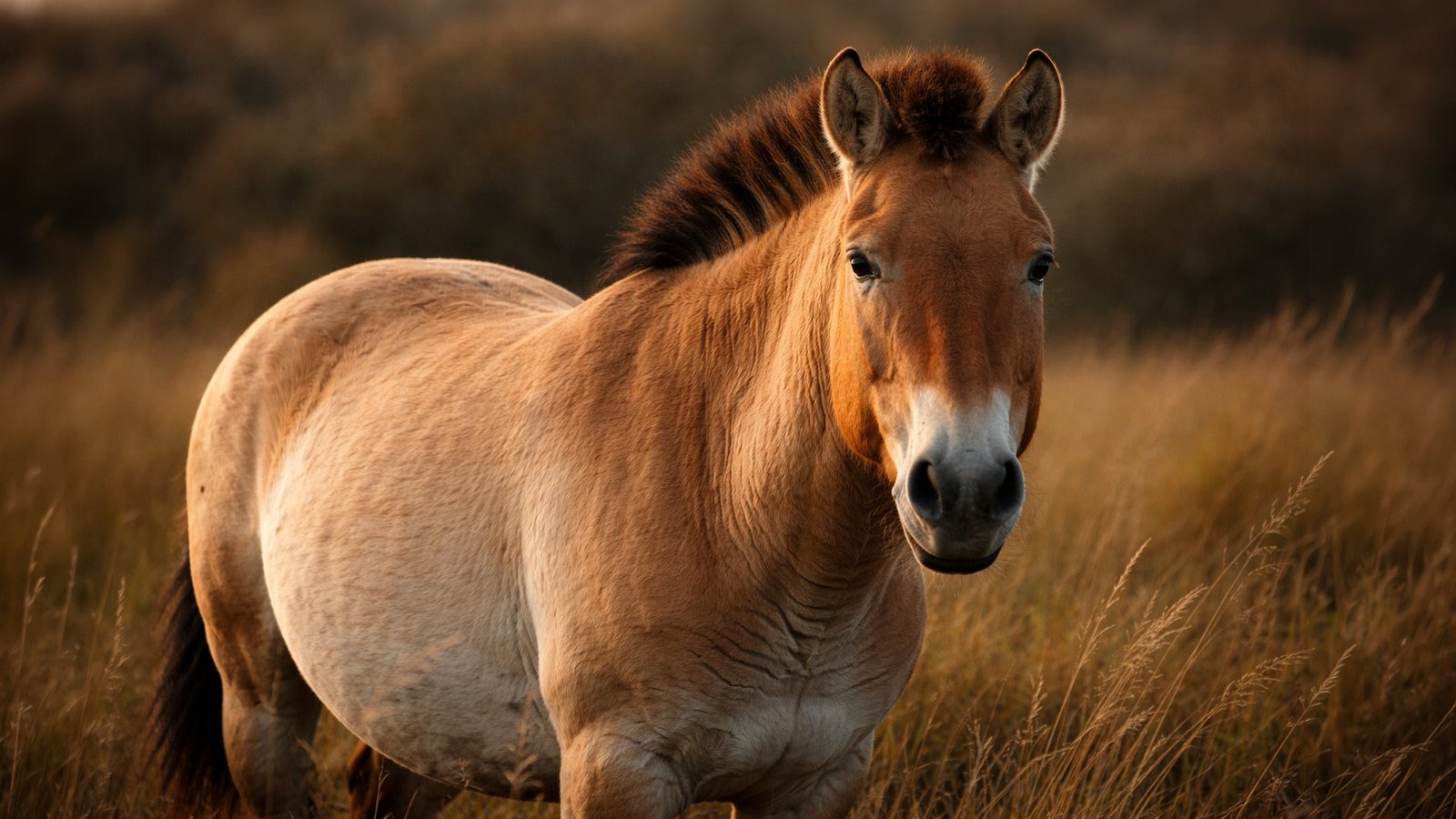
There is something irresistibly tidy about the idea of the last wild horse. One species that somehow slipped through the tightening grip of human control while every other horse on Earth ended up harnessed, bred, traded, and turned into infrastructure. For more than a century, that role belonged to the Przewalski’s horse, named after the Russian explorer Nikolai Przhevalsky, who encountered it in the 1870s during expeditions across Central Asia.
It looked the part from the very beginning, which made the story easier to believe. Short and muscular, with a dun coat and a dark dorsal stripe running down its back, it carries an upright mane that refuses to fall and lacks the soft forelock that gives many domestic horses a more polished appearance. Early European accounts described it as stubborn, untameable, and faintly primitive, reinforcing the idea that this was what horses looked like before humans began shaping them to their needs.
The story settled quickly into scientific consensus. By the early twentieth century, zoologists had classified it as the last truly wild horse, distinct from domesticated breeds and untouched by selective breeding. Museums displayed it as a living relic, and textbooks repeated the claim with quiet confidence, as though the category itself were beyond dispute.
Yet the deeper researchers looked, the less stable that certainty became. The first complication emerged not from genetics but from archaeology, particularly in northern Kazakhstan, where sites associated with the Botai culture began to reshape the narrative. Dated to roughly 3500–3000 BCE, these settlements revealed an overwhelming presence of horses, with excavations led by archaeologist Victor Zaibert uncovering tens of thousands of horse bones. This was not opportunistic hunting but something far closer to dependence.
Further analysis added detail to that picture. Residue studies conducted in the early 2000s identified traces of mare’s milk in pottery, suggesting that Botai communities were milking horses as part of their daily subsistence. At the same time, dental examinations revealed wear patterns consistent with the use of primitive bits, indicating that these animals were likely being controlled and possibly ridden. Taken together, the evidence pointed strongly towards early domestication, and for a time, the Botai sites were widely accepted as the birthplace of domestic horses.
Then genetics complicated everything in a way few expected. In 2018, a landmark study published in Science, led by Ludovic Orlando and an international team, sequenced ancient horse genomes from Botai remains and compared them with modern populations. The expectation was straightforward, with most assuming that Botai horses would sit at the base of the lineage that produced today’s domestic breeds. Instead, the data told a very different story.
Modern domestic horses traced back to another population that spread across Eurasia around 2000 BCE, likely originating from the western steppe regions. The Botai horses, rather than being direct ancestors, followed a separate evolutionary path, and their closest living relatives turned out to be the Przewalski’s horse. This finding shifted the narrative almost overnight, turning a neat origin story into something far more ambiguous.
The implication was both awkward and fascinating. The animal long celebrated as the last untouched wild horse appeared to descend from one of the earliest domesticated horse populations. Rather than representing a pristine past, it seemed to embody a return, a lineage that had once been shaped by humans and then moved away from that relationship over thousands of years.
At this point, the word “feral” entered the discussion, although it struggles to capture the scale involved. These were not animals that escaped human control in recent centuries but ones whose ancestors may have lived under human management more than five millennia ago. Over time, they adapted, survived, and re-established themselves without human intervention, eventually behaving in ways indistinguishable from what we would casually describe as wild.
The twentieth century adds yet another layer to the story, and not a particularly reassuring one. By the 1940s, Przewalski’s horses had effectively disappeared from the wild, with the last confirmed sighting in Mongolia often dated to 1969. Hunting pressure, habitat encroachment, and competition with livestock gradually pushed them out of their natural environment, leaving only a scattered captive population behind.
That remaining population was alarmingly small and genetically fragile. Records suggest that all living Przewalski’s horses descend from roughly twelve wild-caught individuals, with names such as Vaska and Orlitza appearing in early breeding documentation. At various points, domestic horses were introduced into the breeding pool to prevent collapse, further complicating the idea of a pure, untouched lineage.
Despite those limitations, conservation efforts achieved something remarkable. In 1959, the Prague Zoo established an international studbook to coordinate breeding programmes across institutions, carefully tracking lineages and managing pairings to preserve as much genetic diversity as possible. Over the following decades, cooperation between zoos and conservation bodies allowed the population to stabilise and gradually expand, avoiding what had once seemed like an inevitable extinction.
Reintroduction efforts began in the 1990s, marking a new phase in the story. Horses were released into protected areas in Mongolia, including Hustai National Park and the Takhin Tal region, where they had to relearn how to survive without human support. Some struggled in the early stages, while others adapted more successfully, forming social groups, establishing territories, and enduring winters that regularly drop below minus thirty degrees Celsius.
Today, several hundred Przewalski’s horses live in the wild again, with additional populations maintained in reserves across China and even within the Chernobyl Exclusion Zone. That last location adds a peculiar twist, as the animals roam through landscapes shaped by nuclear disaster, illustrating how human absence can sometimes create unexpected refuges for wildlife.
Behaviourally, they remain distinct from domestic horses in ways that are difficult to ignore. Attempts to tame or ride them have largely failed, with observers noting their heightened reactivity and strong social cohesion. Herds are typically led by dominant stallions, and individuals display a level of alertness and unpredictability that feels fundamentally different from the temperament seen in most domestic breeds.
All of this makes the original label of “last wild horse” increasingly difficult to sustain without qualification. In ecological and behavioural terms, they are undeniably wild, surviving independently and responding to their environment without human support. At the same time, their genetic history suggests a connection to early domestication, placing them somewhere outside the clean categories we tend to prefer.
The deeper question, then, is whether wildness should be defined by origin or by present reality. If an animal has lived independently for thousands of years, adapting and functioning within its ecosystem, does a distant period of domestication still define it in any meaningful way? Or does wildness reassert itself over time, rendering the original distinction largely irrelevant?
The Przewalski’s horse does not offer a neat answer, but it does expose how fragile those categories can be. It sits in the uncomfortable space between definitions, forcing a reconsideration of what we mean when we talk about wild and domestic. Rather than a binary, the boundary begins to look more like a continuum shaped by time, environment, and human influence.
There is also a quiet irony in how much effort is now required to preserve this form of wildness. Conservation programmes continue to monitor genetics, manage habitats, and occasionally intervene to maintain population health. The horses live freely, but their survival depends on a framework that ensures they do not disappear again.
Despite all this complexity, the experience of seeing one in its environment remains disarmingly straightforward. A compact, muscular animal stands against an open horizon, its upright mane catching the wind as it watches its surroundings. It moves with its herd, grazes, survives, and continues a lineage that has crossed in and out of human influence more than once.
The tidy story no longer holds, but what replaces it is far more compelling. Rather than a symbol of untouched wilderness, the Przewalski’s horse becomes a reminder of how entangled human and animal histories really are. It represents a lineage that entered domestication, moved away from it, and now exists in a state that challenges the categories we rely on.
Wild, feral, or something in between stops being the most interesting question. The more revealing one is how often we impose clean narratives on messy realities, only to revise them when new evidence emerges. In that sense, the Przewalski’s horse is less an exception and more a case study in how nature resists simplification.
Out on the steppe, the horse itself remains indifferent to all of this. It grazes, moves, and endures, shaped by its environment rather than by the labels assigned to it. That quiet independence, sustained across centuries of change, may be the closest thing to wildness we can realistically define.