The Botai Culture Mystery
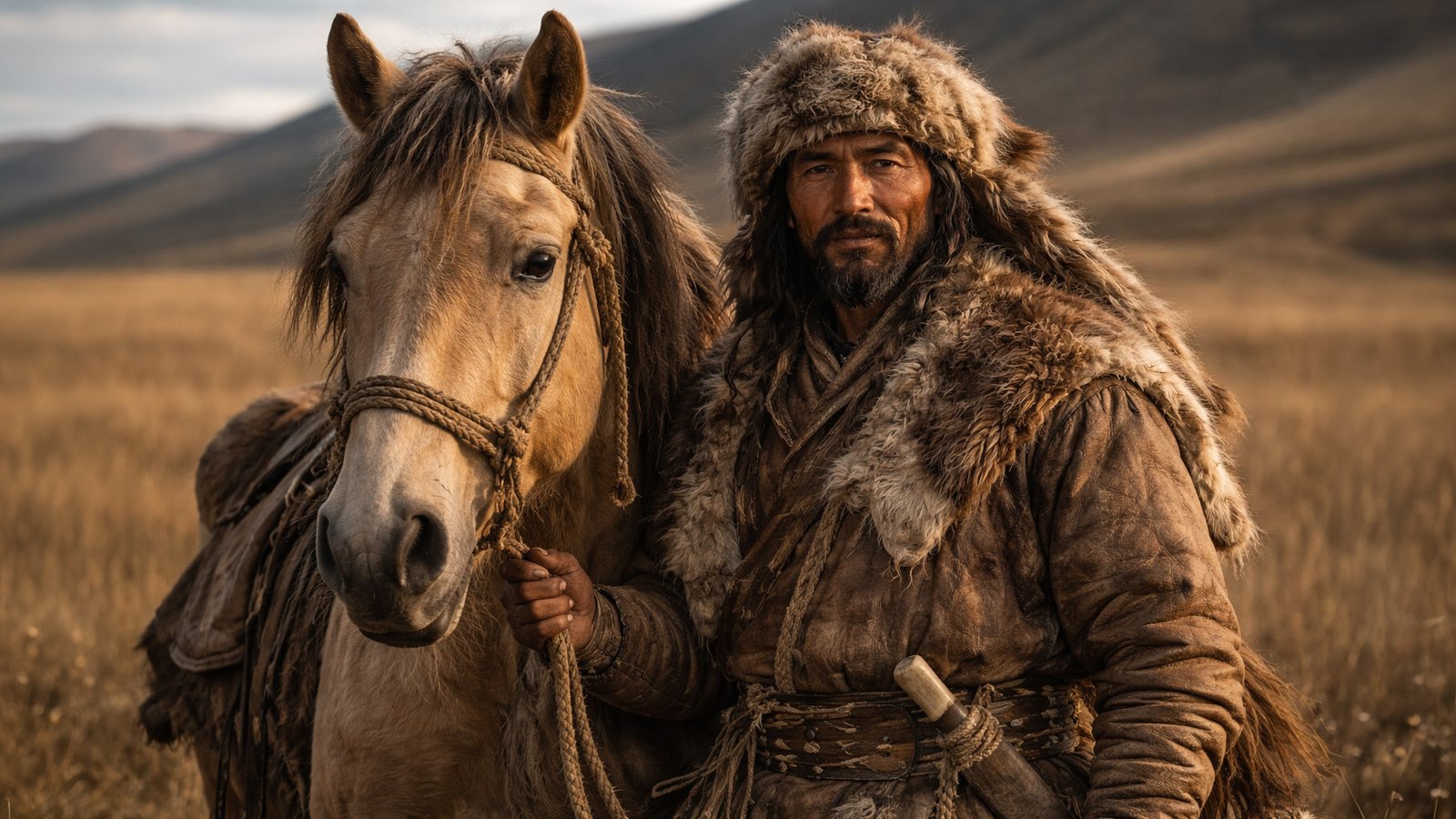
There is something quietly unsettling about the Botai culture, and it has very little to do with primitiveness. In fact, the discomfort comes from the opposite direction. They disrupt a story we have grown rather fond of telling ourselves, one where history moves in clean, upward steps. Stone gives way to copper, copper to bronze, bronze to iron, and each transition brings more tools, more complexity, more visible proof of progress. The Botai, sitting firmly in what archaeologists call the Eneolithic, simply refuse to follow that script.
These were people living in what is now northern Kazakhstan around 3500 BCE, and yet they may have been among the first to domesticate the horse in any meaningful sense. Not tentatively, not as a side experiment, but at scale. Excavations at Botai settlements have revealed tens of thousands of horse bones, clear evidence of corralling, and even chemical traces of mare’s milk preserved in ancient pottery. Taken together, this suggests a society that was not merely hunting horses but actively managing them, milking them, and likely riding them, reshaping their entire economic and social structure around this one animal.
At this point, the usual expectation would be a cascade of technological change. After all, a breakthrough of that magnitude tends to trigger others. Greater control over animals should lead to surplus, surplus should enable specialisation, and specialisation should drive innovation in tools and materials. Yet when you turn to the Botai material record, the picture feels almost deliberately restrained, as if that expected chain reaction never quite took hold.
Their tools remain largely stone-based, their pottery functional rather than decorative, and there is little convincing evidence that metallurgy ever became central to their way of life. Copper existed in the broader region, and neighbouring cultures were beginning to experiment with it, but the Botai seem to have treated it as peripheral at best. There is no obvious rush toward more specialised implements, no ornamental escalation, and no clear shift toward the layered technological systems we tend to associate with societies that have unlocked a major economic advantage.
So the question becomes unavoidable. Why does a culture capable of one of humanity’s most transformative relationships with animals appear, in material terms, so restrained? More importantly, why does that restraint feel so intentional rather than accidental?
One way to approach this is to reconsider what we mean by complexity in the first place. It is tempting to measure it through objects because objects survive. Metal tools, ornaments, and architectural remains give archaeologists something tangible to catalogue. However, complexity can just as easily reside in systems, and systems do not fossilise neatly. In the case of the Botai, much of their sophistication may have been embedded not in artefacts but in knowledge, coordination, and behaviour, particularly in their relationship with horses.
Domestication on this scale is not a simple achievement. It requires an understanding of breeding cycles, herd dynamics, seasonal movement, and risk management. Horses are not passive animals; they spook easily, require vast grazing areas, and can become dangerous if mishandled. Managing large herds would have demanded cooperation, planning, and a shared body of expertise that passed from one generation to the next without leaving a clear material trace. In other words, the Botai may have invested their ingenuity in a domain that archaeology struggles to measure.
Once that perspective settles in, their technological simplicity begins to look less like a gap and more like a trade-off. Instead of diversifying into multiple crafts, they concentrated their efforts on mobility and animal management. Horses extend range, reduce the cost of movement, and allow access to dispersed resources. On the Eurasian steppe, this is not a minor advantage but a structural one, effectively redefining how a society interacts with its environment.
Mobility, however, imposes its own logic. Heavy or highly specialised toolkits become impractical, while flexible and easily replaceable tools gain value. Settlements, even when semi-permanent, must remain adaptable. Under such conditions, technological minimalism is not a failure to innovate but a rational response to a mobile way of life. Carry less, depend less, move more freely, and the system holds together.
At the same time, access to metallurgy was likely uneven. Technologies do not spread automatically; they move through networks of exchange, migration, and sustained contact. The Botai world, while not isolated, may have occupied the edges of early copper distribution systems. If metal objects were rare, costly, or unreliable to obtain, there would have been little incentive to reorganise an entire toolkit around them, particularly when existing stone tools already met most practical needs.
Even when copper was available, its advantages may not have justified the shift. Stone, when carefully worked, performs well for a wide range of tasks. If the Botai economy revolved around horse management rather than intensive agriculture or craft production, then the marginal benefit of adopting metal tools would have been limited. In that context, choosing not to adopt metallurgy widely becomes a sensible decision rather than a missed opportunity.
Cultural preference adds another layer. Societies do not adopt technologies simply because they exist; they adopt them when those technologies fit within established practices and priorities. The Botai may have had little motivation to pursue diversification because their core system was already efficient, resilient, and well adapted to their environment. Change, in such a system, is not always an improvement.
There is a subtle irony in all this. Standard narratives of human development often follow a predictable chain: domestication leads to settlement, settlement leads to surplus, surplus encourages specialisation, and specialisation drives technological innovation. The Botai interrupt that sequence. In their case, domestication appears to have led not to increasing material complexity but to a different equilibrium, one where mobility and adaptability took precedence over accumulation and diversification.
Their settlements reflect this balance. Semi-subterranean houses arranged in clusters suggest a community that combined stability with flexibility. They were not fully nomadic, yet they were not anchored in the way early agricultural societies often were. This intermediate position reduced the pressure to develop complex material cultures. Without large, permanent populations or monumental construction projects, the demand for advanced tools and materials simply did not intensify in the same way.
Environmental conditions reinforce this interpretation. The steppe rewards those who move with it rather than against it. Seasonal variation, grazing cycles, and climatic fluctuations all favour adaptability. Horses, once again, sit at the centre of this system, allowing communities to follow resources instead of exhausting them. In such a context, sophistication lies in responsiveness rather than accumulation.
Seen from this angle, the Botai no longer appear as an anomaly but as a reminder that complexity can take forms that are easy to overlook. It can reside in patterns of movement, in shared knowledge, and in the ability to maintain balance within a demanding environment. It does not always announce itself through metal or monument.
That said, the story is not entirely settled. Some researchers question whether the Botai fully domesticated horses or instead practised highly organised hunting. Others point to later steppe cultures, which clearly embraced metallurgy and more elaborate material systems, as evidence that the Botai represent an early phase in a longer developmental trajectory.
Genetic evidence complicates matters further. Modern domestic horses do not appear to descend directly from Botai populations, suggesting that whatever domestication occurred there may not have led to the lineages that dominate today. This does not diminish their importance, but it reframes it. Rather than being the definitive origin of domesticated horses, the Botai may represent an early and sophisticated experiment that did not become the dominant model.
Framed this way, their story becomes even more interesting. Instead of a missing link in a linear progression, they appear as a parallel path, a society that explored a different balance between knowledge, environment, and material culture. They invested heavily in one transformative relationship, between humans and horses, and allowed other forms of complexity to remain understated.
In the end, the Botai force a slightly uncomfortable question. If a society can achieve such a profound economic and behavioural shift without embracing the full suite of available technologies, then what exactly do we mean when we talk about progress? Perhaps complexity is not a ladder after all but a series of choices, shaped by environment, priorities, and constraints. The Botai, quietly but decisively, chose differently, and their world worked on its own terms.