
There is something wonderfully suspicious about the idea that one man sitting on a Greek island somehow produced an entire mountain of medical literature that shaped Western medicine for more than two thousand years. The Hippocratic Corpus, the famous collection of around sixty ancient Greek medical texts linked to Hippocrates, carries the aura of a single towering genius. It sounds neat, authoritative, and reassuringly simple. One brilliant doctor. One coherent philosophy. One founding father of medicine.
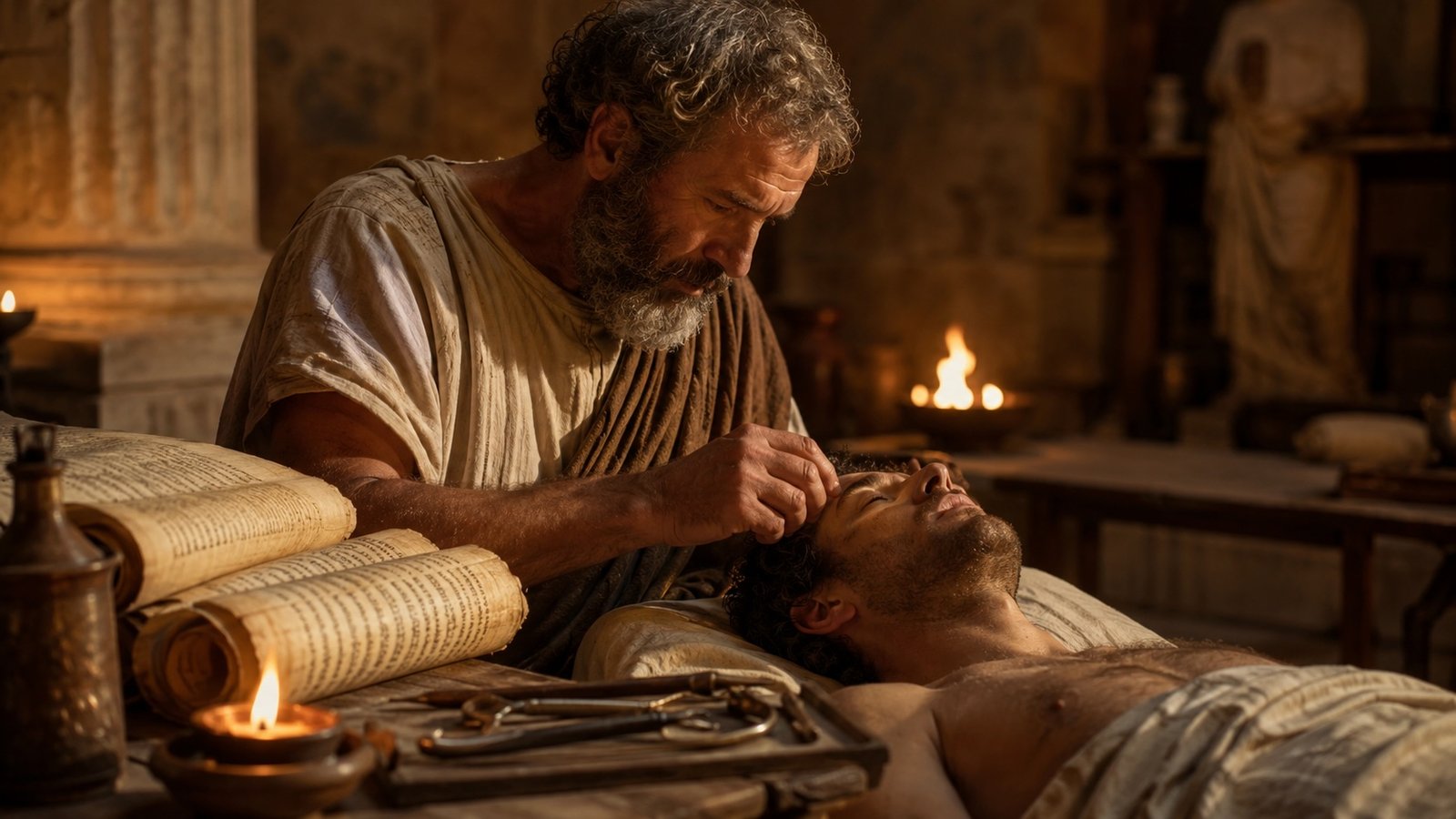
Historians today look at that story with considerable scepticism. The modern consensus is that Hippocrates almost certainly did not write most of the texts attached to his name. In fact, scholars are not even certain which, if any, he personally wrote at all. The Hippocratic Corpus now looks less like the work of one legendary physician and more like a sprawling medical library assembled over generations by many different authors, schools, teachers, students, and wandering practitioners across the Greek world.
That changes the way historians understand one of the most famous names in intellectual history. The real Hippocrates probably did exist. Ancient writers such as Plato and Aristotle mention him as a respected physician from the island of Kos during the fifth century BCE. He developed a reputation so large that later generations began attaching medical authority itself to his name. This created a curious historical effect. Once “Hippocrates” became synonymous with good medicine, texts from different places and periods slowly gathered beneath his reputation like iron filings around a magnet.
By the time scholars in Alexandria started organising ancient knowledge into vast libraries, the process had accelerated. Medical writings that seemed valuable, useful, or prestigious often ended up filed under the Hippocratic tradition. The result was less a carefully curated author collection and more an expanding archive of Greek medicine itself.
And the texts do not exactly hide the fact that they come from different minds. Some works in the Corpus sound practical and restrained. Others become strangely philosophical. Certain texts emphasise observation and prognosis with almost modern clinical calm, while others drift into speculative theories about bodily fluids, air, climate, or spiritual imbalance. A few sound remarkably sophisticated. Others sound eccentric enough to make modern readers quietly back away.
One treatise might insist that disease comes from environmental factors and diet. Another leans heavily into humoral theory. Some writers focus obsessively on surgery. Others seem fascinated by gynaecology or epidemics. Certain texts advocate methods that contradict advice found elsewhere in the collection. Even the writing style shifts dramatically between works. Historians noticed long ago that the Corpus does not read like one coherent authorial voice.
That inconsistency became one of the biggest clues. Linguists and classicists studying the Greek language of the texts found that the works likely emerged across several centuries rather than during one lifetime. Some treatises appear rooted in the late fifth century BCE, close to Hippocrates’ historical period. Others seem significantly later, stretching into the Hellenistic era.
This creates a small problem if one insists on imagining Hippocrates as a sort of ancient medical productivity machine capable of writing through time.
The famous Hippocratic Oath offers another example of the puzzle. Although people still invoke it symbolically in modern medicine, many historians doubt that Hippocrates himself wrote it. Some scholars even believe the oath may have emerged from a specialised medical sect with beliefs that differed sharply from mainstream Greek medicine of the time.
That irony feels perfectly suited to history. One of the most famous ethical texts in medicine may not have been written by the man whose name became attached to it.
Then again, ancient authorship rarely worked the way modern audiences imagine. The modern obsession with precise individual attribution did not always exist in the same form in antiquity. Intellectual traditions often functioned collectively. Schools transmitted ideas orally. Students copied teachers. Lectures evolved into notes, notes evolved into treatises, and treatises accumulated additions over time.
Medicine in classical Greece also operated within travelling networks of practitioners. Physicians moved between islands, courts, ports, and cities. Knowledge circulated constantly. A successful idea rarely stayed in one place for long.
The Hippocratic Corpus therefore resembles something closer to a living professional ecosystem than a modern authored book series.
That is partly why historians increasingly talk about “Hippocratic medicine” rather than “the writings of Hippocrates”. The distinction matters.
“Hippocratic medicine” refers to a broader intellectual movement that gradually shifted Greek medicine away from supernatural explanations and toward observation, environment, symptoms, prognosis, and physical causes. Not every text in the Corpus follows this approach consistently, but many share an underlying attempt to explain illness through natural processes rather than divine punishment.
This was revolutionary because earlier societies often treated disease as a spiritual event. Illness might reflect divine anger, curses, ritual impurity, or cosmic imbalance. The Hippocratic tradition did not completely erase those beliefs, but it pushed medicine toward something recognisably empirical. Physicians began recording symptoms carefully, studying patterns, and observing how diseases progressed over time.
One famous Hippocratic text, On the Sacred Disease, attacks the idea that epilepsy is divine punishment. Its anonymous author argues that the condition has natural causes like any other illness. The argument sounds strikingly modern in spirit, even if the medical explanations themselves now seem scientifically outdated.
This creates another fascinating contradiction. The Hippocratic Corpus contains many ideas modern medicine has completely abandoned, including the famous theory of the four humours. Blood, phlegm, yellow bile, and black bile supposedly governed health and temperament. Physicians attempted to restore balance through diet, purging, bloodletting, and lifestyle adjustments.
By modern standards, much of that theory was wrong. Yet the broader intellectual move toward systematic observation proved enormously important. Historians often argue that the true legacy of the Hippocratic tradition lies less in its specific medical conclusions and more in its method. The writers attempted to observe, compare, document, and reason about disease as a physical phenomenon.
That methodological shift mattered far beyond ancient Greece. The Corpus eventually travelled through Roman medicine, Byzantine scholarship, Islamic intellectual centres, medieval universities, and Renaissance Europe. Physicians copied and translated these texts for centuries. Galen later expanded and interpreted Hippocratic ideas so aggressively that medieval medicine often blended the two traditions together almost inseparably.
Ironically, the confusion surrounding authorship may have helped the Corpus survive. A fragmented archive linked to a legendary founder possessed enormous authority. If these works had circulated separately under obscure names, many might simply have vanished. Instead, the reputation of Hippocrates acted like a preservation shield across centuries of political collapse, library destruction, and intellectual upheaval.
Historians still debate whether fragments of the Corpus may genuinely come from Hippocrates himself. A handful of texts remain plausible candidates, particularly some clinical case observations and epidemic records. Yet certainty remains elusive because ancient medical works rarely include reliable signatures, publication histories, or biographical clues.
In a strange way, Hippocrates became less a person and more a brand. Not a modern commercial brand with logos and marketing departments, obviously, but an ancient symbol of trustworthy medicine. Once that symbolic authority formed, generations of medical writers effectively entered the Hippocratic orbit.
There is something oddly familiar about that process today. Large intellectual traditions still become attached to simplified names. Entire schools of economics get compressed into single thinkers. Technology companies present massive collaborative achievements through the mythology of visionary founders. Films involving thousands of people become associated with one director. Scientific breakthroughs often acquire a single heroic face despite huge networks of contributors behind them.
Human beings seem to prefer stories with central characters. The Hippocratic Corpus reminds us that history rarely behaves so neatly.
Behind the famous marble bust of Hippocrates stands a crowded world of anonymous physicians, teachers, copyists, students, editors, travellers, and observers. Some disagreed with one another. Some probably borrowed ideas freely. Others likely rewrote older material. Together, however, they created one of the most influential bodies of medical writing in history.
And perhaps that collective authorship makes the story more impressive rather than less. The birth of medicine did not emerge from a lone genius descending from a mountain with perfect knowledge. It grew slowly through argument, accumulated experience, observation, mistakes, revision, contradiction, and shared curiosity. Which, honestly, sounds much closer to how knowledge usually develops.