There are many ways to reward loyalty to the British state. Some involve medals. Some involve peerages. And some involve quietly being moved into a very comfortable advisory role where nobody can quite explain what you do anymore. Then there is the Order of the Bath, an honour so gloriously British that it manages to combine medieval purification rituals, scarlet robes, military prestige, civil service hierarchy and Westminster Abbey into one institution that still exists in full ceremonial splendour three centuries later. And yes, originally, it involved an actual bath.
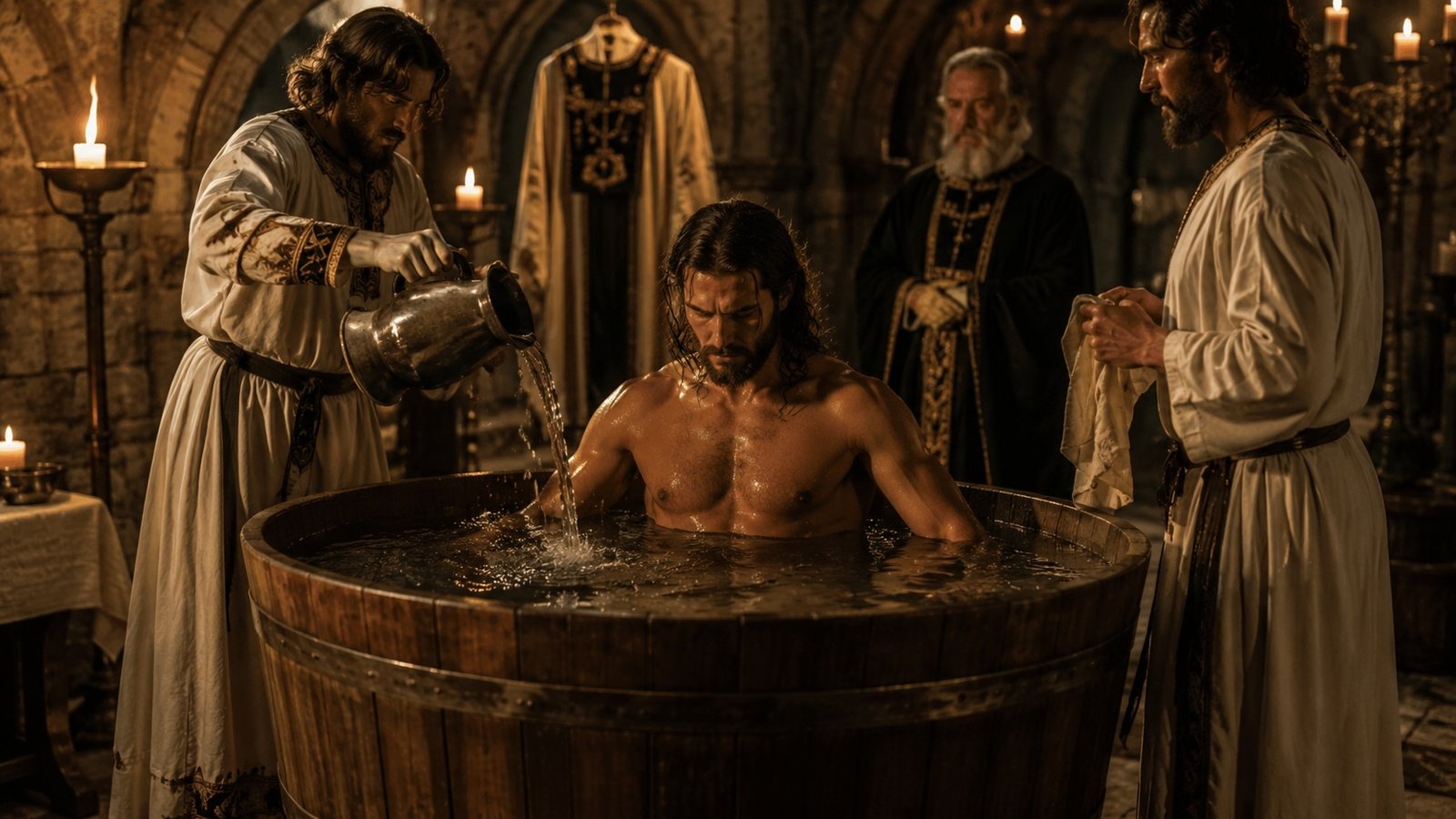
The first thing most people assume about the Order of the Bath is that the name must be symbolic or metaphorical in some obscure way. It sounds almost too strange to be real. Yet the bath was once entirely literal. In medieval England, a knight preparing for honour underwent a ritual washing ceremony intended to symbolise purification before entering service. The candidate would bathe, fast, keep vigil overnight and then proceed to the formal act of knighthood. The ritual mixed religion, warfare and theatre in exactly the way medieval Europe tended to do best.
Centuries later, Britain looked at this ancient ceremonial idea and, instead of quietly leaving it in the Middle Ages where it probably belonged, transformed it into one of the highest honours in the country.
The formal Order of the Bath arrived in 1725 under King George I. Britain at the time was becoming a modern state with a growing empire, an expanding military and an increasingly powerful administrative machine. The monarchy needed ways to reward senior figures who kept that machinery functioning. A structured order of chivalry solved several problems at once. It looked ancient, sounded prestigious and created an elegant system for recognising loyal service without necessarily handing out political power.
Robert Walpole, often regarded as Britain’s first Prime Minister, understood perfectly how useful honours could be. Early appointments to the Order included diplomats, MPs, royal household figures and military officers. Merit certainly mattered, but politics sat comfortably beside it. In many ways, the Order of the Bath became a perfect reflection of the British establishment itself: respectable, ceremonial, hierarchical and never entirely free from patronage.
Still, the theatre remained magnificent. The Order’s chapel sits inside Henry VII’s Lady Chapel in Westminster Abbey, which already sounds less like a government institution and more like the setting for an expensive fantasy series. Scarlet banners hang above the stalls of Knights and Dames Grand Cross. Heraldic plates line the woodwork. Elaborate crests rise above carved seating. During ceremonies, members wear crimson satin robes and hats decorated with white ostrich feathers. At no point does anyone appear remotely embarrassed by any of this. And frankly, that confidence is part of the charm.
The Order’s chapel sits inside Henry VII’s Lady Chapel in Westminster Abbey, which already sounds less like a government institution and more like the setting for an expensive fantasy series. Scarlet banners hang above the stalls of Knights and Dames Grand Cross. Heraldic plates line the woodwork. Elaborate crests rise above carved seating. During ceremonies, members wear crimson satin robes and hats decorated with white ostrich feathers. At no point does anyone appear remotely embarrassed by any of this.
And frankly, that confidence is part of the charm. Modern Britain often projects an image of managerial efficiency, spreadsheets and transport delays, yet institutions like the Order of the Bath reveal another side entirely. The country still enjoys pageantry with complete sincerity. Somewhere behind the language of ministries and defence committees sits an ancient instinct to wrap authority in velvet, Latin mottos and candlelit ceremony.
The motto itself, Tria Juncta in Uno, means “Three Joined in One”. Historians generally interpret this as a reference to England, Scotland and Ireland. Like much of British symbolism, it carries just enough ambiguity to sound important even when nobody fully explains it.
Over time, the Order evolved into a highly structured honours system. Today, it contains three ranks: Companion, Knight or Dame Commander, and Knight or Dame Grand Cross. The initials matter enormously in establishment circles. CB, KCB, GCB. A tiny collection of letters capable of communicating decades of military service, Whitehall influence or diplomatic importance in a single line of text.
The Order also split into Military and Civil divisions. That distinction matters because the Order became deeply connected to Britain’s expanding imperial and administrative state during the eighteenth and nineteenth centuries. Senior naval officers, army commanders, colonial governors and top civil servants all passed through its ranks. During the Napoleonic Wars, honours flowed toward military figures associated with Britain’s survival against France. Nelson and Wellington both became members. Later came Haig, Kitchener, Montgomery and Dowding, men whose names became attached to entire eras of warfare.
Yet the Order was never exclusively military. That is where things become particularly British. The same institution that rewarded battlefield command also recognised senior bureaucrats whose greatest tactical achievement may have involved surviving Treasury meetings.
Queen Victoria reshaped the Order significantly in 1847. Earlier versions retained traces of medieval ritual that had become increasingly impractical in industrial Britain. Victoria modernised the structure and expanded civil appointments more formally. The Order became less about symbolic purification and more about rewarding service to the Crown and state. Thankfully for everyone involved, this also reduced the practical importance of the bathing element.
Queen Victoria reshaped the Order significantly in 1847. Earlier versions retained traces of medieval ritual that had become increasingly impractical in industrial Britain. Victoria modernised the structure and expanded civil appointments more formally. The Order became less about symbolic purification and more about rewarding service to the Crown and state. Thankfully for everyone involved, this also reduced the practical importance of the bathing element.
Not every recipient inspired admiration. One of the recurring tensions surrounding British honours systems involves the blurry line between genuine service and political favour. Critics have long argued that honours sometimes function as establishment networking tools dressed in ceremonial language. That criticism did not disappear in modern times. In 2024, controversy followed the appointment of Martin Reynolds, a former aide to Boris Johnson associated with the Downing Street lockdown scandal known as “Partygate”. Reynolds became a Companion of the Order of the Bath despite public criticism over his role in events during Covid restrictions. The reaction reminded people that honours systems remain political territory, no matter how medieval the robes appear.
The Order has also demonstrated the Crown’s ability to revoke honours when reputational damage becomes too severe. Robert Mugabe received an honorary knighthood-equivalent appointment in 1994 during a period when Western governments still hoped Zimbabwe might stabilise democratically. By 2008, amid growing outrage over political violence and economic collapse, the honour was stripped away. Even centuries-old ceremonial systems eventually collide with modern geopolitics.
Meanwhile, the ceremonial side continues almost untouched. Every four years, members gather for a service in Westminster Abbey wearing robes that appear magnificently unconcerned with modern fashion trends. King Charles III currently serves as Sovereign of the Order, while Prince William became Great Master in 2025 during the Order’s 300th anniversary celebrations. Charles himself previously held the role for half a century before passing it to his son. That continuity matters enormously within royal culture. The Order does not merely reward service; it reinforces institutional permanence.
Permanence may be the most interesting thing about it. Britain has changed governments, lost an empire, survived industrial upheaval, endured wars, navigated constitutional crises and transformed socially beyond anything George I could have imagined. Yet the Order of the Bath still gathers in Westminster Abbey beneath medieval heraldry as if history itself has simply adjusted around it.
There is something strangely revealing about that endurance. Most modern states reward officials through titles that sound administrative or technocratic. Britain instead preserved institutions that feel almost theatrical. A senior civil servant in another country might receive a distinguished public service medal. In Britain, they may become part of a centuries-old order originally inspired by ritual washing ceremonies before knighthood.
The absurdity is real, but so is the symbolism. Beneath the velvet and Latin sits an old political truth: states need stories around power. Bureaucracy alone rarely inspires loyalty or emotional attachment. Ceremony fills that gap. It transforms administration into tradition. The Order of the Bath survives because it turns state service into something larger, stranger and far more memorable than a line on a CV.
Besides, if someone offered most people a crimson robe, a Westminster Abbey ceremony and mysterious Latin post-nominals tomorrow, very few would refuse on the grounds that the whole thing sounded slightly ridiculous.