Mallorca: More Than Just a Pretty Beach
Everyone has a mate who’s been to Mallorca. They come back with a tan, a bottle of Hierbas, and the same story: “Oh, it’s just full of British tourists.” And fair enough — the numbers don’t exactly suggest otherwise. In 2024, the island welcomed 13.4 million visitors. That’s more than fourteen times its actual population. To put that another way, the sign that one protester held up in Palma said it all: “1,232,014 residents. 18 million tourists.” So yes, Mallorca is busy. Extraordinarily, almost comically busy. But here’s the thing — the island has been quietly harbouring one of the most staggeringly beautiful, culturally rich, and historically layered destinations in all of Europe, and most people fly straight over it to get to the pool bar.
Let’s start with the mountain range nobody talks about nearly enough. The Serra de Tramuntana runs for 90 kilometres along the northwest coast, a spine of soaring peaks and terraced cliffs dropping straight into the Mediterranean. In 2011, UNESCO gave it World Heritage Site status, not just for the scenery but for the millennia of human ingenuity written into the landscape — stone terraces, ancient water channels, charcoal kilns, and dry-stone walls that farmers have been maintaining since Moorish times. Villages like Deià and Valldemossa cling to the hillsides with the kind of effortless beauty that makes you want to quit your job immediately. Deià was where the poet Robert Graves settled and stayed for most of his life, attracting writers and artists who were presumably also trying to quit their jobs. Valldemossa, meanwhile, is famous for hosting Chopin and his partner George Sand for a winter in the 1830s — not that the damp Mallorcan winter did much for his tuberculosis, but it did inspire some rather lovely piano compositions.
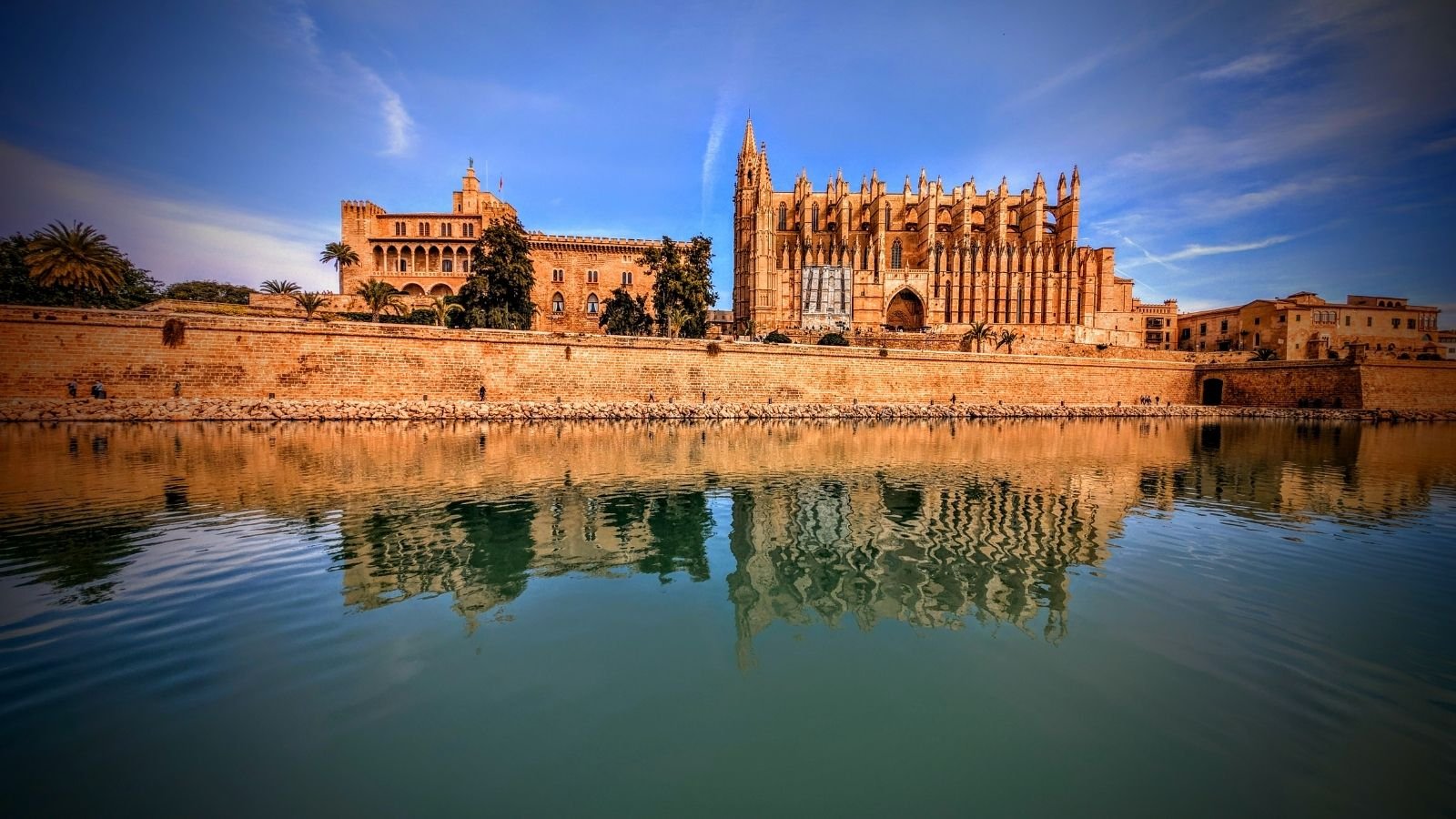
Then there’s Palma itself, which tends to get overlooked in favour of the beach resorts. The city’s Gothic cathedral, La Seu, is genuinely jaw-dropping — it holds the largest Gothic rosette window in the world, a vast stained-glass eye that floods the interior with colour. Gaudí had a hand in some of the interior redesign, which is one of those facts that sounds made up until you’re standing underneath it. Not far from the cathedral, tucked into the old town, are the Arab Baths — remnants of a tenth-century Moorish city, now sitting quietly behind a garden wall while tourists trundle past. Nearby, the Bellver Castle is the only circular fortified castle in Europe and offers views over Palma Bay that would make an estate agent weep with envy.
Outside the capital, the island rewards curiosity rather handsomely. The Caves of Drach near Porto Cristo contain one of the largest underground lakes in the world, where a classical music recital takes place by boat at the end of every tour. It sounds deeply eccentric. It absolutely is. And yet somehow it works. Over on the west coast, the village of Banyalbufar produces wine from the Malvasia grape on terraced vineyards that have been worked since the tenth century. A rare toad — the Mallorcan Midwife Toad — lives only in the Tramuntana mountains, was declared extinct in 1977, and then had the audacity to turn up alive in 1979. There are thought to be fewer than 500 breeding pairs left. The sand at Es Trenc beach — widely considered the island’s most beautiful stretch of coastline — is so fine and so beloved that tourists take an estimated 25 tonnes of it home every year, accidentally or otherwise.
All of which makes it particularly poignant that Mallorca finds itself at the heart of one of Europe’s most heated arguments about tourism. Through 2024 and into 2025, tens of thousands of locals took to the streets in protest. In July 2024, around 20,000 people marched through Palma under the banner “Let’s change course and set limits on tourism.” Activists described housing becoming unaffordable, public services stretched beyond capacity, and beaches they’d grown up on now feeling inaccessible. The protest movement grew through 2025, with further demonstrations in June of that year echoing a sentiment that had spread across Spain: “Your luxury is our misery.” The Balearic government responded with fines of up to €80,000 for illegal holiday rentals and a Sustainable Tourism Tax, but critics argue these are sticking plasters on a wound the size of the island’s entire economy.
The irony is genuinely vertiginous. Mallorca’s biggest problem is that people love it too much. The same quality of light that inspired Chopin now attracts a cruise ship every other day. The same hidden coves that kept the island mysterious for centuries are now geotagged and shared before the sunscreen has dried. Forecasts suggest the Balearic Islands could receive up to 28.5 million visitors annually by 2050 if the current trajectory holds. For an island that already has more tourists per resident than anywhere else in Europe, that figure reads less like a projection and more like a threat.
None of this means you shouldn’t go. In fact, the argument could be made that going thoughtfully — spending locally, exploring inland, avoiding peak August, taking the vintage wooden train from Palma to Sóller instead of another pool day — is precisely the kind of tourism Mallorca needs more of. The island, for all its overcrowding, retains a soul that its concrete-and-sunlounger reputation simply doesn’t deserve. Rafa Nadal was born in Manacor. The lighthouse at Porto Pí, standing in Palma Harbour, dates back to the year 1300 and is the third oldest functioning lighthouse in the world. The olive trees at Banyalbufar are centuries old and still being harvested.
Mallorca is, against considerable odds, genuinely extraordinary. The beaches are beautiful, yes. But so is the light on the Tramuntana at dusk, the smell of oranges in Sóller, the weight of history in a cathedral built over seven centuries. So next time someone tells you it’s just a British holiday resort — gently suggest they’ve been looking at the wrong bit.
1 comment