
A coral reef in distress does not always look like a disaster. Sometimes it looks like an underwater nightclub with better taste. Pink, violet, electric green and ghostly blue flare across the reef, as if nature has suddenly decided that ecological collapse needs a lighting designer. To a diver, the scene can feel magical. To a coral biologist, it may look more like a warning light on the dashboard.
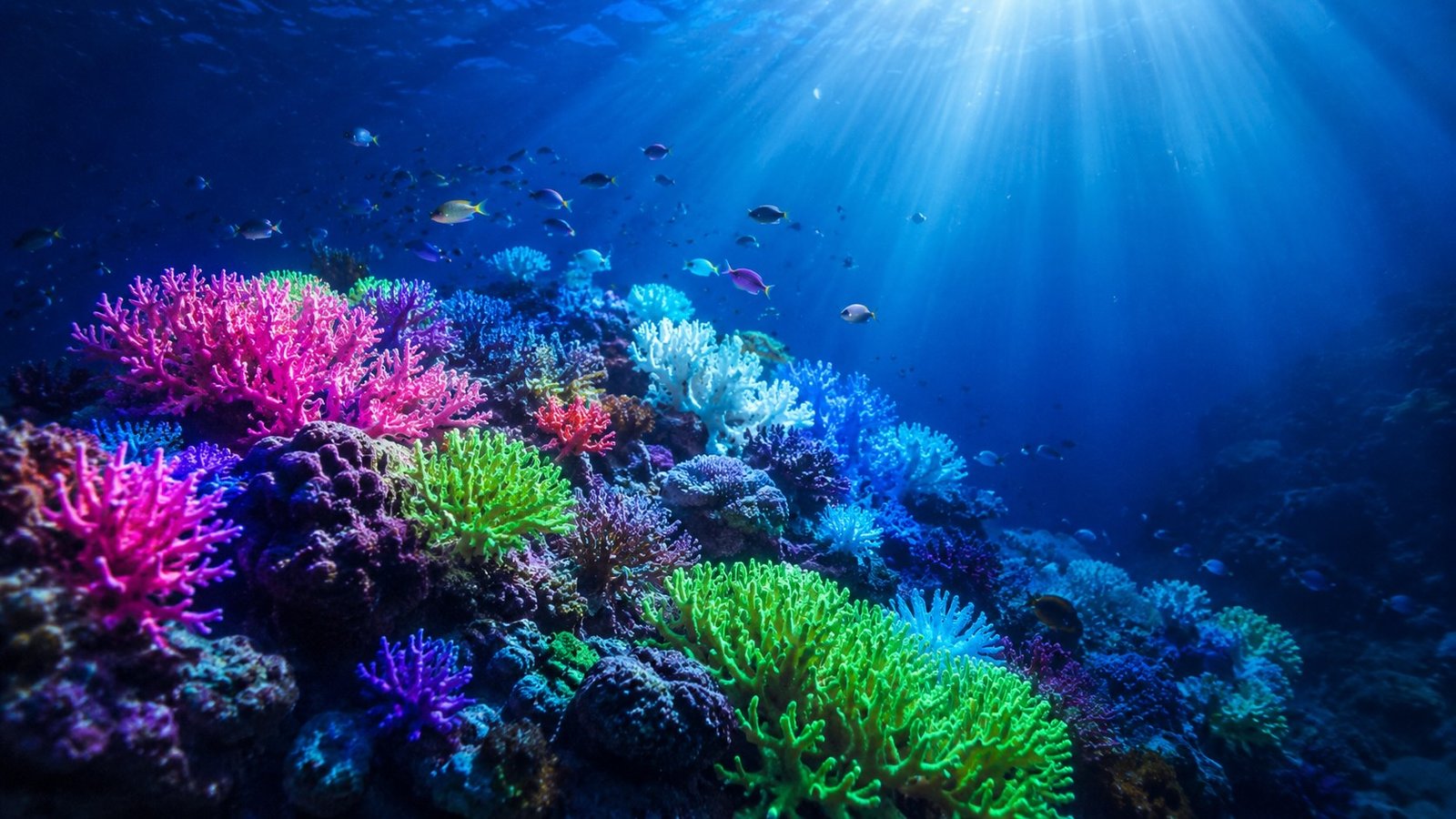
This is the strange cruelty of coral fluorescence. The colours are beautiful, but beauty is not always good news. In some corals, those luminous pigments appear when the animal faces heat, intense light, nutrient stress or the early stages of bleaching. What humans see as neon wonder can actually be biological panic, a last-minute attempt to protect fragile tissue and persuade lost partners to come home.
Corals are animals, though they behave like tiny landlords with an unusually demanding tenant agreement. Inside their tissues live microscopic algae, often called zooxanthellae, which photosynthesise and share food with the coral. In return, the coral provides shelter, carbon dioxide and prime real estate in warm, shallow seas. It is one of the great partnerships on Earth: a living bargain that builds reefs, feeds fish, protects coastlines and quietly supports millions of human livelihoods.
Then the water gets too warm. Or the light becomes too intense. Or pollution, disease, changing salinity and other insults pile on top of one another. The partnership starts to wobble. The algae produce damaging chemical by-products, the coral ejects them, and the animal’s pale limestone skeleton begins to show through its translucent tissue. That is coral bleaching: not death exactly, but a form of starvation with excellent public relations. A bleached coral can recover if conditions improve. Leave it too long, though, and the reef becomes a cemetery with architecture.
The fluorescent version of this story is even odder. Some corals do not simply turn white. They turn spectacular. Scientists call this “colourful bleaching”, which sounds like a cheerful paint catalogue until you realise what it means. Research led by Elena Bollati, Cecilia D’Angelo and Professor Jörg Wiedenmann at the University of Southampton described an optical feedback loop between the coral host and its algal symbionts. When algae disappear, they no longer absorb much of the sunlight entering the coral tissue. Light then bounces around inside the coral and reflects off the white skeleton beneath, increasing the stress on cells already having a terrible week.
The coral responds by producing bright fluorescent and chromoprotein pigments. These pigments work rather like sunscreen, not in the beach-holiday sense, but in the desperate “please stop frying my internal tissues” sense. They absorb and re-emit light, reducing some of the excess radiation and creating a more tolerable environment for returning algae. In mild or temporary heat stress, these colours can develop within two or three weeks. The reef glows because it is trying to save itself.
That detail matters because the glow is not simply a death sentence. In some cases, colourful bleaching may indicate that a coral still has enough energy and cellular machinery to fight back. Think of it as a flare, not a funeral. The coral has lost much of the machinery that feeds it, yet it is still spending energy on a protective display. If the heat fades, if water quality holds, if disease does not arrive like an opportunistic burglar, recovery remains possible.
Still, nobody should mistake resilience for invincibility. A person can sweat during a heatwave; that does not mean they should be left in a locked car. Corals can mount stress responses, but they cannot negotiate with a warming ocean forever. The current global bleaching crisis has made that painfully clear. NOAA confirmed the fourth global coral bleaching event in April 2024, and by 2025 the International Coral Reef Initiative reported that bleaching-level heat stress had affected about 84% of the world’s reef area. That is not a quirky local episode. That is the planet tapping the glass.
The Great Barrier Reef offers a grim example because it has become both icon and patient chart. Recent monitoring by the Australian Institute of Marine Science found major coral cover losses after the 2024 mass bleaching and cyclone impacts, with particularly heavy declines in northern areas around Lizard Island and Cooktown. The reef still contains life, recovery and complexity; it is not the dead postcard some headlines prefer. Yet each repeated bleaching event narrows the recovery window. Corals need time to regrow. Heat keeps arriving early.
Here is the part that feels almost rude: fluorescent corals also helped science long before many people understood their ecological drama. Coral fluorescent proteins became prized tools in biological research and bioimaging because they glow under specific light. The same family of pigments that gives a stressed coral its eerie colour can help scientists track cells, proteins and disease processes in laboratories. A reef under pressure helped humans see microscopic life more clearly. We are, as usual, not entirely sure whether to say thank you or apologise.
There are myths around glowing reefs too. One says fluorescence always means a coral is dying. Not quite. Some healthy corals fluoresce naturally, and fluorescence can serve different roles depending on species, depth and habitat. In deeper or dimmer waters, some research suggests green fluorescence may even help lure plankton prey, which is wonderfully sinister for an animal that looks like decorative stone. Another myth says bright colour means the reef is fine because, well, look at it. Also wrong. A coral can look fabulous while experiencing serious physiological stress. Nature has never promised that suffering will dress modestly.
This is why scientists increasingly treat fluorescence as a signal worth monitoring, not a pretty extra. Divers, underwater microscopes, hyperspectral imaging and remote sensing tools can help detect changes in coral colour, pigment intensity and health before collapse becomes obvious to casual observers. The challenge is interpretation. A drop in green fluorescent protein may show declining health in some experiments. A burst of colour may suggest active defence in others. Different species speak different dialects of light, and reefs do not come with subtitles.
Even so, the promise is powerful. If researchers can read these signals more accurately, fluorescence could help identify corals with better recovery prospects, map stress before mass mortality, and guide conservation teams towards reefs that need urgent attention. It could also help restoration programmes choose which coral strains cope better with heat and light stress. That does not solve the root problem, but it improves triage. In a hospital, nobody confuses a thermometer with a cure. Still, you would rather have the thermometer.
The controversy sits exactly there. Some critics worry that the language of “super corals”, assisted evolution and restoration can make the crisis sound manageable through clever intervention alone. Grow tougher corals, plant fragments, monitor the glow, add a bit of technology, and perhaps the reef survives like a start-up after a difficult quarter. But coral reefs are not software. They cannot pivot away from physics. Restoration helps in specific places, and science matters enormously, yet no fluorescent trick can cancel sustained marine heatwaves, pollution, overfishing and coastal damage.
That makes the glowing coral one of the most uncomfortable symbols in the ocean. It is beautiful enough for a screensaver and alarming enough for an emergency briefing. It reminds us that nature rarely communicates in the tidy categories humans prefer. White bleaching looks like surrender. Neon bleaching looks like spectacle. Both can mean stress. One whispers. The other puts on a light show.
So the next time a glowing reef appears in a photograph, it is worth pausing before calling it pretty. It may be pretty, of course. Corals have no obligation to make their crises visually convenient for us. But the glow may also be an animal’s distress signal, a sunscreen, a recruitment poster for missing algae, and a warning from a system running out of spare capacity. The reef is not decorating itself. It is trying, with all the strange chemistry it has left, to stay alive.