When Rome Had Five Emperors in a Single Year
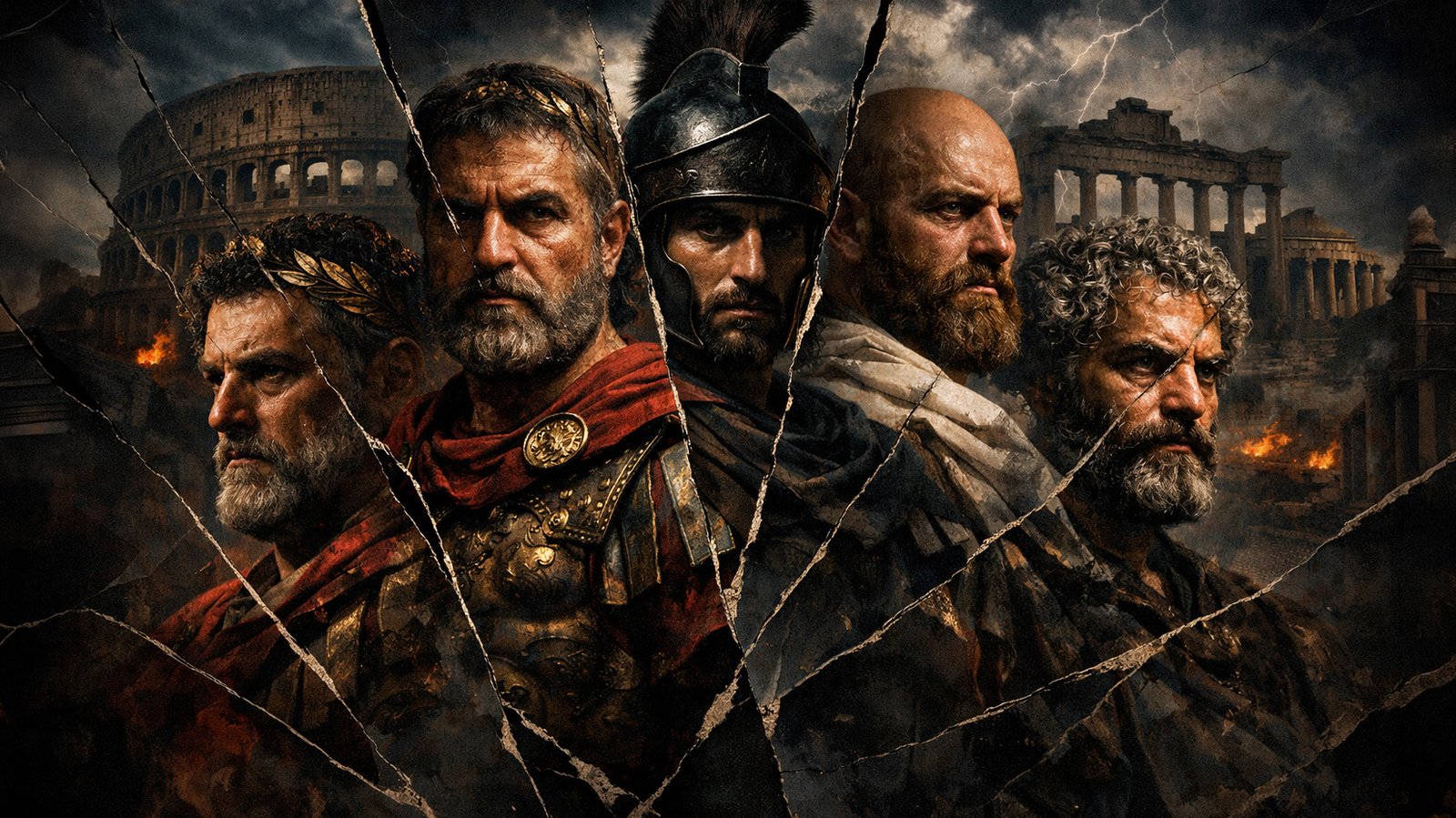
Rome liked to imagine itself as steady, rational, almost boringly eternal. Laws held things together, traditions smoothed over the cracks, and emperors, at least in theory, followed one another in something resembling order. Then came AD 193, and the whole illusion collapsed in spectacular fashion. When Rome had five emperors in a single year, it stopped being a system and started looking more like a live experiment in power.
It began, as these things often do, with a corpse. Commodus, whose reign had drifted from eccentric to outright chaotic, was murdered on the last day of AD 192. The empire, suddenly without a centre, reached for stability and found Pertinax. He was experienced, sensible, and about as exciting as a tax audit. In calmer times, that might have been an advantage. In Rome, at that particular moment, it was a liability.
Pertinax tried to impose discipline, especially on the Praetorian Guard, who had grown rather fond of their own importance. He attempted reforms, cut excess, and behaved like someone who thought the empire could still be governed by rules. The Guard disagreed. Three months into his reign, they killed him. Not subtly, not discreetly, but in a way that made it clear who really held the keys to power.
At that point, Rome crossed from instability into something close to farce. The imperial throne effectively went up for sale. Didius Julianus secured the support of the Praetorian Guard by promising them generous rewards, which is a polite way of saying he bought the empire. The Senate, faced with armed men and limited options, confirmed him. Legitimacy, it turned out, could be negotiated.
Outside Rome, however, the reaction was immediate and hostile. Governors and generals across the empire looked at the situation and reached the same conclusion: this was not a government, it was an opening. Three men in particular stepped forward. Pescennius Niger in the east, Clodius Albinus in the west, and Septimius Severus in the Danube region all decided that if the empire was up for grabs, they might as well compete.
Severus moved first, and that mattered more than anything else. Speed, in moments like this, becomes its own kind of authority. His troops proclaimed him emperor, and instead of waiting for events to unfold, he marched on Rome. Crucially, he framed his campaign not as ambition but as justice. He presented himself as the avenger of Pertinax, which gave his actions a convenient moral polish.
Meanwhile, Julianus remained in Rome, increasingly isolated and increasingly irrelevant. The Senate, sensing which way the wind was blowing, switched allegiance with impressive speed. Julianus was executed, and Severus entered the city not as a challenger, but as the man everyone had already decided to accept.
It might have ended there, but Rome in AD 193 was not interested in tidy endings. Two serious rivals still remained. Niger had strong support in the eastern provinces, while Albinus controlled significant forces in the west. A less disciplined strategist might have rushed to confront both at once and collapsed under the strain. Severus chose a different approach.
He postponed one problem. By offering Albinus the title of Caesar, he effectively turned a rival into a temporary ally. It was not trust. It was timing. With the west momentarily quiet, Severus focused on Niger.
The eastern campaign was decisive. Battles followed, alliances shifted, and eventually Niger was defeated. Severus had removed one major threat without overextending himself. Only then did he turn his attention back to Albinus, whose usefulness had quietly expired.
The final confrontation came at Lugdunum in AD 197. It was one of the largest and bloodiest clashes of Roman civil war. By the time it ended, Albinus was dead, and Severus stood alone at the top.
Looking back, the pattern becomes obvious. This was not luck. Severus understood sequencing. He understood perception. Most importantly, he understood that power in Rome no longer flowed through tradition or approval, but through control of the army and the ability to act faster than anyone else.
There is something quietly revealing about this year. Rome liked to present itself as a civilisation governed by law, consensus, and inherited authority. Yet when pressure arrived, those ideas faded quickly. The real structure of power emerged: soldiers, loyalty, and the willingness to move before your rivals had finished thinking.
Severus did not invent that system. He simply recognised it. Where others hesitated or tried to play by older rules, he adapted. He turned chaos into a series of manageable steps, and each step made the next one easier.
Once in control, he made sure the lesson stuck. He weakened the Praetorian Guard that had destabilised the empire, replacing it with forces loyal to him. He increased military pay and tightened his grip on the army. Stability returned, but it came with a shift. The empire became more openly dependent on military power than it had been before.
That is the paradox of the year. It looks like pure disorder, yet it produced a new kind of order. The old illusion of balanced authority gave way to something more direct. If you controlled the army, you controlled Rome.
So was this a collapse or a transformation? In truth, it was both. The traditional image of Rome as a carefully managed state did not survive AD 193 intact. In its place emerged a more pragmatic, less romantic version of the empire, one that admitted, if only indirectly, what had always been true beneath the surface.
When Rome had five emperors in a single year, it revealed itself. Not as the polished machine it liked to describe, but as a system that, under pressure, reverted to competition, speed, and force.
Severus did not just win that competition. He defined it. And in doing so, he left behind an empire that was a little more stable, a little more honest, and a great deal more dependent on the men who carried swords.