The first thing to understand about the Terracotta Army is that it wasn’t built to impress anyone. Not visitors, not historians, not even rivals. It was built for one man who had no intention of sharing it with the world. And yet, two thousand years later, here we are, peering into what might be the most extravagant afterlife insurance policy ever conceived.
Qin Shi Huang, the first emperor of a unified China, did not do things in moderation. He standardised writing, currency, and infrastructure across a vast territory, and then, almost as a side project, decided that death would not interrupt his authority. So he commissioned an entire underground empire, complete with soldiers, horses, officials, and, according to some accounts, rivers of liquid mercury flowing beneath a ceiling of stars.
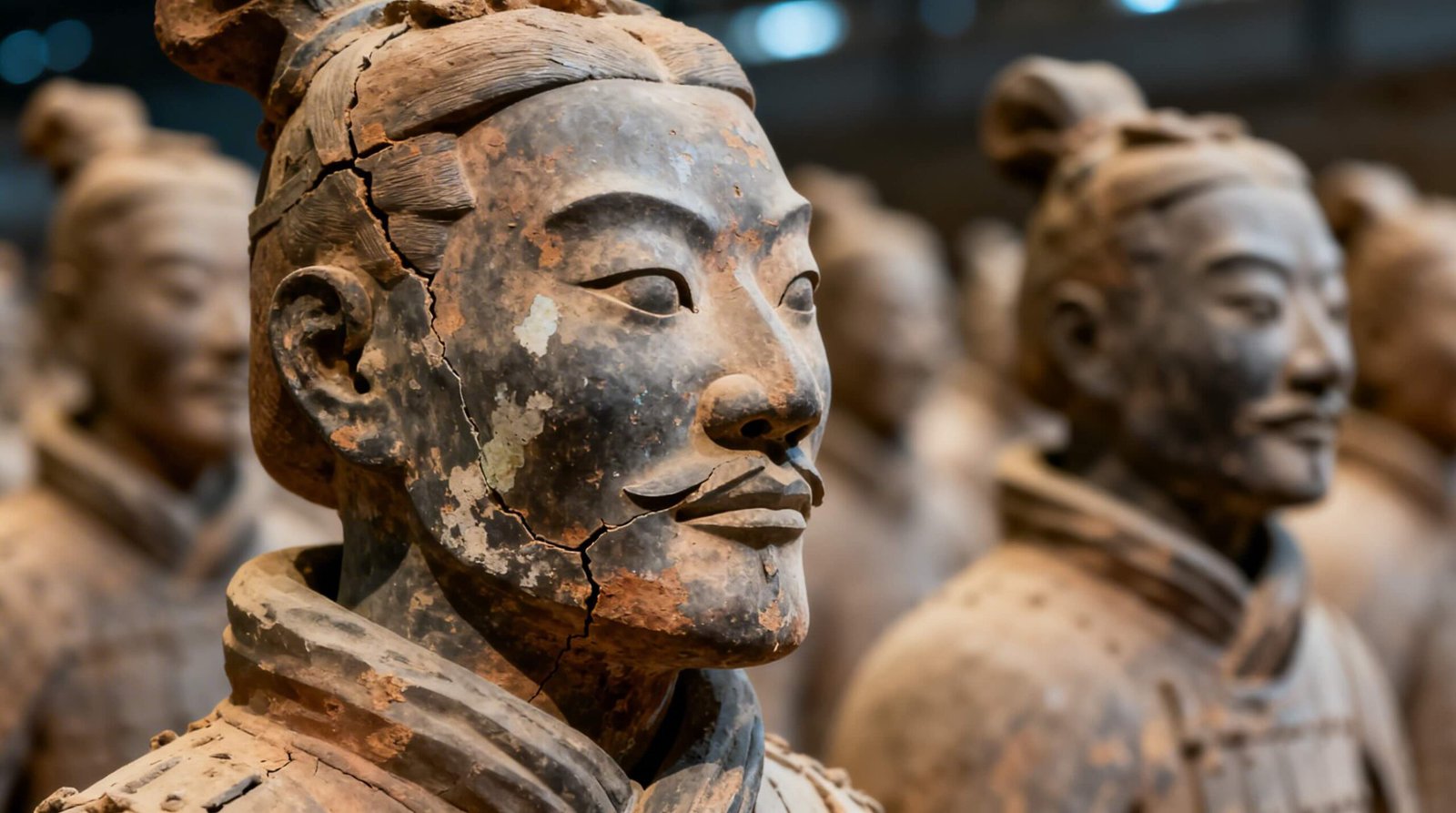
The Terracotta Army was just one part of this vision, but it’s the part that survived with startling clarity. Thousands of life-sized figures stand in formation, arranged with the kind of discipline you’d expect from a real military force. Infantry in front, archers positioned strategically, chariots ready behind them. It looks less like a tomb and more like a paused moment in a campaign that never quite began.
What makes it unsettling, though, is the individuality. No two faces are exactly the same. Some look stern, others calm, a few almost bored, as if eternity might not be as thrilling as advertised. Hairstyles differ. Armour varies. Even posture carries subtle personality. It’s as if the craftsmen were encouraged to create not just soldiers, but characters.
And yet, this was also mass production on a staggering scale. Workshops operated almost like ancient factories. Heads, torsos, arms, and legs were made separately and then assembled. After that, artisans added details by hand, turning standardised components into something convincingly human. It’s an odd blend of efficiency and artistry, like a production line that refused to become impersonal.
Originally, these figures were painted in vivid colours. Bright reds, deep blues, rich purples. When archaeologists first uncovered them, traces of pigment still clung to the surface, only to fade almost immediately upon exposure to air. What we see today, in muted earthy tones, is effectively the ghost of a far more theatrical display.
The scale of the operation borders on the absurd. Historical records suggest that hundreds of thousands of workers contributed to the emperor’s burial complex. This wasn’t just a construction project; it was a national undertaking. For years, resources and labour were funnelled into a site that no one was meant to see.
And then, quite abruptly, it vanished from memory. After Qin Shi Huang’s death, his dynasty collapsed with surprising speed. Rebellions followed. The carefully planned continuity of power dissolved. The tomb complex was buried, partially looted, and eventually forgotten, absorbed back into the landscape as if it had never existed.
The rediscovery feels almost accidental enough to be fictional. In 1974, farmers digging a well struck fragments of pottery. Not particularly promising at first glance. But as more pieces emerged, the scale of what lay beneath became clear. Excavations revealed not just a handful of statues, but entire pits filled with soldiers, many broken, others still standing exactly where they had been placed over two millennia earlier.
Even now, the site feels unfinished, not in construction, but in understanding. Large sections remain unexcavated. The central tomb itself, where the emperor lies, has not been opened. Partly this is due to preservation concerns. Modern archaeology, for all its sophistication, still struggles to protect delicate materials once they are exposed. But there is also a certain restraint at play, a recognition that some things, once disturbed, cannot be put back together.
Then there’s the mercury. Ancient historian Sima Qian wrote about rivers of it flowing through the tomb, designed to mimic China’s waterways. For years, this sounded like poetic exaggeration. Yet soil tests around the burial mound have revealed unusually high mercury levels. Suddenly, the story feels less like myth and more like a warning label from antiquity.
It’s hard not to notice the irony in all of this. Qin Shi Huang was famously obsessed with immortality. He sent expeditions in search of elixirs and reportedly consumed substances that were meant to prolong life but likely did the opposite. The man who tried so hard to escape death ended up ensuring his legacy in a way he probably didn’t anticipate.
Because what survived wasn’t his body, nor his dynasty, but his idea of control. An army that doesn’t age, doesn’t question orders, doesn’t defect. It simply stands, eternally ready, guarding a ruler who may or may not still lie undisturbed beneath a sealed chamber.
There’s something quietly modern about that. The desire to preserve influence beyond one’s lifetime, to build systems that outlast their creators. The Terracotta Army just happens to express that impulse on a scale that’s difficult to replicate.
Walking through the site today, or even just looking at photographs, you get a sense of suspended intention. These soldiers were meant to serve a purpose, to protect, to accompany, to reinforce authority in the afterlife. Instead, they became witnesses. Not to battles or empires, but to time itself.
And perhaps that’s the real twist. The emperor planned for eternity, but not for an audience. Yet now, centuries later, millions of people come to see what he tried so carefully to hide. The army still stands in formation, but the war it was meant to fight never came. Instead, it tells a different story, one about ambition, control, and the peculiar ways in which history chooses what to preserve.
If anything, the Terracotta Army feels less like a monument to power and more like a reminder of its limits. Even the most absolute ruler couldn’t control what would happen after he was gone. He could build, command, and bury an entire world beneath the earth, but he couldn’t decide who would eventually uncover it, or how it would be understood.
So the soldiers wait. Not for enemies, not for orders, but for interpretation. And that might be the most enduring role they were never designed to play.