The Zohar: A Suspiciously Convenient Book of Splendour and Secrets
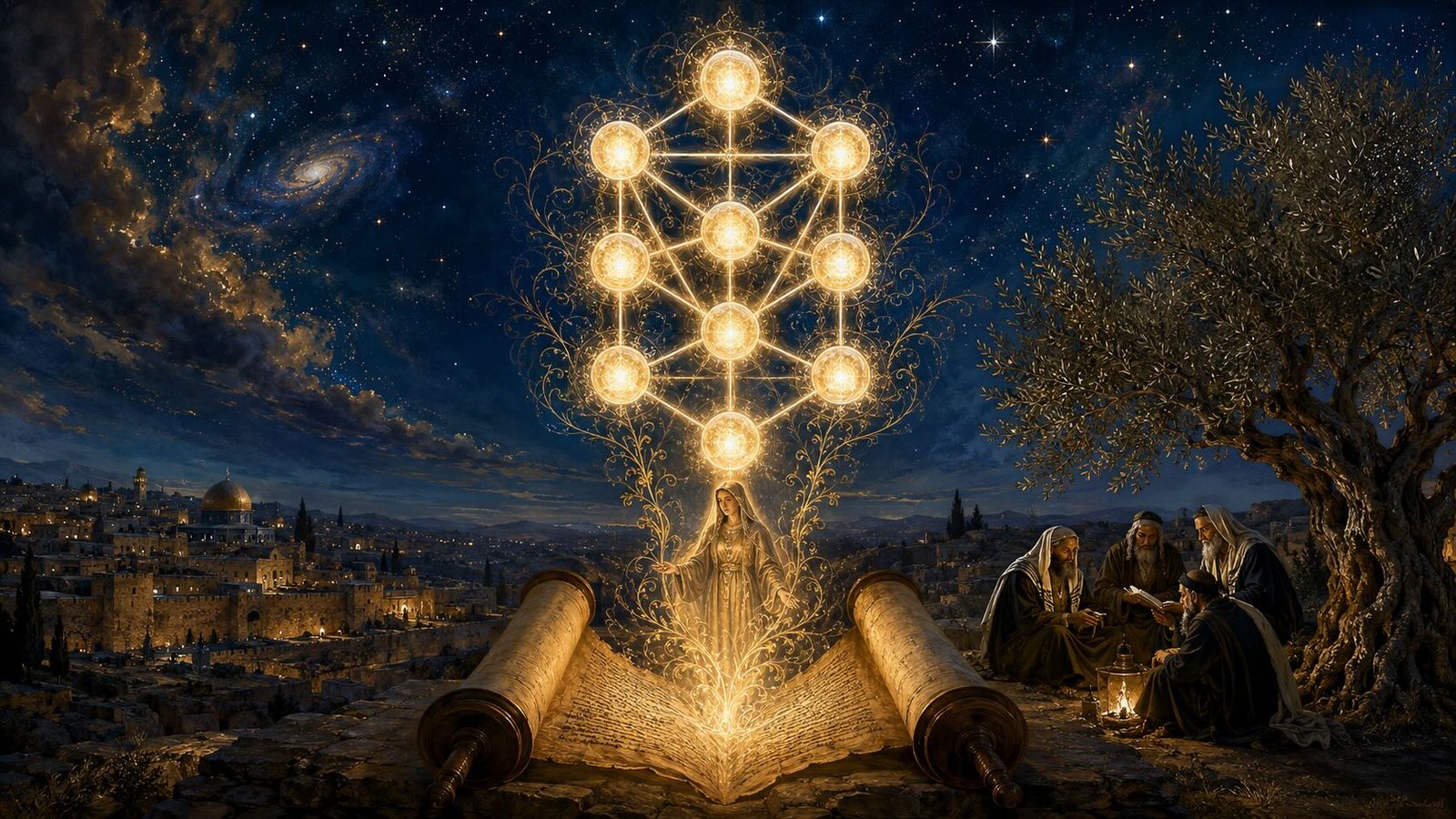
Some books explain the world. Others seem determined to make it more mysterious. The Zohar, usually translated as the “Book of Splendour” or “Book of Radiance”, belongs firmly to the second category. It stands at the heart of Kabbalah, the mystical tradition within Judaism. Yet reading it feels less like opening a theology manual and more like joining a moonlit conversation already in progress.
The Zohar takes the Torah, particularly the first five books of the Hebrew Bible, and searches beneath its familiar stories. It looks for hidden structures, cosmic dramas and coded relationships. Adam and Eve become more than unfortunate gardeners. Noah’s Ark turns into a pattern of spiritual protection. Abraham’s journeys reflect movements within the divine realm. A seemingly ordinary verse may suddenly contain several worlds, multiple souls and an argument about the nature of light.
The text uses an unusual and deliberately archaic form of Aramaic. It presents many teachings through Rabbi Shimon bar Yochai and a circle of disciples. They wander through ancient Galilee, discuss scripture and meet mysterious strangers. Revelations often occur beneath trees, beside roads or inside caves. Apparently, mystical wisdom rarely respected office hours.
Jewish tradition attributes the work to Shimon bar Yochai, a second-century rabbi who lived under Roman rule. According to a famous story, he criticised the Romans and had to hide. He and his son spent thirteen years in a cave. They survived on carob fruit and water while studying sacred mysteries.
When they emerged, they had gained extraordinary spiritual insight. However, their return to ordinary society went badly. They became offended by people doing everyday work. Their powerful gaze reportedly caused destruction. A divine voice then ordered them back into the cave to reconsider their attitude.
The story captures something essential about the Zohar. Spiritual insight may illuminate the world, but it can also burn it. Mysticism without humility can turn into contempt for ordinary life. The Zohar celebrates divine secrets, yet it also values human relationships, prayer, marriage, ethical conduct and community.
There is, however, a small historical complication. The Zohar did not publicly appear in second-century Galilee. It surfaced in thirteenth-century Spain and circulated through Moses de León, a Jewish mystic from Castile. He claimed to possess an ancient manuscript containing the teachings of Shimon bar Yochai.
Modern scholars usually date the work to medieval Spain. Many regard Moses de León as its main author, compiler or creative force. Others believe he may have worked with a circle of fellow mystics. Either way, the book probably did not spend eleven centuries quietly waiting in a cupboard.
The authorship debate produced one of Jewish literary history’s most irresistible stories. After Moses de León died, a wealthy man reportedly approached his widow. He offered her a large sum for the original manuscript.
She allegedly replied that no ancient manuscript existed. Her husband had written the book himself, she said. He attributed it to an ancient sage because readers respected old wisdom more than new wisdom.
Historians treat this report cautiously. It survives through later testimony, not through a signed medieval confession. Still, the story endures because it feels horribly plausible. Publishers understood the commercial value of mysterious manuscripts long before modern marketing discovered the phrase “lost secret”.
Yet calling the Zohar a medieval work does not reduce it to a literary fraud. Medieval writers sometimes used the names of revered figures to place new ideas within sacred tradition. They did not always see authorship as modern readers do.
The Zohar also draws on much older Jewish teachings, texts and mystical traditions. Its characters belong to Roman-era Palestine. However, its language, concerns and composition reflect medieval Spain. It is ancient and medieval at the same time, depending on which layer one examines.
At the centre of the Zohar lies a daring idea. God remains ultimately unknowable, yet divine energy unfolds through ten interconnected qualities called the sefirot. These include wisdom, understanding, mercy, judgement, beauty, foundation and sovereignty.
The sefirot do not represent ten separate gods. Instead, they describe ways in which infinite divinity becomes present and active. They also make the divine more understandable without making it entirely comprehensible.
These qualities interact with one another. Mercy must balance judgement. Wisdom requires understanding. Masculine and feminine dimensions seek reunion. Human actions can influence this divine harmony.
Prayer, generosity and ethical behaviour therefore do more than improve society. They help repair the structure of reality. Cruelty and selfishness create separation. The universe behaves less like a machine and more like a relationship under permanent negotiation.
This idea gives everyday religious actions cosmic importance. Lighting candles, blessing food or helping another person may restore harmony between heaven and earth. The smallest action can carry enormous spiritual weight. In the Zohar’s world, even dinner may become a metaphysical event.
The text often identifies the Shekhinah with a feminine dimension of God. The Shekhinah represents the divine presence dwelling among humanity. She appears as queen, bride, mother, moon and garden.
Exile separates her from other divine aspects. Prayer and righteous behaviour help bring about reunion. This imagery gave Jewish mysticism a richly gendered language. Modern readers still debate whether it elevates femininity or simply dresses traditional assumptions in celestial poetry.
One popular myth claims that merely owning or scanning the Zohar brings supernatural protection. Some communities have treated the physical book as a sacred object. Passages have also appeared in amulets and protective rituals.
However, the idea that incomprehensible reading automatically creates blessings belongs mainly to later popular practice. It does not summarise the whole text. The Zohar expects interpretation, discipline and ethical transformation. Mystical speed-reading was never really the point.
Another misconception presents Kabbalah as a system for predicting the future, attracting wealth or decoding celebrity names through numerology. The Zohar certainly uses symbolism and numerical interpretation. It also speculates about cosmic forces and hidden connections.
Nevertheless, its main concern remains the relationship between God, creation, scripture and the human soul. It does not offer a medieval programme for manifesting the perfect lifestyle by Thursday. For centuries, some Jewish communities restricted advanced mystical study. They often expected students to be mature, learned men with a strong grounding in traditional texts. The familiar claim that nobody should study Kabbalah before forty exaggerates a more complicated history.
Still, the restriction reflected a genuine fear. Mystical speculation could confuse, destabilise or mislead an unprepared student. Sacred secrets seemed powerful, but power required discipline. Those fears were not entirely imaginary. Kabbalistic ideas later influenced major messianic movements. The most notorious centred on Sabbatai Zevi during the seventeenth century.
Many followers believed he was the promised Messiah. Then Ottoman authorities pressured him to convert to Islam, and he complied. The shock spread across Jewish communities in Europe and the Mediterranean. Mysticism had promised redemption and produced one of history’s more awkward religious reversals.
Even so, the Zohar transformed Jewish thought. It shaped the mystics of Safed during the sixteenth century. Later, it influenced Hasidism in Eastern Europe. It also inspired generations of poets, philosophers and theologians.
The first printed editions appeared in Mantua and Cremona during the sixteenth century. Printing helped the text travel beyond its earlier manuscript circles. Its ideas reached readers who had never met a wandering Galilean mystic or a suspiciously productive Castilian author.
The Zohar remains difficult because it does not behave like one orderly book. It contains commentaries, stories, sermons, visions and later additions. Characters appear and disappear. Symbols change meaning. Explanations often create a second mystery instead of solving the first.
That frustration forms part of its appeal. The Zohar refuses to accept that reality ends where literal language ends. It imagines scripture as a living organism with garments, a body and a soul. A casual reader sees the garment. A serious interpreter reaches the body. The mystic searches for the soul beneath both.
The Zohar may preserve the hidden teachings of an ancient sage. It may be the masterpiece of Moses de León. It may also represent the collective work of a medieval mystical circle. The argument will probably continue, which feels entirely appropriate.
Whatever its origins, the book achieved something remarkable. It persuaded generations that every familiar story might conceal another story. Each commandment might influence the cosmos. Every spark of ordinary life might contain a trace of splendour.