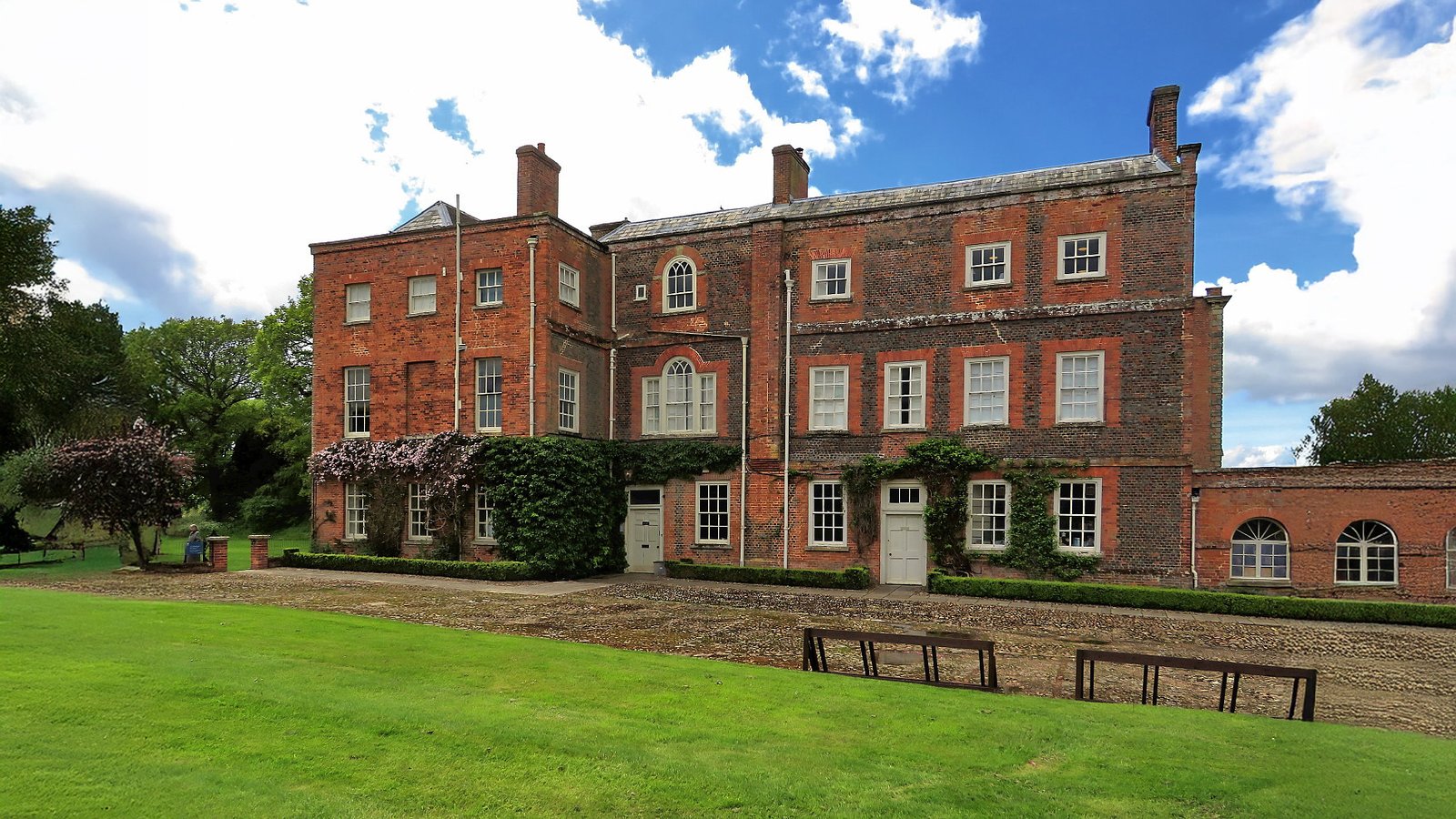
From a distance, Claydon House appears unusually restrained. Its weathered stone front looks symmetrical, dignified and almost modest by stately-home standards. There are no theatrical domes, enormous Corinthian columns or battalions of stone gods posing along the roof. It resembles a respectable Georgian gentleman who has remembered to polish his shoes and avoid discussing money.
Step inside, however, and the gentleman suddenly reveals a passion for dragons, exotic birds, carved foliage, Chinese screens and decorative excess. Claydon’s interiors do not merely abandon restraint. They wave goodbye to it from a gilded balcony.
This contrast gives Claydon House its wonderfully flamboyant identity. The building sits near Middle Claydon in Buckinghamshire, surrounded by peaceful countryside that seems quite unaware of the visual commotion indoors. The Verney family has occupied the estate for more than 400 years, although its involvement with the manor stretches further back. During that time, Claydon has witnessed political ambition, war, financial disaster, architectural experimentation and the determined survival of a family that proved remarkably skilled at losing fortunes and rebuilding them.
The present house largely owes its character to Ralph Verney, 2nd Earl Verney. During the eighteenth century, he wanted a country seat capable of competing with nearby Stowe, one of Britain’s grandest aristocratic estates. This was not a minor refurbishment involving tasteful curtains and a new gravel drive. Ralph imagined a vast mansion with several wings, impressive reception rooms and interiors designed to make visitors reconsider their own social importance.
Architect John Adam, a member of Scotland’s celebrated Adam family, prepared plans for the rebuilding. Work began during the 1750s, but the final result became a complicated collaboration involving different designers and craftsmen. Among them, the most memorable was Luke Lightfoot, an ambitious woodcarver, designer and decorative entrepreneur whose imagination rarely encountered a surface it wished to leave alone.
Lightfoot transformed several rooms into elaborate fantasies. In the Chinese Room, carved pagodas, bells, foliage, figures and fantastical creatures cover the walls. The decoration draws on European ideas about China rather than faithful Chinese design. This style, known as chinoiserie, allowed eighteenth-century Europeans to invent an imaginary East filled with elegant gardens, exotic architecture and conveniently decorative people.
Historical accuracy had little involvement. Visual excitement handled the negotiations. The room reflects an age fascinated by imported porcelain, lacquerware, silk and stories from distant trading networks. Britain’s elite wanted objects that suggested global sophistication, even when they understood very little about the cultures that produced them. Consequently, chinoiserie became less a portrait of China and more a mirror of European fantasy. Claydon offers one of the most extravagant surviving examples.
Nearby, the Saloon follows a different but equally energetic path. Classical figures, trophies, scrolls and foliage compete across its carved surfaces. The effect sits somewhere between a Roman palace, a theatrical stage and an exceptionally ambitious wedding cake. Yet the craftsmanship prevents the room from becoming ridiculous. Lightfoot’s carvings possess extraordinary depth and movement, creating shadows that change as daylight crosses the room.
The North Hall delivers another surprise. Its pale plasterwork includes niches, arches and decorative forms that feel both classical and slightly dreamlike. Elsewhere, doors disguise themselves within walls, carved creatures emerge from foliage and architectural details refuse to behave predictably. Claydon rewards slow looking because almost every surface contains a small performance.
Unfortunately, magnificent taste requires magnificent funding, and Ralph Verney’s finances could not support his ambitions. Building costs combined with unsuccessful investments and expensive political activity. He eventually faced bankruptcy. Parts of the enormous new house remained unfinished, while others had to be demolished.
The Claydon visible today represents only a portion of the intended mansion. Rather than ruining the experience, this failed ambition makes the house more compelling. Claydon is not a perfectly completed monument to aristocratic confidence. It is the beautiful remainder of a dream that became much too expensive.
That story also challenges a familiar myth about stately homes. We often imagine aristocratic estates as stable worlds where wealthy families calmly inherited land, portraits and reliable servants. In reality, many operated like fragile businesses. Agricultural income fluctuated, elections consumed fortunes, marriages affected ownership and one enthusiastic building project could destabilise generations of wealth.
The Verneys experienced more drama than most. During the English Civil War, members of the family supported opposing sides. Sir Edmund Verney served King Charles I and carried the royal standard at the Battle of Edgehill in 1642, where he died. His son Ralph supported Parliament. The disagreement turned national conflict into a family matter, proving that awkward political conversations at dinner existed long before social media.
Claydon’s later history gained a quieter but globally significant figure through Florence Nightingale. Her sister, Parthenope, married Sir Harry Verney in 1858. Nightingale consequently became a frequent visitor and received rooms where she could write, organise campaigns and meet influential people.
Calling Claydon “Florence Nightingale’s home” stretches the truth, although it sometimes appears in simplified descriptions. She never owned the estate and did not live there permanently. Nevertheless, it became an important working refuge. From Claydon, she continued her efforts to reform nursing, military healthcare, sanitation and hospital administration.
This connection changes the atmosphere of the house. Behind its exuberant carvings lies the memory of a woman analysing mortality data and pressing governments to act. She appears in popular culture as the gentle “Lady with the Lamp”, but that sentimental image hides a formidable strategist. Nightingale used evidence, political relationships and relentless correspondence with a level of discipline that could frighten a modern consultancy team.
The family gave Claydon House to the National Trust in 1956, although the Verneys retained close ties to the wider estate. The arrangement created an unusual division. The National Trust cares for the historic house and its principal interiors, while the family continues to run the surrounding Claydon Estate and Courtyard. This helps the place feel less like an isolated museum and more like an evolving country estate.
Claydon’s layered character also makes it a suitable setting for contemporary art. Modern installations can feel intrusive in some historic houses, especially when they compete with architecture, furniture and family history. At Claydon, however, artistic tension already forms part of the building’s identity. Palladian order, rococo carving, chinoiserie fantasy and Victorian domestic life occupy the same space without asking permission from one another.
Critics may still argue that modern work distracts from the historic interiors. Supporters believe it helps visitors notice familiar rooms differently. Claydon provides a convincing case for both sides. The house has never possessed a single, obedient aesthetic identity, so another artistic layer feels less like an invasion and more like a new guest joining an argument that began 250 years ago.
Practical expectations matter when visiting. Claydon is smaller than its history initially suggests because much of Ralph Verney’s intended palace disappeared. Anyone expecting to spend an entire day marching through endless corridors may feel surprised. Yet its concentrated scale works in its favour. Visitors can examine the carvings properly, absorb the Florence Nightingale material and still have time to explore the lawn, church, courtyard businesses and surrounding estate.
Claydon House ultimately succeeds because it refuses to fit the standard stately-home script. Its exterior promises Georgian order, while its rooms celebrate decorative rebellion. It records wealth but also bankruptcy, aristocratic tradition but also radical reform, careful preservation but also artistic experimentation.
Most grand houses want us to admire their perfection. Claydon invites us to enjoy its contradictions. Behind that calm Buckinghamshire façade stands an unfinished palace, a family archive, a carved fantasy and a reminder that flamboyance often survives long after financial common sense has quietly left the building.