Tzimtzum: Why Creation Began with Divine Withdrawal
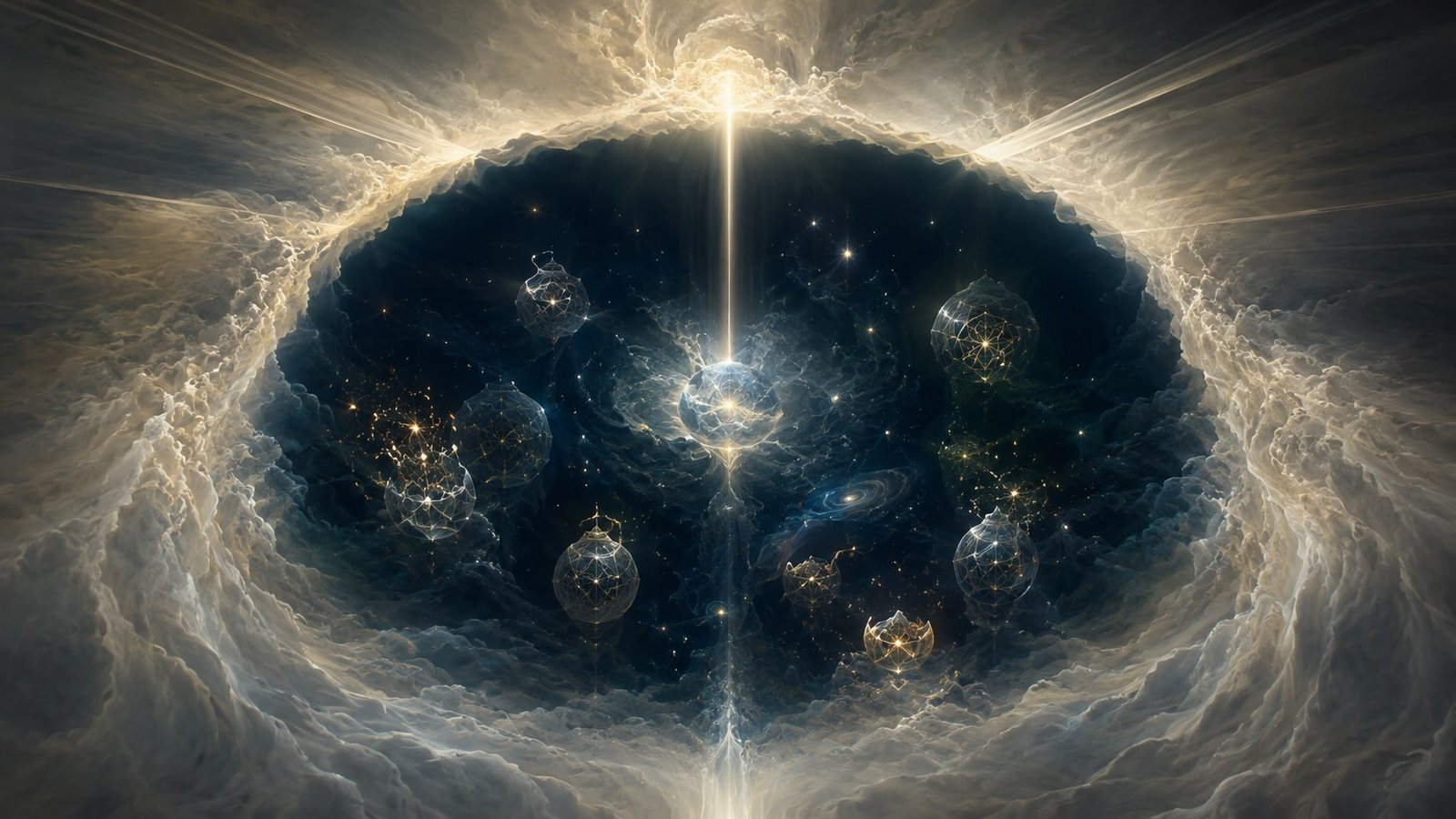
Imagine an infinite divine presence filling absolutely everything. There is no outside, no empty corner and certainly no spare shelf where a universe might sit. Then comes the awkward question: how can anything other than God exist when infinity already occupies the entire metaphysical property? Sixteenth-century Jewish mysticism answered with one of its boldest ideas: tzimtzum, usually translated as contraction, withdrawal or self-limitation.
The concept became central to the teachings associated with Isaac Luria, the influential Kabbalist known as the Ari. Luria lived and taught in Safed, in Ottoman Galilee, during the 1570s. He wrote very little himself, which feels almost mischievous considering how profoundly his ideas shaped Jewish mystical thought. His disciples, especially Hayyim Vital, recorded and organised his teachings. As a result, later generations inherited not a neat theological manual but an elaborate cosmic drama reconstructed from lectures, notes and competing interpretations.
According to the familiar account, before creation there was only the Ein Sof, the Infinite, whose divine light filled all reality. A finite world could not exist independently within that overwhelming presence. It would disappear into infinity like a candle flame in the midday sun, although even that comparison seems unfair to the candle.
The Infinite therefore performed tzimtzum. Divine light contracted or became concealed, creating what the Kabbalists described as a vacant space. Into this apparent emptiness, a measured ray of divine light entered. Worlds, souls, matter and history could now emerge without immediately dissolving back into their source.
This story does not describe creation as a divine construction project. God does not simply assemble planets, oceans, beetles and human beings who argue online. Instead, creation begins through restraint. Something new becomes possible because overwhelming fullness makes room for difference.
That reversal gives tzimtzum much of its emotional power. Human beings often associate strength with expansion, control and visibility. Lurianic Kabbalah suggests another form of power: the ability to withdraw enough for something else to exist. A parent makes room for a child’s independence. A teacher resists answering every question. A leader steps back so colleagues can act. Naturally, none of these people becomes infinite merely by remaining quiet during a meeting, but the comparison still carries practical weight.
However, the idea immediately creates a theological headache. Can an infinite God genuinely withdraw from somewhere? If God is absent from the vacant space, divine infinity no longer seems infinite. Yet if God remains fully present, no real withdrawal occurred. Kabbalah solves problems with remarkable creativity, although it occasionally replaces one mystery with three larger ones.
This paradox produced a long-running debate over whether tzimtzum happened literally. Some Kabbalists argued that divine light truly withdrew in a meaningful sense. Others insisted that the withdrawal only appears real from the perspective of created beings. God did not leave; creation simply lost the ability to perceive divine presence directly.
Hasidic thinkers strongly developed the non-literal interpretation. Shneur Zalman of Liadi, founder of Chabad Hasidism, argued that tzimtzum concealed divine light without changing or removing God. The world experiences itself as separate because the divine source remains hidden. A table appears solid, ordinary and impressively uninterested in theology, yet divine energy continually sustains its existence.
This view turns everyday reality into a kind of carefully maintained illusion, though not an illusion in the sense that nothing matters. The world exists, choices have consequences and tables remain painful when encountered by one’s shin. Nevertheless, apparent independence hides a deeper unity.
Opponents of early Hasidism worried about where such thinking might lead. If God exists equally everywhere, someone might argue that sacred and profane places differ less than religious law suggests. Worse, careless language about universal divinity could blur the line between Creator and creation. The dispute between Hasidic and non-Hasidic Jewish thinkers therefore concerned more than abstract cosmology. It influenced prayer, religious discipline and the way people understood God’s presence in ordinary life.
Even among scholars, the details remain contested. Isaac Luria left no definitive written explanation settling whether the contraction was literal, metaphorical or something beyond both categories. Later interpreters often presented their own reading as the obvious one, a habit not entirely confined to mystics.
Another common misunderstanding treats tzimtzum as an ancient Jewish version of the Big Bang. Both accounts begin with dramatic cosmic language, but the resemblance quickly becomes superficial. The Big Bang belongs to physical cosmology and describes the development of the observable universe from an extremely hot, dense early state. Tzimtzum addresses a metaphysical question: how can finite existence appear within divine infinity? It offers symbolism and theology, not an early draft of astrophysics.
Likewise, the vacant space should not become a literal dark bubble floating somewhere before time. Spatial language allows the human mind to approach an idea that supposedly precedes space itself. Kabbalistic diagrams may depict circles, lines and vessels, but they function more like conceptual maps than photographs of celestial plumbing.
The wider Lurianic story becomes even more dramatic after the contraction. Divine light enters vessels intended to contain it, but some vessels cannot withstand the intensity and shatter. Their fragments fall through creation, carrying trapped sparks of holiness. Human beings participate in tikkun, the repair or rectification of the world, by releasing and elevating those sparks through ethical action, prayer and religious practice.
Creation, in this vision, does not emerge perfectly finished. It begins with limitation, proceeds through catastrophe and leaves repair partly in human hands. That idea may explain why Lurianic Kabbalah proved so compelling. It gives cosmic significance to a familiar experience: the world feels fractured because fracture belongs to its story, yet brokenness does not have the final word.
Modern thinkers have carried tzimtzum far beyond its original mystical setting. Philosophers have used it to discuss divine vulnerability, freedom and responsibility. Some theologians drew on the idea after the Holocaust, asking whether divine self-limitation could help explain a world where terrible human freedom operates without constant supernatural intervention. Such interpretations remain controversial because they can seem to defend God by reducing divine power, while offering little comfort to those who suffered.
Psychologists and relationship writers have also adopted the term. They describe emotional tzimtzum as the practice of creating space for another person rather than dominating every conversation with one’s opinions, advice or fascinating account of a delayed train. The comparison works best when treated as inspiration rather than clinical science. Kabbalah did not secretly invent modern psychotherapy, and every moment of silence does not qualify as cosmic contraction.
Still, the idea offers an unusually practical metaphor. Love sometimes requires presence, but it also requires room. Authority can guide, yet excessive control prevents growth. Creativity needs material, discipline and attention, although it also needs an empty space where something unexpected can appear.
That may be the most striking feature of tzimtzum. Creation begins not with accumulation but with restraint. Infinity expresses power by refusing to overwhelm. Absence becomes a form of presence, concealment allows freedom, and emptiness turns into possibility.
Whether one reads the story literally, symbolically or as a magnificent piece of mystical poetry, it challenges a deeply modern assumption that more visibility, more control and more noise always produce better results. Sometimes the most creative act is not adding another thing. Sometimes it is stepping back, making room and trusting that what emerges may possess a life of its own.