In 1995, scientists at Kew Gardens persuaded a spectacular tropical plant to produce seeds by imitating bats. Their subject was the jade vine, a Philippine climber whose turquoise flowers resemble pieces of coloured glass. Growing the plant was relatively straightforward. Getting it to reproduce required a rather more imaginative approach. The researchers needed to understand how a hungry bat feeds while hanging upside down.
The jade vine, scientifically known as Strongylodon macrobotrys, comes from the tropical rainforests of the Philippines. Locally known as tayabak, it belongs to the pea family. This makes it a relative of runner beans, chickpeas and soya beans. While its agricultural cousins produce useful vegetables, the jade vine has chosen a different career. It produces elaborate cascades of claw-shaped flowers in one of nature’s most unusual colours. Apparently, being a legume does not necessarily require modest ambitions.
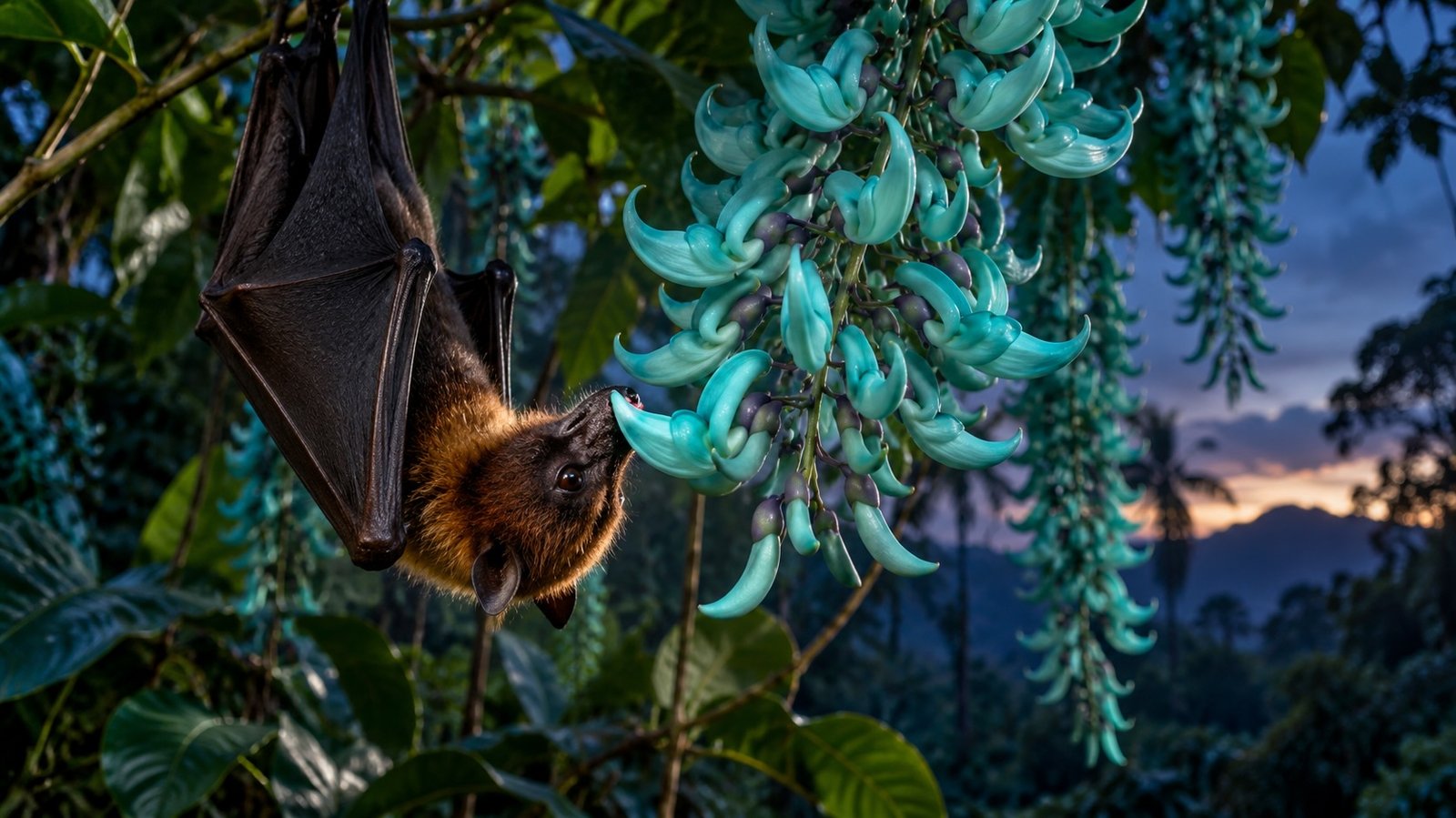
In its natural habitat, the jade vine climbs through the forest using neighbouring trees for support. Its woody stems can grow approximately 18 to 20 metres long. The flowers hang beneath its leafy canopy. A single flowering cluster often approaches a metre in length, while exceptional examples can reach three metres. Each cluster contains numerous curved blossoms resembling bird beaks, hooked claws or carved jade. When several clusters hang together, they create something between a botanical chandelier and an extravagant piece of jewellery.
Yet the most extraordinary feature is undoubtedly the colour. Flowers appear in almost every imaginable shade, but genuine turquoise remains exceptionally uncommon. The jade vine occupies that narrow territory between green and blue, sometimes appearing almost luminous against darker foliage. Its petals can seem pale mint in one light and intensely aquamarine in another. The colour is entirely natural, although photographs sometimes exaggerate its intensity. A flowering jade vine hardly needs image-editing software, unlike certain holiday destinations.
Two plant pigments help explain this unusual appearance: malvin and saponarin. Malvin belongs to the anthocyanin family, which produces many red, purple and blue colours in plants. Saponarin is a flavone compound. Their interaction, together with the slightly alkaline conditions inside petal cells, creates the flower’s characteristic turquoise. It is a fine example of botanical chemistry achieving something that would make a paint manufacturer considerably richer.
The spectacular colour is not necessarily intended for human admiration. In Philippine rainforests, nectar-feeding bats pollinate the flowers. Their hanging clusters and curved structures suit animals capable of manoeuvring beneath them. A visiting bat approaches a blossom and reaches inside for nectar. As it feeds, pollen may settle on its head. When the bat visits another flower, it can transfer that pollen to the reproductive structures. The arrangement is elegant, although the bat is presumably concerned primarily with dinner.
Researchers suspect the blue-green colour helps attract pollinators in the dim rainforest canopy. Yet scientists have not established precisely why this particular shade evolved. Bats perceive their surroundings differently from humans, so their experience of turquoise may differ considerably from ours. The relationship between plant and animal is easier to explain than the flower’s unusual colour preference.
This partnership also creates complications in botanical gardens. A jade vine can flourish inside a tropical glasshouse, covering supports with abundant foliage and producing impressive flowers. But flowering does not guarantee reproduction. Without suitable pollinators, the plant may fail to develop seed pods. Its reproductive biology creates further difficulties because pollen from the same plant may not produce successful fertilisation.
At Kew Gardens, horticultural researchers studied how bats interact with jade vine flowers and developed hand-pollination techniques. In 1995, Chrissie Prychid successfully encouraged a jade vine in the Palm House to produce pods. Kew had not achieved this for more than thirty years. The resulting pods grew so heavy that staff supported them with makeshift string nets. There is something wonderfully British about solving an exotic botanical problem involving tropical bats with careful observation and a little string.
The plant has an equally curious connection with nineteenth-century exploration. American botanist Asa Gray formally described Strongylodon macrobotrys in 1854. Specimens had reached scientists through the United States Exploring Expedition of 1838–1842, an ambitious naval undertaking across the Pacific. The vine subsequently attracted attention as an ornamental plant. By the twentieth century, botanical gardens far beyond the Philippines had begun cultivating it.
Today, visitors can admire the jade vine at several British botanical institutions, including Kew Gardens and Cambridge University Botanic Garden. At Kew, flowering usually occurs between February and May, although growing conditions influence the timing. Cambridge’s Tropical House offers another opportunity to encounter its remarkable blossoms. Checking current flowering reports before travelling is sensible. A tropical climber without flowers remains a respectable plant, but visiting one is rather like attending a fireworks display the following morning.
Growing a jade vine at home is possible, although it makes demands that most British gardens cannot satisfy. It requires warmth, high humidity, strong support and considerable space. The Royal Horticultural Society recommends heated glasshouse conditions, generally above 15°C. The plant prefers moist but well-drained soil and protection from harsh direct sunlight. Given enough encouragement, it can become an enormous woody climber. Anyone considering one for a conservatory should first decide whether the conservatory is prepared to become a tropical rainforest.
Behind its international popularity lies a troubling reality. The jade vine grows naturally in a limited geographical area, particularly the Philippine islands of Luzon, Mindoro and Catanduanes. Deforestation and land conversion have severely damaged its rainforest habitat. Conservation authorities differ in their assessments of the species, but habitat loss presents a clear threat. Botanical gardens help preserve living collections and develop cultivation techniques. Nevertheless, cultivated specimens cannot replace the complex ecological relationships of a tropical forest.
The Philippines has given the jade vine an unusual form of public recognition. Its flowers appear on the reverse of the country’s five-peso coin, celebrating a remarkable native plant. For a species that depends on rainforest trees and animal pollinators, becoming part of everyday currency is an unexpected distinction.
There is a final botanical irony here. A plant whose flowers resemble precious gemstones belongs to the same family as an ordinary garden bean. Its colour depends on unusual chemistry, its reproduction involves bats, and its survival depends on vulnerable rainforests. Meanwhile, scientists have learned to imitate flying mammals, and gardeners have constructed elaborate tropical environments to accommodate its ambitions. The humble pea family, it seems, has at least one member that refuses to behave humbly.