Some flowers are difficult to grow. Others seem personally offended by the suggestion that they should grow where they are planted. The Himalayan blue poppy belongs firmly in the second category. With petals the colour of an impossibly clear summer sky, it looks almost imaginary. Yet this remarkable flower is entirely real. Its journey from remote Himalayan valleys to British gardens involves explorers, mountain expeditions, scientific puzzles and a century of frustrated gardeners.
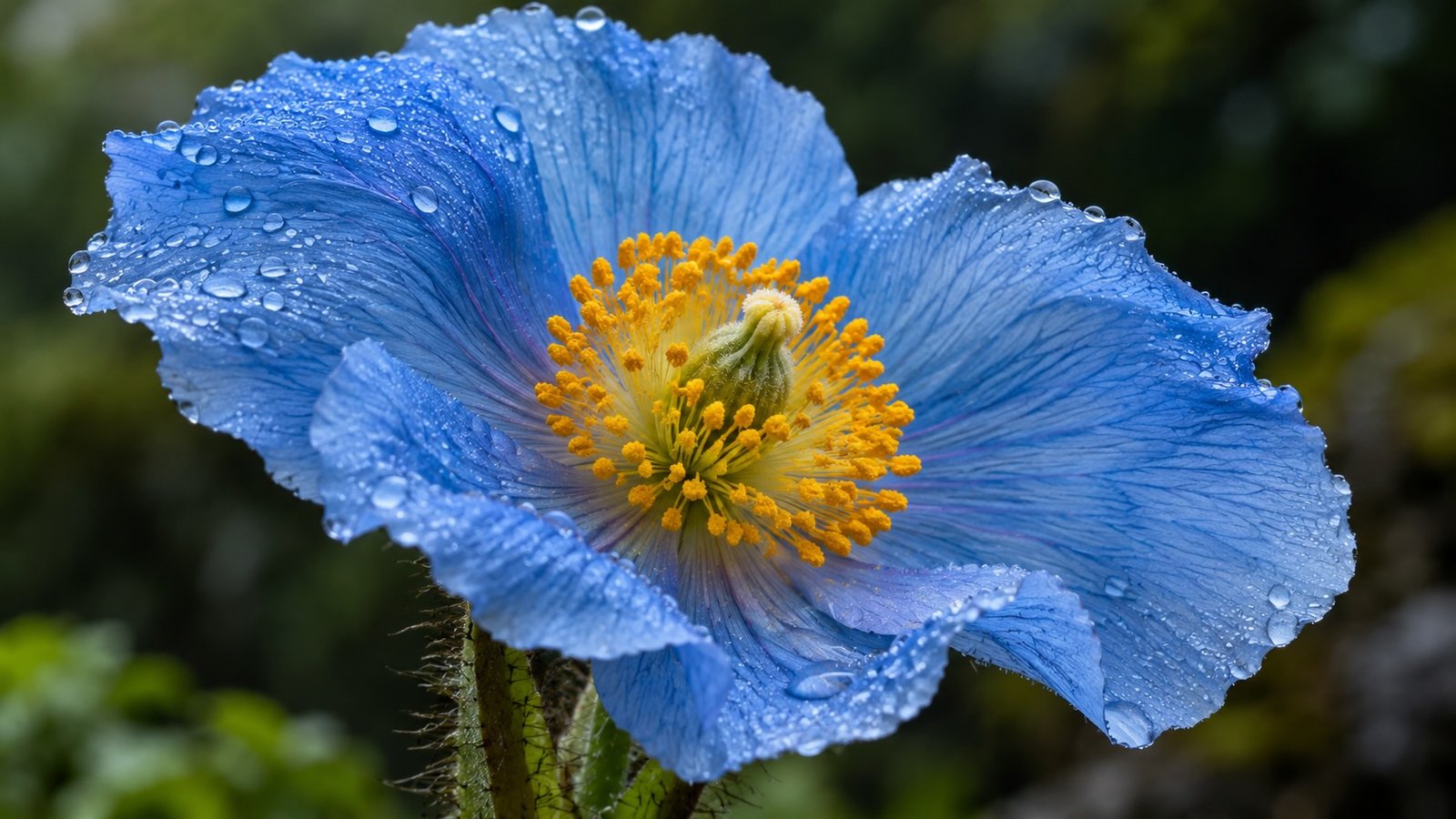
Known botanically as Meconopsis, the Himalayan blue poppy belongs to the same family as familiar red field poppies. The resemblance is obvious in the delicate, papery petals and central cluster of stamens. The colour, however, is another matter. While most poppies favour red, orange, yellow or white, certain Himalayan species produce striking shades of blue. Their golden-yellow centres provide an equally impressive contrast. The best-known garden species, Meconopsis baileyi, produces flowers approximately ten centimetres across. They appear on tall, slightly hairy stems above a rosette of leaves.
The story of how this flower reached Britain belongs to the adventurous, occasionally eccentric age of botanical exploration. In 1913, British officer Frederick Marshman Bailey encountered a tall blue poppy while exploring the Tsangpo region of Tibet. He was travelling with surveyor Henry Morshead. Bailey preserved a specimen, but bringing living plants into cultivation presented another challenge. Botanical collecting then involved difficult mountain journeys, unpredictable weather and considerable dependence on local knowledge. An explorer might return with pressed flowers, a handful of seeds or an entirely unknown species. Occasionally, returning alive was an achievement in itself.
The decisive breakthrough came in 1924, when British plant collector Frank Kingdon-Ward travelled into southeastern Tibet. Bailey helped direct him towards the region where the blue poppy grew. Kingdon-Ward succeeded in collecting its seeds. He was no ordinary weekend gardener. Over his career, he undertook 25 expeditions across Asia, collecting plants that transformed British horticulture. His interests ranged from rhododendrons and lilies to primulas and gentians. Yet the blue poppy became one of his most celebrated prizes. For British gardeners accustomed to relatively restrained flower colours, its arrival caused considerable excitement.
The seeds reached Britain in 1925 and were distributed to gardens capable of cultivating them. At the Royal Botanic Garden Edinburgh, horticulturists helped establish the plants. The flowers attracted widespread attention when displayed in 1926. Botanical artist Lilian Snelling produced an exquisite illustration for Curtis’s Botanical Magazine in 1927. The blue poppy had travelled from a remote mountain valley to a prestigious British botanical publication. Naturally, gardeners now wanted one. Nature, unfortunately, had made other arrangements.
To understand the problem, consider the Himalayan blue poppy’s original habitat. These plants evolved in cool mountain environments with moist summers and moderate temperatures. Their preferred soil contains plenty of decaying vegetation. They appreciate reliable moisture but dislike permanently waterlogged roots. They need light, although fierce sunshine can damage their delicate leaves. Cold winters rarely trouble them, yet prolonged summer heat can prove disastrous. They require a particular combination of conditions that British weather occasionally provides, usually by accident.
Scotland consequently became one of the blue poppy’s favourite adopted homes. Its cool summers, frequent rainfall and woodland gardens offer suitable growing conditions. Northern English gardens can also be successful. Farther south, the plant often behaves like an unwilling guest who has already booked a return journey. A few days of hot, dry weather may cause serious damage. The problem becomes particularly severe when the roots cannot obtain sufficient moisture. A flower that survives winter frost but succumbs to a pleasant June afternoon presents a distinctly British gardening problem.
The flowers themselves conceal an even stranger scientific story. Genuine blue is relatively unusual among flowering plants, and producing it requires sophisticated chemistry. Many blue flowers rely on pigments called anthocyanins. Their appearance changes according to their chemical surroundings. In 2006, Japanese researchers investigated the blue petals of Meconopsis grandis and found an unexpected arrangement. The underlying pigment belonged to the cyanidin family, normally associated with red and purple colours. Its brilliant blue appearance depended on interactions involving other plant compounds and metal ions, particularly iron and magnesium.
The researchers reproduced the flower’s blue colour experimentally under controlled conditions. They combined the relevant pigments, supporting compounds and metal ions. Their results demonstrated that the poppy did not simply possess a special blue pigment. Instead, its colour emerged from chemical relationships within the petal cells. A flower that looks almost artificially coloured relies on remarkably sophisticated natural chemistry. There is something rather amusing about such exquisite blue depending partly on iron, a metal associated with rusty garden tools.
The name Himalayan blue poppy also conceals considerable botanical variety. Meconopsis includes species with yellow, red, pink, purple and white flowers. Some follow an especially uncompromising timetable. They spend years building a substantial rosette of leaves before producing an impressive display. After flowering and setting seed, they die. Botanists call this behaviour monocarpic flowering. Other species, including certain popular blue forms, can survive for several seasons under favourable conditions. Even these may remain frustratingly short-lived. The distinction matters to gardeners who expect expensive acquisitions to survive beyond one successful performance.
There are also differences between the blue poppies available from nurseries. Meconopsis baileyi remains the classic Himalayan blue poppy. It sometimes appears under the older or misapplied name Meconopsis betonicifolia. Garden varieties such as ‘Lingholm’ produce particularly impressive blue flowers and can be raised from seed. Another admired selection, ‘Slieve Donard’, belongs to a sterile group and requires propagation by division. Such distinctions may seem unnecessarily technical. That changes when a gardener attempts to collect seeds from a plant biologically incapable of producing them.
For anyone determined to grow Himalayan blue poppies, the practical advice is reasonably consistent. Choose a sheltered position with partial shade and protection from intense afternoon sunshine. Provide moist, well-drained soil enriched with leaf mould or other organic matter. Never allow the roots to dry out during summer. Spring generally offers suitable planting conditions, while young seedlings require particularly careful handling. The plants dislike drought, waterlogging, intense heat and sudden changes in their environment. Even perfect attention cannot guarantee success. Gardening books politely describe them as challenging. This is horticultural terminology for a plant that may die despite receiving excellent treatment.
Their delicate appearance also disguises an unexpected geographical adaptability. These mountain plants can survive British winters without elaborate protection. Many supposedly robust exotic species demand considerably more attention. The blue poppy’s difficulty lies less in enduring cold than in accepting summer heat. This reverses the usual assumption that mountain plants need protection from Britain’s chilly weather. A Himalayan blue poppy might happily accept a colder January in exchange for a cooler July.
More than a century after Kingdon-Ward’s expedition, Himalayan blue poppies remain among Britain’s most admired garden flowers. They have never become commonplace bedding plants. Their flowering season is brief, successful cultivation depends heavily on local conditions, and their appearance remains improbable. Even the most determined gardener cannot persuade them to abandon their preferences simply because a border would look splendid in blue.
For all the scientific work invested in understanding their pigments, these flowers have preserved a certain independence. Kingdon-Ward managed to transport their seeds across continents. But moving a plant is easier than persuading it to forget where it came from. Somewhere in a damp Scottish garden, beneath a grey summer sky, a Himalayan blue poppy may be perfectly content. Its owner, meanwhile, is probably complaining about the weather.