At first glance, the Boer War sounds like a colonial mismatch so absurd that even a Victorian newspaper editor might have felt embarrassed printing the fixtures. On one side stood the British Empire, owner of maps, fleets, medals, moustaches and an alarming amount of confidence. Facing it stood the Boers, descendants of Dutch-speaking settlers in southern Africa, many of them farmers, horsemen, hunters and stubborn republicans who preferred rifles, wide horizons and being left alone. Britain expected a brisk imperial errand. Instead, it got mud, humiliation, guerrilla warfare, global criticism and a nasty preview of twentieth-century conflict.
The word “Boer” simply means “farmer” in Dutch and Afrikaans, which gives the whole story a misleadingly cosy smell of hay, cattle and homemade bread. These were not gentle allotment enthusiasts arguing over courgettes. The Boers had built two republics inland from the British Cape Colony: the South African Republic, often called the Transvaal, and the Orange Free State. Independence mattered fiercely to them, partly because they had moved away from British rule during the Great Trek of the 1830s and 1840s. Then diamonds and gold entered the picture, because history enjoys adding expensive minerals whenever things are already tense.
Gold changed everything. The Witwatersrand gold rush turned the Transvaal into one of the most economically tempting places on earth. Suddenly, British politicians, mining magnates and imperial dreamers developed a deep philosophical interest in “rights”, “stability” and “good government”, which by happy coincidence aligned beautifully with control over the richest goldfields in the world. The Boers, led in the Transvaal by the bearded and formidable Paul Kruger, suspected Britain wanted their republic whether they behaved nicely or not. They were probably not wrong.
The road to war involved grievances, bad diplomacy and more than one ego large enough to require its own transport arrangements. British settlers and foreign workers in the Transvaal, known as Uitlanders, complained about limited political rights. London presented itself as their champion. Boer leaders saw this as a Trojan horse with a Union Jack painted on the side. After failed negotiations, the Boers issued an ultimatum in October 1899 demanding that British troops withdraw from their borders. Britain refused, and the war began.
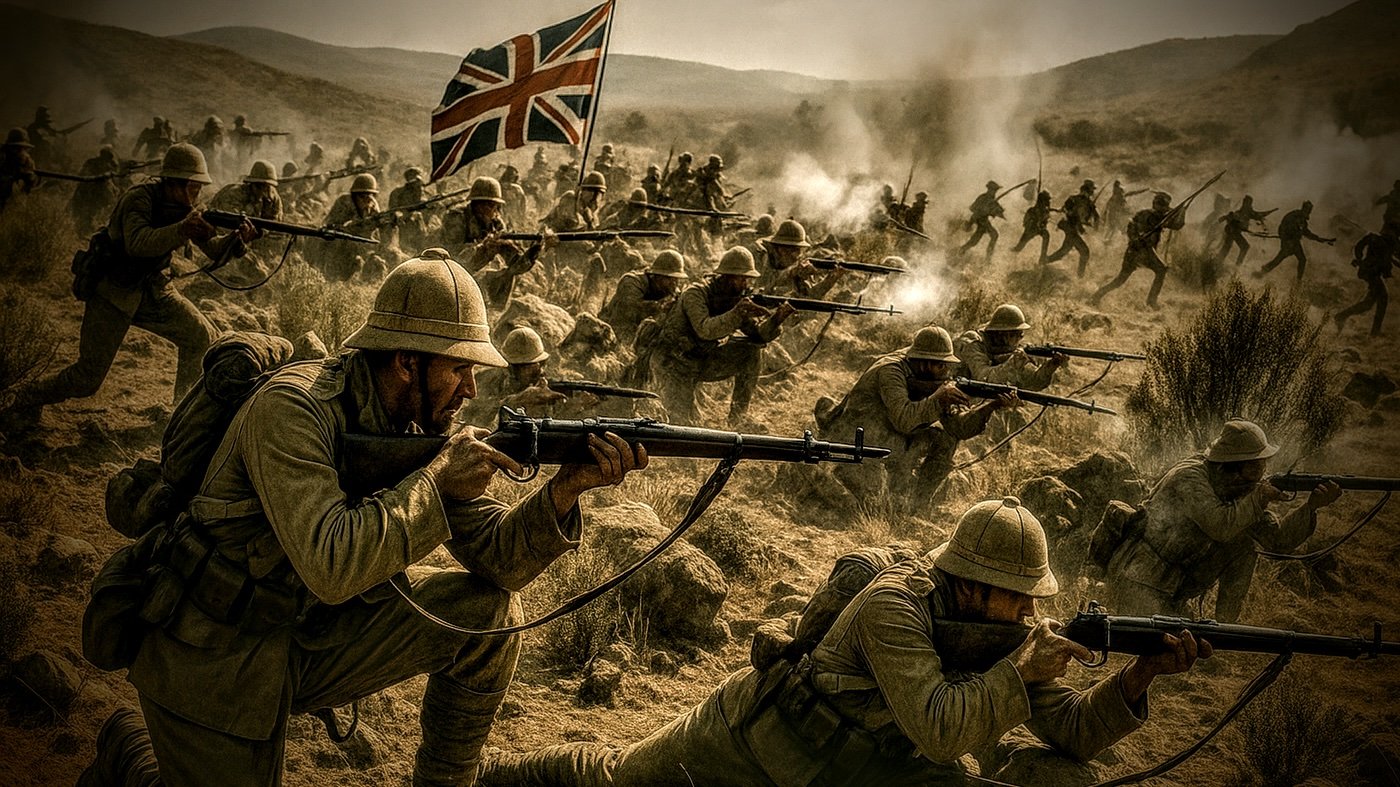
Then came the awkward part for the empire: the farmers could fight. Boer commandos moved fast, shot accurately and knew the land far better than many British officers, some of whom still appeared emotionally attached to the idea that war should be orderly, visible and preferably conducted according to a timetable. Early British reverses shocked the public. During “Black Week” in December 1899, British forces suffered defeats at Stormberg, Magersfontein and Colenso. The imperial machine had not broken, but it had tripped over its own boots in front of everyone.
The Boers did not look like a modern army in the grand European style. Parade-ground glitter held little appeal for them. Many brought their own horses, rifles and supplies. Officers were elected, arguments were common and discipline sometimes looked like a polite suggestion. Yet this loose structure suited their world. They could ride hard, vanish into the veld and reappear where least convenient. A British general might have a staff map. A Boer fighter had memory, instinct and a horse that knew the landscape better than the mapmaker.
Britain eventually responded with overwhelming force. Reinforcements poured in from across the empire, including troops from Canada, Australia, New Zealand and India. Lord Roberts took command and captured Bloemfontein, Johannesburg and Pretoria in 1900. To many British observers, the war seemed nearly over. Capitals had fallen. Flags had changed. Speeches could be polished. Unfortunately for Britain, the Boers had not read the script. Losing cities did not mean losing the war, especially if your army could dissolve into the countryside and continue fighting from farms, ridges and railway lines.
So the war entered its nastiest phase. Boer commandos cut communications, raided supply lines and forced Britain into a frustrating chase across vast distances. The British army, built for battles, now faced a mobile insurgency. Lord Kitchener, who succeeded Roberts, answered with blockhouses, barbed wire, armoured trains, mounted columns and a brutal scorched-earth campaign. Farms burned. Crops disappeared. Livestock were killed or seized. The idea was simple and grim: if Boer fighters depended on civilian support, destroy the support network.
This policy led to the most notorious feature of the war: concentration camps. British authorities placed Boer women and children in camps, along with large numbers of Black Africans in separate camps that long received less attention in popular memory. Officials claimed the system offered protection and control. Reality brought overcrowding, poor sanitation, disease and severe shortages. Thousands died, many of them children. Emily Hobhouse, a British welfare campaigner, exposed the suffering and helped turn the camps into a moral scandal. Back home, critics accused the government of “methods of barbarism”, a phrase that stuck because it had the rare advantage of being both politically useful and largely accurate.
The camps still sit at the centre of Boer War memory. For Afrikaners, they became symbols of martyrdom and British cruelty. For Britain, they exposed the unpleasant truth that liberal empire could behave with savage efficiency when challenged. And for Black South Africans, the war revealed something even more bitter: they suffered, laboured, fought, scouted, transported goods and died, yet both British and Boer narratives often pushed them to the margins. The conflict was frequently described as a “white man’s war”, but that phrase hides more than it explains. Black communities lost land, livelihoods and lives while two white powers fought over sovereignty in a country neither had created alone.
Myths cling to the Boer War like old medals in a drawer. One claims the Boers were merely simple freedom-loving farmers defending home and hearth. That contains truth, but not the whole truth. Boer society rested on racial hierarchy and restricted political rights. Another myth presents Britain as fighting only for justice and Uitlander rights. The argument sounds noble until the goldfields walk into the room, jingling loudly. A third myth treats the war as a minor imperial sideshow. In reality, it shook British confidence, exposed military weaknesses and influenced debates about army reform, national fitness and imperial responsibility.
Strange cultural ripples followed. The war boosted the fame of war correspondents, stirred patriotic songs, inspired adventure stories and gave Britain a new kind of public argument about empire. Baden-Powell’s defence of Mafeking turned him into a celebrity and later fed into the creation of the Scout movement. The phrase “to maffick”, meaning to celebrate wildly, came from the public frenzy after Mafeking was relieved. Nothing says empire quite like inventing a verb because people got too excited in the street.
Peace came with the Treaty of Vereeniging on 31 May 1902. The Boer republics accepted British sovereignty, but Britain promised reconstruction funds and eventual self-government. That final detail matters. The Boers lost the war, then regained much influence within a British-controlled South Africa. In 1910, the Union of South Africa brought the former Boer republics and British colonies together. Black South Africans, however, did not receive equal political rights. Reconciliation between British and Boer elites helped build a state that soon entrenched racial exclusion more deeply.
That is why the Boer War remains so uncomfortable. It can look like David versus Goliath, and in military terms it often was. Farmers on horseback embarrassed the largest empire on earth. Yet it was not a clean morality play. The Boers fought for independence, but not for universal freedom. Britain claimed civilisation, then burned farms and filled camps. Both sides spoke of rights while most of the population remained outside the political bargain.