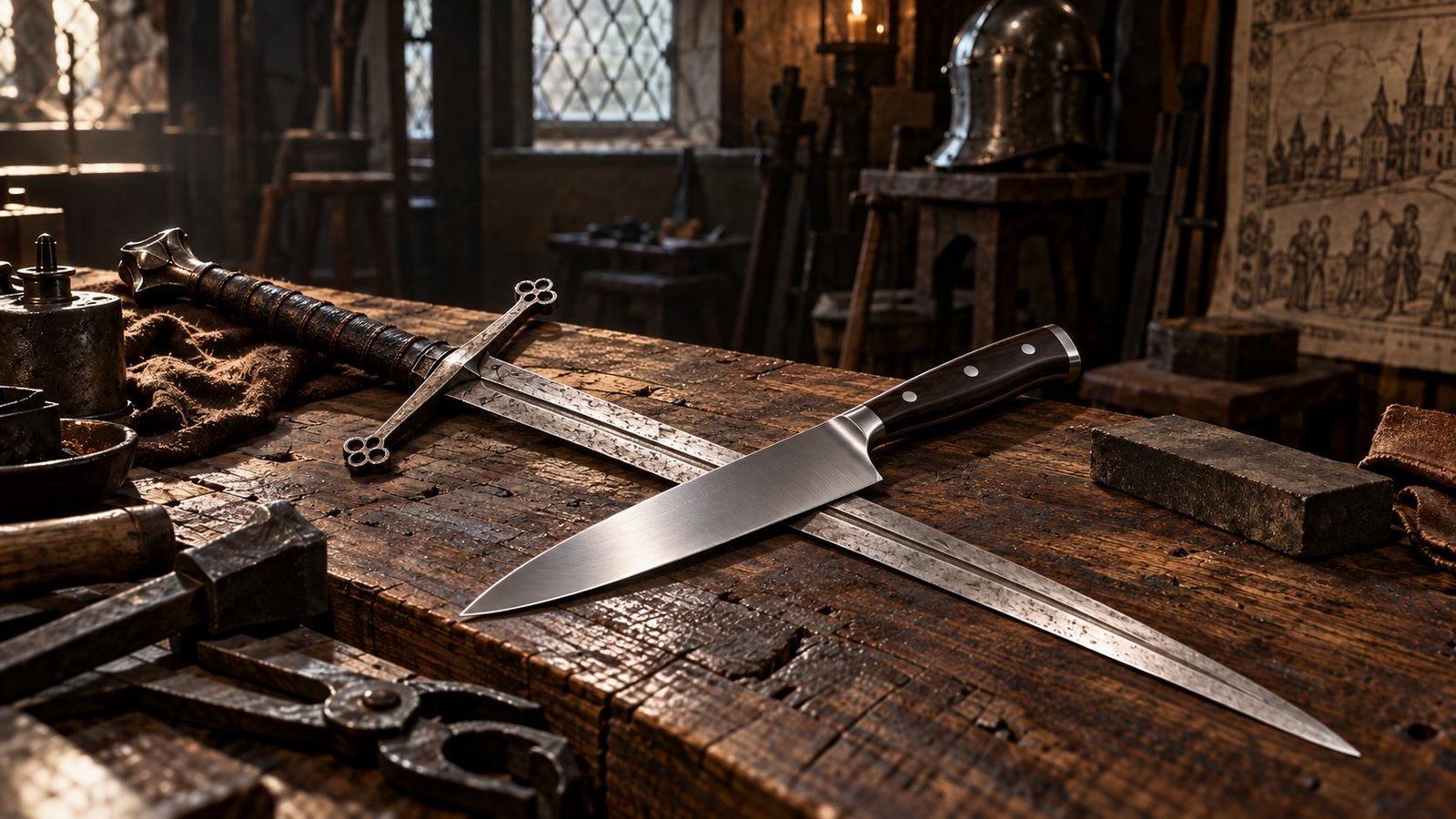
For centuries, the name Solingen has appeared on objects designed to do two rather different things: kill people and prepare their dinner. Medieval swords, military sabres, kitchen knives, surgical instruments and delicate manicure scissors have all helped turn this German town into one of the world’s most recognisable centres of blade-making. Few places have built such an enduring international reputation around a single industrial speciality. Sheffield has its steel, Murano its glass and Limoges its porcelain. Solingen has spent hundreds of years making things sharp, and doing so rather well.
Situated in North Rhine-Westphalia, east of Düsseldorf, Solingen occupies the wooded hills of the Bergisches Land region. Its official designation, Klingenstadt Solingen, means the City of Blades, a title formally adopted in 2012. The name might suggest a medieval fortress populated by sword-wielding knights, but the real explanation involves something considerably less romantic: geography, water, specialised labour and a remarkably effective system of manufacturing. Solingen’s industrial success began long before anyone thought of putting a factory logo on a kitchen knife.
The region’s metalworking traditions developed during the Middle Ages, with blade production firmly established by the fourteenth century. The surrounding forests supplied charcoal for furnaces, while streams flowing through the valleys provided the energy needed to operate grinding wheels and other machinery. Iron and steel could be obtained through regional and wider trading networks. These advantages allowed generations of craftsmen to specialise in forging, hardening, grinding and polishing blades. Rather than one enormous workshop producing everything, Solingen developed a network of independent specialists, each contributing a particular skill to the finished product.
This division of labour became one of the city’s greatest strengths. A sword blade might pass between several craftsmen before reaching its purchaser. Forgers shaped the steel, grinders established the cutting edges, polishers finished the surfaces, and other specialists supplied handles and fittings. Merchants coordinated production and arranged sales. The arrangement resembled a factory distributed across an entire town, with water-powered workshops scattered along the valleys. It also meant that expertise could accumulate over generations, sometimes within the same families. Long before industrial management consultants began recommending specialised supply chains, Solingen had developed one with hammers, grinding wheels and considerably fewer PowerPoint presentations.
By the sixteenth and seventeenth centuries, Solingen blades enjoyed a substantial reputation beyond Germany. Sword makers supplied European markets, and their products circulated through military, commercial and diplomatic networks. Some blades bore inscriptions identifying their place of manufacture, including the Latin phrase Me fecit Solingen, meaning ‘Solingen made me’. The wording gave the weapon something approaching a personal voice, although its owner was probably more interested in how effectively it performed than in its conversational abilities.
One particularly curious feature of this trade was the relationship between manufacturing reputation and authenticity. Solingen’s name became commercially valuable, encouraging imitation and the use of misleading markings. The running wolf, or Passauer Wolf, associated originally with Passau blade-making, also appeared on blades connected with Solingen. Marks travelled, changed and acquired meanings that were not always straightforward. A sword carrying a famous symbol was not necessarily manufactured where a modern collector might assume. The problem sounds suspiciously contemporary: once a name commands a premium, somebody will find a way to borrow it.
The city’s fortunes also reflected Europe’s changing appetite for weapons. During the early modern period, swords remained essential military equipment, but the development of firearms gradually transformed warfare and reduced the sword’s practical importance. Solingen’s craftsmen adapted rather than abandoning their skills. Knives, razors, scissors and other cutting instruments offered growing markets, while military blades continued to generate orders. The transition was not instantaneous, nor did swords disappear from the battlefield overnight. Instead, the town diversified into products that required much the same expertise in metallurgy and precision finishing.
The nineteenth century brought a more dramatic transformation. Industrialisation gradually replaced many traditional production methods with mechanised manufacturing. Steam-powered grinding shops appeared around the middle of the century, while the decades after German unification in 1871 witnessed substantial factory expansion. Companies such as Zwilling J. A. Henckels helped develop new methods of forging and manufacturing. Solingen was no longer simply a collection of craftsmen producing expensive blades by hand. It became a major industrial centre capable of supplying large markets with increasingly standardised products.
There was a price for progress. Traditional grinders worked in difficult and often dangerous conditions. Grinding generated fine particles that could damage the lungs, while accidents involving high-speed wheels posed serious risks. The romantic image of the solitary craftsman producing a perfect sword tends to overlook the occupational hazards of spending a working life beside industrial machinery. Solingen’s prosperity depended not only on technical ingenuity but also on generations of physically demanding labour.
The town’s commercial success eventually created a problem familiar to producers of prestigious goods: how could buyers distinguish genuine Solingen products from cheaper imitations? Germany addressed this through legislation protecting the geographical designation. The Solingen name acquired a legally regulated status for qualifying cutlery products, linking commercial claims to manufacturing requirements in the recognised production area. It is not simply a decorative word that any knife manufacturer can print on a blade. This distinction matters because the reputation of Solingen depends on the place of manufacture, not merely on a German-sounding brand name.
Modern Solingen still produces knives, scissors, razors and specialist blades, although its industrial structure has changed substantially. Global competition, automation and shifts in manufacturing have reduced the importance of traditional blade-making employment. Some historic firms have disappeared, others have relocated parts of their production, and surviving manufacturers operate in markets where craftsmanship, design and industrial efficiency must coexist. A premium kitchen knife may still emerge from a Solingen workshop, but the city is no longer an industrial community organised almost entirely around the production of cutting tools.
Its history remains visible in the German Blade Museum, housed in a former Augustinian monastery in the Gräfrath district. The collection stretches from ancient weapons to modern cutlery, showing how blades have shaped warfare, cooking, medicine, personal grooming and ceremonial life. A permanent exhibition opened in December 2024 under the title Me Fecit Solingen – Blades: City: History, examining the city’s development from medieval workshops into an internationally recognised manufacturing centre. The museum also reveals a curious contradiction: some of the most elaborate blades were never intended for serious cutting. Ceremonial swords and decorative weapons could demonstrate wealth, craftsmanship and status without ever being used in combat.
Solingen’s identity extends beyond its factories. The historic district of Gräfrath preserves a different architectural atmosphere from the industrial areas, while the surrounding Wupper valley contains reminders of the water-powered economy that helped establish the town’s prosperity. Nearby, the Müngsten Bridge carries a railway high above the valley, offering an imposing example of nineteenth-century German engineering. Schloss Burg, the reconstructed medieval castle overlooking the Wupper, adds a more conventional historical attraction to a region whose greatest contribution to European history was often produced in modest workshops rather than royal halls.
There is something unusual about a town whose name has become a guarantee of quality without necessarily becoming a household destination. Millions of people may have encountered Solingen through a pair of scissors or a kitchen knife without knowing precisely where it lies. Its reputation travelled farther than many of its craftsmen ever did. A medieval sword-maker might find modern manufacturing technology bewildering, but the principle behind the city’s success would be entirely familiar: a good blade requires the right steel, careful workmanship and an edge that does exactly what its maker intended. After seven centuries, Solingen is still selling the same essential promise, even if its customers are now rather more likely to be chopping onions than confronting an armoured opponent.