King Michael of Romania: The Boy King Who Defied Hitler and Lost His Crown
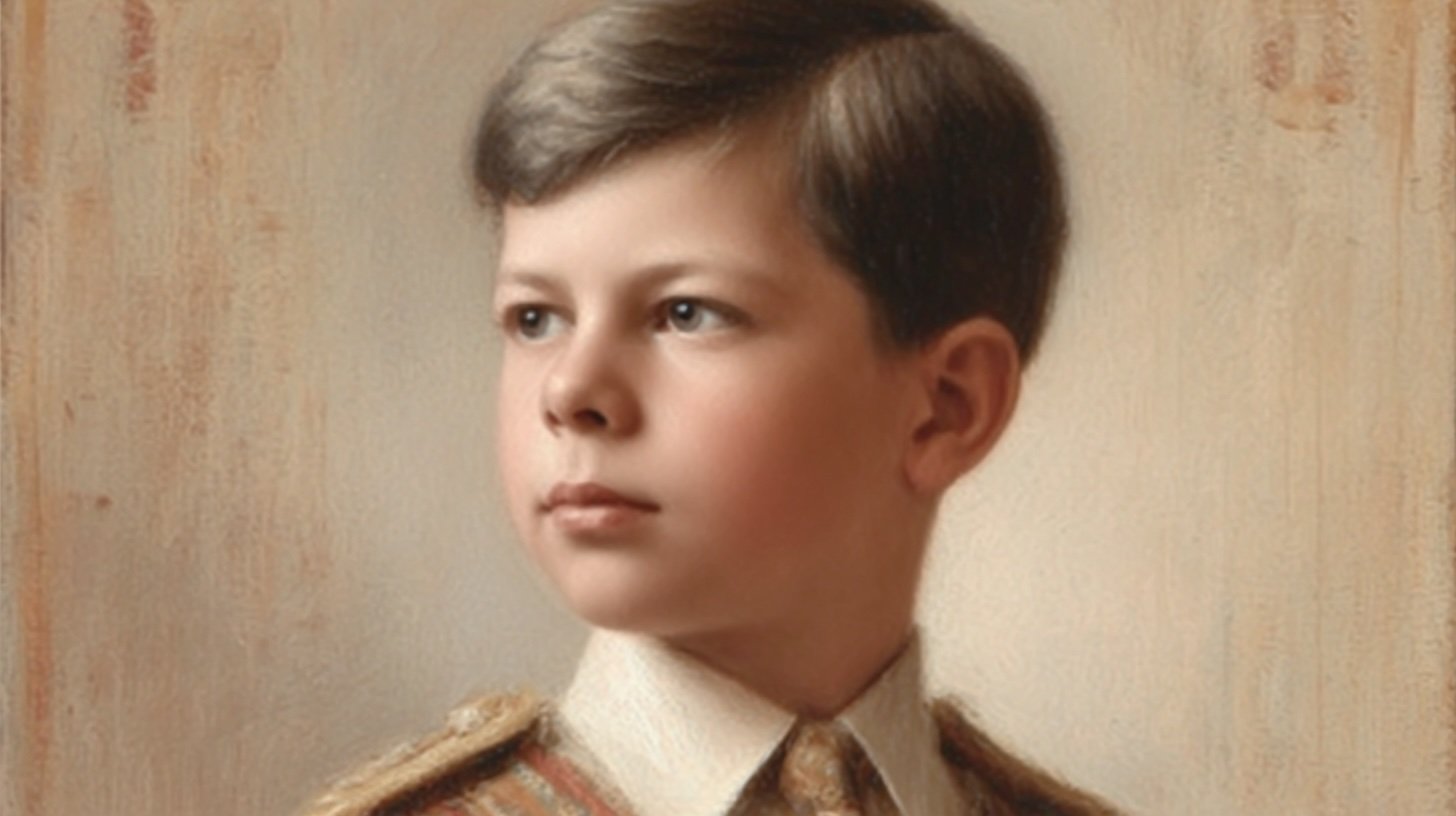
Some monarchs inherit peaceful kingdoms, wave from balconies and spend decades opening hospitals. King Michael of Romania received a rather less comfortable assignment. He became king as a child, lost his throne to his own father, regained it during a dictatorship, arrested his country’s authoritarian ruler, turned Romania against Nazi Germany and then watched the Soviet-backed communists abolish the monarchy. He managed all this before his twenty-seventh birthday. Most people of that age struggle to choose a sensible pension scheme.
Michael was born on 25 October 1921 at Peleș Castle in Sinaia, the mountain residence of Romania’s royal family. His father, Crown Prince Carol, possessed charm, expensive tastes and a remarkable ability to turn his private life into a national emergency. Carol abandoned his royal duties and left Romania with his mistress, Elena Lupescu. Consequently, when King Ferdinand died in 1927, five-year-old Michael inherited the throne.
A regency governed on his behalf because allowing a small boy to run the country seemed unwise, even by the flexible standards of European monarchy. Michael’s first reign lasted only three years. In 1930, Carol returned, displaced his son and became King Carol II. The former child monarch received the specially invented title of Grand Voivode of Alba Iulia, which sounded magnificent but did not compensate for having one’s crown taken away by one’s father.
Michael’s relationship with Carol remained distant. His parents had divorced, his mother lived largely abroad, and court life surrounded him with ceremony rather than warmth. He developed an interest in cars, engines and aircraft, perhaps because machines followed understandable rules. Romanian politics certainly did not.
Carol II established an increasingly authoritarian regime during the 1930s. Meanwhile, fascism grew, the violent Iron Guard gained influence and Romania found itself trapped between Nazi Germany and the Soviet Union. In 1940, the country lost large territories to its neighbours. Public anger became overwhelming, and General Ion Antonescu forced Carol to abdicate.
At eighteen, Michael became king again. Yet the crown came without meaningful power. Antonescu styled himself the Conducător, ruled as a military dictator and aligned Romania with Hitler. Michael performed ceremonies while ministers made decisions. He later described himself as little more than a decorative seal placed on documents he had not shaped.
Romania joined the invasion of the Soviet Union in 1941, partly to recover Bessarabia and northern Bukovina, territories seized by Moscow the previous year. Romanian forces then continued beyond those lands, fighting as far as Stalingrad. Antonescu’s government also participated in the Holocaust. Romanian authorities deported and murdered Jews and Roma, particularly in Bessarabia, Bukovina and Transnistria. Estimates vary, but hundreds of thousands died under Romanian administration.
Michael’s precise ability to influence events remains controversial. Admirers portray him as a young constitutional monarch imprisoned by a dictatorship. Critics argue that the royal household remained part of the state and cannot sit entirely outside its crimes. Both views contain uncomfortable truths. He lacked executive power, yet he occupied the throne and appeared at official events. History rarely offers spotless roles, especially when a king reigns under a marshal allied to Hitler.
By 1944, Germany was losing the war, Soviet troops were approaching Romania and Antonescu still hesitated to leave the Axis. Michael began working with opposition politicians, military officers and representatives of several parties, including the communists. Their plan carried enormous risks. German forces remained in Romania, Antonescu controlled the state, and failure could have ended with the king facing a firing squad rather than a future series of commemorative stamps.
On 23 August 1944, Michael summoned Antonescu to the royal palace. He asked him to seek an immediate armistice. Antonescu refused to commit himself, so Michael gave the agreed signal. Soldiers entered the room, arrested the dictator and reportedly confined him in a palace safe room normally used for storing postage stamps. It was an oddly modest prison for one of Europe’s most powerful military rulers.
That evening, Michael addressed the nation by radio and announced Romania’s break with Germany. Romanian forces turned against their former ally and joined the Allied war effort. Germany responded by bombing Bucharest and attempting to reverse the coup, but Romanian troops resisted.
Supporters later claimed that Michael shortened the European war by six months and saved hundreds of thousands of lives. Those exact figures remain disputed because history does not provide a spare version of events for comparison. Nevertheless, the coup deprived Germany of Romanian oil, opened a new route for Soviet forces and forced the Wehrmacht to confront another hostile front. Michael, still only twenty-two, had taken a decision that many older and louder leaders had avoided.
The Allies rewarded him. The Soviet Union awarded him the Order of Victory, its highest military decoration, while American President Harry Truman granted him the Legion of Merit. Stalin’s admiration, however, had practical limits. Soviet troops occupied Romania, and Moscow intended to reshape the country.
Communists gradually captured the police, ministries and armed forces. In March 1945, Soviet pressure forced Michael to appoint Petru Groza as prime minister. The king attempted what became known as the “royal strike”, refusing to sign government decrees. Western governments offered sympathy, which proved less useful than troops.
Romania’s opposition parties faced intimidation, arrests and manipulated elections. By late 1947, the monarchy remained the last visible institution not fully controlled by the communists. It therefore had all the long-term prospects of a porcelain vase at a hammer-testing convention.
On 30 December 1947, Groza and Communist leader Gheorghe Gheorghiu-Dej summoned Michael to Bucharest. The king later said that troops surrounded the palace and that Groza threatened to execute hundreds, perhaps a thousand, imprisoned young people unless he abdicated. Groza reportedly displayed a pistol and joked that he did not wish to share Antonescu’s fate.
Michael signed the abdication document. Within hours, parliament proclaimed the Romanian People’s Republic. The new authorities confiscated royal property and eventually stripped the former king of his citizenship. Communist propaganda claimed that he had voluntarily abandoned Romania while carrying away immense riches. Michael insisted that coercion made the abdication legally invalid.
Stories about the royal train became part of the mythology. Some claimed that Michael departed with carriages full of gold, paintings and treasures. Evidence for the more extravagant versions remains weak. However, disputes over royal artworks did not disappear. Romania has pursued claims involving paintings once held in the royal collection, arguing that they belonged to the Crown or the state rather than Michael personally. The arguments combine law, inheritance, communist confiscation and historical resentment in one impressively tangled parcel.
Exile offered little grandeur. Michael married Princess Anne of Bourbon-Parma in 1948, and they raised five daughters. The family lived in Britain and later Switzerland. He worked as a test pilot, ran a chicken farm and became involved in electronics and stockbroking. A man who had received Stalin’s highest military order now worried about invoices, machinery and school fees.
After Nicolae Ceaușescu’s communist dictatorship collapsed in 1989, Michael tried to return home. The new Romanian authorities initially treated him as a political threat. In 1990, officials stopped him, escorted him towards the airport and expelled him. Two years later, the government allowed him to visit for Easter. Hundreds of thousands of people gathered in Bucharest to see him, which apparently reminded the political leadership why it had been nervous.
Romania restored his citizenship in 1997. Michael did not lead a serious campaign to recover the throne. Instead, he supported Romania’s entry into NATO and the European Union, using his contacts with European royal families and Western leaders. In 2011, aged ninety, he addressed the Romanian parliament for the first time since 1947. He spoke not of revenge but of duty, democracy and institutions.
King Michael died in Switzerland on 5 December 2017, aged ninety-six. Romania gave him a state funeral, and enormous crowds lined the streets. The country that had once expelled him now mourned him as a link to a lost, complicated past.
Was he a heroic king who rescued Romania from Hitler? In August 1944, he certainly showed extraordinary courage. Was he powerless during the years of dictatorship and persecution? Largely, though not so completely that every moral question disappears. Could he have saved the monarchy? Almost certainly not. Once Stalin controlled Romania and the Western Allies accepted Soviet dominance in the region, a young king with no army of his own possessed very few cards.
Michael’s life resists the comfortable fairy-tale treatment often given to royalty. He wore a crown twice but rarely controlled events. His boldest action helped liberate his country from one dictatorship, only to make way for another. Exile turned a head of state into an ordinary working father, while old age transformed an apparent historical loser into a symbol of dignity.
Perhaps that explains his lasting appeal. Michael did not restore an empire, win a civil war or deliver theatrical speeches from a palace balcony. He simply acted when action became unavoidable, lost when resistance became impossible and refused to pretend that coercion meant consent. For a quiet king surrounded by dictators, that was no small achievement.