London in 1746 was not an obvious substitute for Venice. One city offered glittering canals, marble palaces and gondolas sliding through theatrical sunlight. The other offered muddy riverbanks, coal smoke, unfinished bridges and weather that could turn a blue sky into damp grey porridge before lunch. Canaletto came anyway.
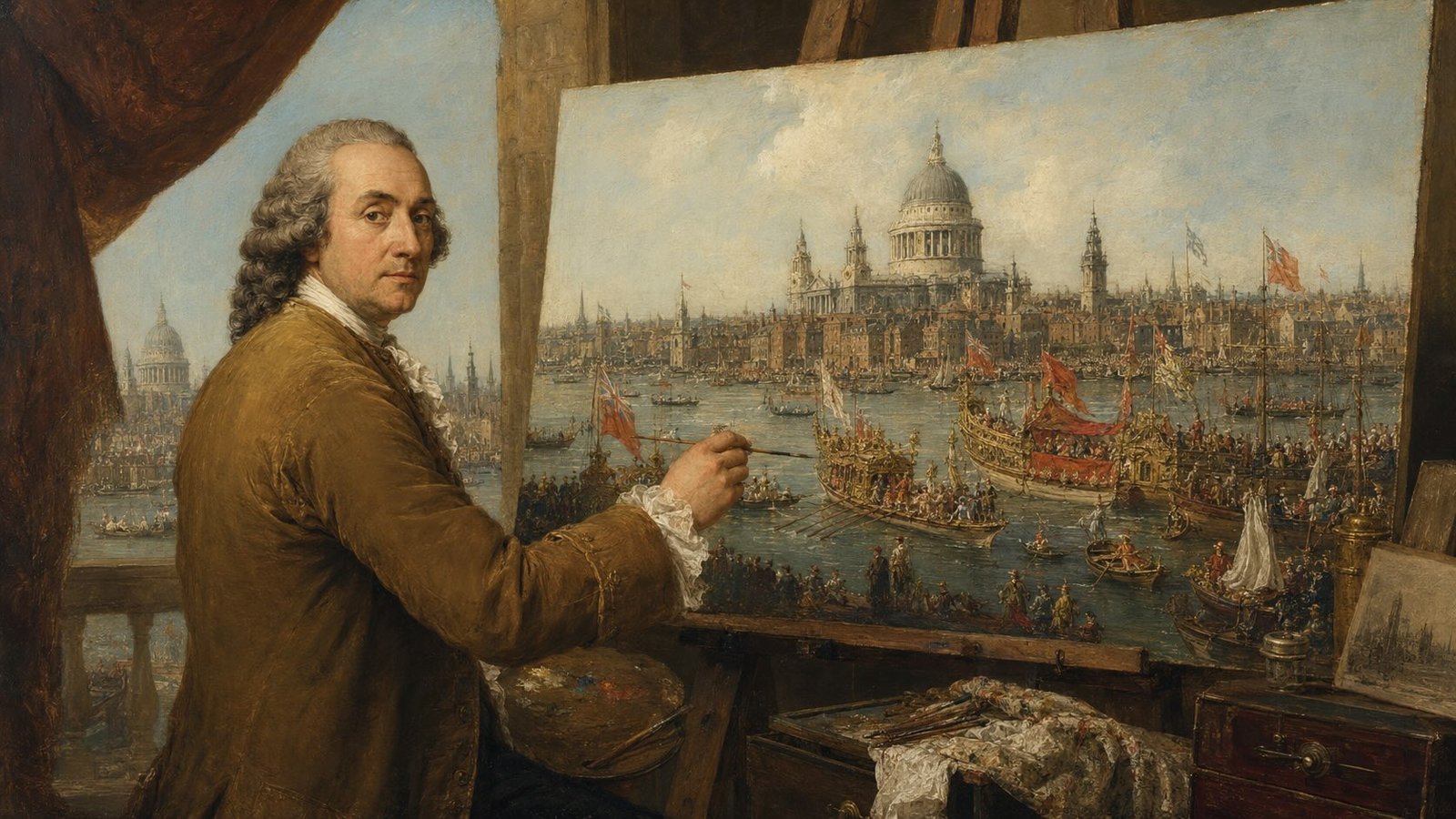
Giovanni Antonio Canal, better known as Canaletto, had already built an international reputation by painting Venice for wealthy visitors. British aristocrats adored his sweeping urban views and bought them as elegant souvenirs of the Grand Tour. Yet the War of the Austrian Succession disrupted travel to Italy and reduced the flow of customers. Rather than wait in Venice for Britain’s collectors to return, Canaletto travelled to Britain in 1746 and remained there, with some interruptions, until 1755.
It was an unusually practical decision for an artist whose paintings often look like dreams. Canaletto followed the market, crossed Europe and began selling Georgian Britain back to the British.
Canaletto specialised in the veduta, a highly detailed city view that combined recognisable architecture with careful perspective, atmospheric light and lively human activity. He did not simply record buildings. Instead, he turned cities into performances.
His family background helped. Canaletto’s father painted theatrical scenery, and the son inherited an instinct for staging space. Roads, rivers and squares often behave like enormous theatre sets in his pictures. Buildings frame the action, distant landmarks pull the eye towards the horizon, while tiny figures supply movement and scale.
In London, the Thames replaced the Grand Canal. Barges took the role of gondolas, St Paul’s Cathedral became a grand focal point, and Westminster Bridge offered the sort of architectural drama that Canaletto understood immediately.
The bridge mattered because it represented the city London believed it was becoming. Construction had begun in 1739, and the bridge opened in 1750, creating the first permanent Thames crossing in central London since London Bridge. Canaletto painted it repeatedly, sometimes while it was still under construction and later as a gleaming symbol of progress.
Naturally, he improved the experience. Canaletto cared about recognisable reality, but he did not behave like a surveyor with a paintbrush. He shifted viewpoints, adjusted proportions and reorganised buildings when the composition demanded it. Georgian London appears accurate enough to trust and polished enough to flatter.
Canaletto understood that the Thames served as London’s main road, commercial artery and ceremonial stage. His river paintings teem with passenger boats, working vessels, ceremonial barges and fashionable spectators. Modern London often turns its back on the river. Canaletto’s London faces it directly.
One of his grandest English works shows the Thames during the Lord Mayor’s Day celebrations. The annual ceremony marked the inauguration of the new Lord Mayor of London, and its river procession offered Canaletto something wonderfully close to a Venetian state pageant.
In The River Thames with St Paul’s Cathedral on Lord Mayor’s Day, decorated barges and crowded boats spread across the water while St Paul’s dominates the skyline. The spectacle celebrates civic authority, commercial success and public confidence. London’s merchants were effectively announcing that they could provide grandeur without borrowing a king’s crown.
The comparison with Venice would not have escaped Canaletto’s audience. Venice had the Bucintoro, the magnificent ceremonial barge used by the doge. London had the Lord Mayor’s procession, liveried companies and enough flags to make subtlety surrender completely.
However, Canaletto’s river scenes also include ordinary life. Small boats cross between larger vessels. Workers handle cargo. People gather along the banks. The pageantry matters, but so does the practical city underneath it.
Canaletto’s Westminster looks strangely familiar and wonderfully alien. Westminster Abbey appears, but the present Houses of Parliament do not. The medieval Palace of Westminster still stood beside the Thames, decades before the fire of 1834 destroyed most of it. Big Ben, needless to say, had not yet entered the skyline.
His views preserve buildings, river stairs, gardens and embankments that later disappeared. York Water Gate, now stranded in Victoria Embankment Gardens, once opened directly onto the river. In Canaletto’s paintings, it still belongs to an active waterfront rather than sitting inland like an architectural ornament that missed its boat.
Yet these pictures cannot serve as perfectly literal historical photographs. In his late English painting of Eton College, for example, architectural inaccuracies suggest that he may have relied on earlier sketches and altered the scene during composition.
That does not make the work dishonest. It reveals how Canaletto interpreted a place. He painted the city’s structure, status and mood, not every drainpipe in its legally correct position.
Canaletto did not remain beside the Thames. Wealthy patrons invited him to paint their estates, and his English career expanded into a visual tour of aristocratic Britain.
He painted Warwick Castle from several viewpoints, transforming the medieval fortress into an orderly landscape of towers, lawns, courtyards and carefully placed figures. He also painted Badminton House in Gloucestershire, Northumberland House in London and other private properties connected with powerful families.
These commissions served several purposes. They recorded architectural improvements, celebrated landownership and turned family estates into objects of cultural prestige. A Canaletto above the fireplace told visitors that the owner possessed an impressive house, excellent taste and sufficient influence to attract Europe’s most famous painter of city views.
Country-house painting also required a slight adjustment. Venice naturally provided theatrical architecture and reflective water. An English estate could offer a broad lawn, a distant façade and several sheep showing no interest whatsoever in artistic reputation.
Canaletto solved the problem through scale and composition. Carriages move across open ground. Riders, servants and visitors animate the scene. Trees frame the architecture. The house becomes the centre of a private kingdom, while the landscape suggests control, prosperity and permanence.
Of course, many English landowners were busy rebuilding, extending and redesigning their houses. The permanence sometimes arrived only shortly before the painter.
Not everyone admired Canaletto’s British work. Some critics considered the English paintings colder and more repetitive than his Venetian scenes. The artist George Vertue even recorded rumours that the man working in London might not be the famous Canaletto at all.
Canaletto responded with what amounts to an eighteenth-century authenticity campaign. He advertised that gentlemen could inspect a new painting at his studio and judge his work for themselves. The episode shows that disputes over attribution, reputation and suspiciously productive artists existed long before online marketplaces and digitally generated Venetian sunsets.
The criticism was not entirely absurd. London’s climate and architecture demanded a different palette. English commissions could also become formulaic, especially when patrons expected familiar Canaletto effects applied to their own bridge or mansion.
Still, his finest British pictures possess a distinctive character. The light feels cooler. The spaces often seem broader and calmer. Venice crowds the eye with architecture; England gives buildings room to pose.
Canaletto returned to Venice in 1755, leaving behind a remarkable visual record of Britain during a period of expansion and self-confidence. His English paintings document new infrastructure, commercial ambition, aristocratic wealth and public ritual. They also show London before Victorian rebuilding transformed its riverfront and skyline.
More importantly, Canaletto gave Georgian Britain the visual language it wanted. He presented London as a European capital worthy of the same attention as Venice. The Thames became majestic, Westminster became theatrical, and country houses appeared as polished centres of civilisation.
His paintings remain valuable precisely because they sit between record and invention. They show what Britain looked like, but also how Britain wished to appear: prosperous, orderly, modern and magnificently lit.
Georgian London probably contained more smoke, rubbish, shouting and unpleasant smells than Canaletto chose to include. Yet that was never the whole point. He did not paint the city as a pedestrian experienced it on a wet Tuesday. He painted the city as it imagined itself on its best day, with the flags out, the bridge finished and the clouds behaving for once.