Inemuri: The Japanese Art of Falling Asleep in Public
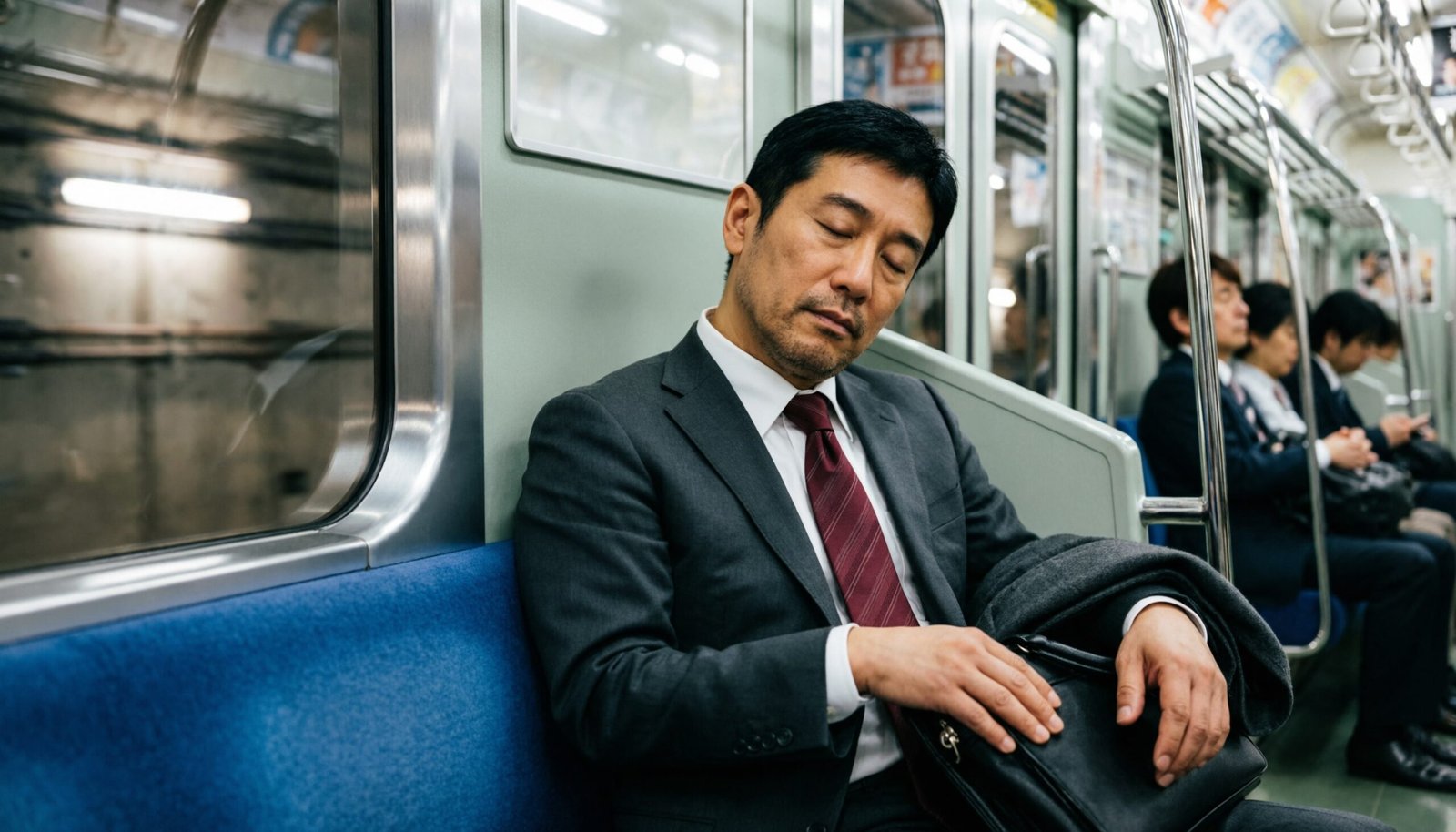
You’re in a Monday morning meeting. The slides are bleeding into one another, your third coffee has betrayed you completely, and the person two chairs down has their eyes gently closed, head tipped forward at a dignified angle, clearly asleep. In Britain, there’d be a panicked whisper, a sharp nudge, possibly a HR memo by Thursday. In Japan, nobody would bat an eyelid, in fact, they might quietly respect the person for it. The Japanese even have a specific word for this state — inemuri (居眠り), which translates as “sleep while being present.” Not a nap, but a culturally recognised, socially nuanced, and occasionally admired practice — and once you understand it properly, the envy kicks in hard.
In a society renowned for its work ethic, inemuri signals dedication and hard work, suggesting that someone has pushed themselves to the absolute limit — often for the benefit of their professional life. So while the rest of the world tiptoes to the loo for a three-minute eye-close against the cubicle wall, the Japanese have built an entire cultural framework around the idea that dropping off in public is basically a medal of honour. Brilliant, frankly.
The story of how inemuri became part of Japanese life is less romantic than it sounds, mind you. Dr Brigitte Steger, a senior lecturer on Modern Japanese Society at the University of Cambridge, first encountered the practice in the late 1980s, during Japan’s economic boom, when the common salaryman would strive to be the first to arrive and the last to leave — spending less time sleeping and more time at work or socialising with colleagues over drinks and dinners. The result was a nation quietly and collectively exhausted, but too committed to the cause to simply go home and have a proper lie-down. Almost 40% of Japanese people sleep fewer than six hours a night — less than their counterparts in other developed economies. Inemuri, then, is less a wellness trend and more a civilised workaround for a country that forgot how to switch off.
That said, it would be too easy — and frankly too Western — to dismiss it as sleep deprivation with good PR. According to Steger, inemuri functions more like a subordinate involvement which can be indulged in as long as it does not disturb the social situation at hand — similar to daydreaming. Even though the sleeper might be mentally away, they must be able to return to the situation when active contribution is required, maintaining the impression of fitting in through body posture, body language, and dress code. So you’re not just asleep — you’re available. On standby. Like a phone screen that’s gone dark but hasn’t switched off entirely. That distinction, which sounds absurd until you’ve experienced the particular relief of a seven-minute train snooze, is genuinely important.
There are rules, naturally. Because this is Japan, and Japan does not do things without rules. You must not borrow the shoulder of the person next to you. When sleeping on the train, tilt your head vertically — downward is preferred, since showing everyone your sleeping face is apparently a bit embarrassing. Resting your head on a table is acceptable, but sleeping on the floor beneath it absolutely is not. Bringing an actual pillow or sleeping bag is right out. The unspoken code: yes, you may sleep, but do try not to make it look as though you’ve completely given up on society.
The social hierarchy applies here too, which makes the whole thing even more fascinating. “If you are new in the company and have to show how actively you are involved, you cannot sleep,” says Steger. “But if you are 40 or 50 years old and it is not directly your main topic, you can sleep. The higher up the social ladder you are, the more you can sleep.” Senior executives dozing through meetings while junior staff sit bolt upright, blinking furiously — turns out that’s not chaos, it’s an ancient and finely calibrated social contract. Somehow that makes it better and worse simultaneously.
One of the more persistent myths about inemuri is that it glorifies overwork — that it’s essentially a cultural excuse to grind people down while framing their exhaustion as admirable dedication. There’s genuine weight to that critique. Japan holds some of the highest rates of work-related stress, and the average number of hours slept per night sits among the lowest in the world, with working days that can be genuinely punishing. Critics argue that normalising public sleep as a badge of hard work makes it harder to challenge the brutal hours culture responsible for the sleep debt in the first place. In that reading, inemuri is less a superpower and more a pressure valve — stopping the whole system from exploding without anyone having to ask why the pressure built up to begin with.
Still, the rest of the world is slowly catching up to at least part of the logic. Google, Apple, Nike, and the Huffington Post now provide dedicated napping rooms and sleeping pods for employees during office hours. Meanwhile, sleep researchers suggest that somewhere between ten and twenty-five minutes is the sweet spot for a restorative nap — long enough to recharge, short enough to avoid waking up not knowing what decade you’re in.
What makes inemuri genuinely interesting, beyond the novelty factor, is what it reveals about the relationship between rest, presence, and how we perform being human at work. In most Western cultures, sleep is private, domestic, and kept firmly behind closed doors. Rest happens at home, in the dark, away from anyone who might judge you. Japan’s approach challenges that assumption entirely, integrating micro-rest into public life in a way that Western framings of sleep simply don’t account for. The idea that you can be physically present, socially available, and also resting — all at the same time — is a remarkably nuanced view of how human attention actually works.
So next time you’re on the 7:43 from Maidstone East, eyes sandpaper-heavy and commute-battered, consider this: somewhere on the Tokyo Metro, a senior manager is peacefully asleep in a suit, head inclined at precisely the correct angle, handbag firmly under their chin, and everyone around them is thinking there goes someone who works really hard. Meanwhile, you’re panic-scrolling your phone to stay awake and feeling vaguely guilty about it. Japan might just be onto something.