Do Dolphins Use Names? What Researchers Actually Found
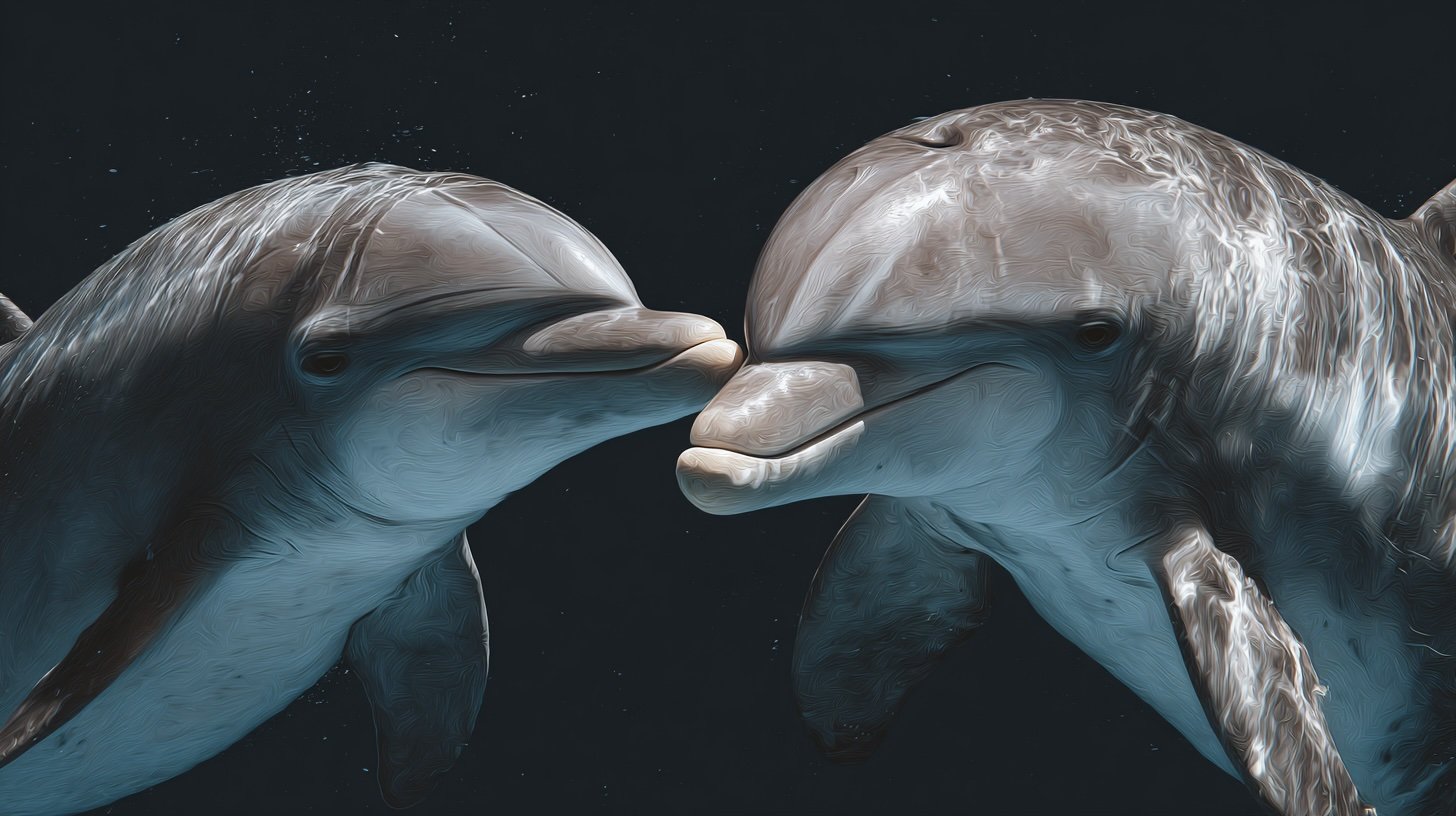
It usually starts with a sound you would miss if you were not listening for it. A quick, looping whistle, almost playful, the sort of thing you might dismiss as background noise in a nature documentary. Then another one answers, not quite identical but close enough to feel deliberate. Two dolphins adjust course, close the distance, and carry on as if nothing particularly remarkable just happened. Except, of course, it might have been the equivalent of calling out someone’s name across a crowded room.
For a long time, scientists resisted that interpretation. Dolphins have always attracted a certain level of narrative exaggeration. They are friendly, photogenic, and just mysterious enough to invite projection. So when early researchers noticed that individual dolphins seemed to repeat specific whistle patterns, the instinct was to explain it away as habit or emotional expression. Still, the pattern refused to go away. The same individuals kept producing the same whistles, not occasionally but consistently, almost stubbornly.
The turning point came when researchers began focusing on the bottlenose dolphin, a species that has an unfortunate habit of being smarter than expected in controlled experiments. Work that began with Melba Caldwell and David Caldwell in the 1960s hinted that these whistles might carry identity information. At the time, it was an intriguing idea rather than a conclusion. Fast forward a few decades, and the tools improved, the recordings sharpened, and the questions became far more pointed.
At the University of St Andrews, a team led by Stephanie King and Vincent Janik decided to test the idea in a way that left little room for interpretation. They recorded what are now known as “signature whistles”, stripped away the individual voice characteristics, and played them back underwater. If these sounds functioned like names, dolphins should react when they heard their own. And they did, quite reliably. They approached the source, responded vocally, and showed clear recognition. When they heard other whistles, especially unfamiliar ones, the enthusiasm disappeared.
It sounds almost straightforward when summarised like that, but it took years of careful work to get there. Dolphins are not cooperative participants in neat laboratory setups. They move, they improvise, and they rarely behave exactly as expected. Yet across multiple trials, the pattern held. Each dolphin appeared to possess a stable, individually distinctive whistle that others could learn, remember, and reproduce.
That last part complicates things in a way that feels oddly human. Dolphins do not just broadcast their own whistles. They can imitate the signature whistle of another individual with surprising precision. Not randomly, not constantly, but in specific contexts, particularly when separated or attempting to reconnect. The effect is difficult to ignore. One dolphin produces the whistle associated with another, and the other responds. It looks less like noise and more like targeted communication.
Then comes the detail that pushes the whole story into slightly uncomfortable territory. Dolphins can remember these whistles for more than twenty years. Not vaguely, not approximately, but well enough to recognise and respond to individuals they have not encountered in decades. That level of long-term social memory is rare enough to stand out even among highly intelligent animals. Humans manage it, elephants manage it, and dolphins seem to have joined the same rather exclusive club.
At this point, it becomes tempting to declare the case closed. Dolphins have names, end of story. Except it is not quite that simple, and scientists, being scientists, have spent a good deal of time arguing about exactly how far the comparison should go. A human name is an arbitrary label. There is nothing inherently “John” about a person called John. Dolphin whistles, on the other hand, are shaped during early development and may carry traces of vocal learning and environmental influence. They sit somewhere between a label and a vocal fingerprint.
That distinction matters because it changes how we interpret what is happening. Some researchers argue that these whistles are simply advanced contact calls, a way of maintaining group cohesion in an environment where visibility is limited. The ocean is not exactly designed for face recognition at a distance. Sound travels better, faster, and further. A distinctive whistle could be a practical solution rather than a conceptual leap into naming.
Others push back, pointing out that the behaviour goes beyond simple location signalling. Dolphins do not just repeat their own whistle when they are lost. They reproduce the whistle of a specific individual, and they do so selectively. That suggests intent. It suggests that the whistle refers to that individual, not just to a general state of being present. Somewhere in that exchange lies the difference between “I am here” and “Where are you, specifically?”
Naturally, the moment dolphins enter the conversation, myths gather like spectators. One persistent idea suggests that dolphins possess a fully developed language, complete with hidden grammar and meaning, waiting patiently for humans to decode it. It is an appealing thought, but the evidence does not support it. Dolphin communication is complex, yes, but complexity alone does not equal language. There is no clear sign of syntax, no structure that resembles the layered organisation found in human speech.
Another popular claim elevates dolphins to near-human intelligence across the board. That, too, overshoots the mark. Dolphins excel in social cognition and acoustic processing. They navigate relationships, recognise individuals, and remember them for extraordinary lengths of time. That does not mean they are writing philosophy in their spare time. Intelligence is not a single scale, and dolphins occupy a very specific, very impressive corner of it.
Still, even after trimming away the exaggeration, what remains is difficult to dismiss. Dolphins operate with a system that allows individuals to maintain identity through sound alone. They develop unique signals early in life, retain them with remarkable consistency, and use them in ways that appear deliberate and socially meaningful. In a fluid social structure where groups split and reform constantly, that system becomes more than interesting. It becomes essential.
There are smaller details that make the whole picture feel even more textured. Young dolphins seem to shape their signature whistles during their first year, sometimes influenced by the sounds around them. It is not simple imitation, but it is not entirely independent creation either. In captivity, some dolphins adjust their whistles slightly over time, particularly when their social environment changes. The comparison to human nicknames feels almost unavoidable, even if it is not perfect.
And so the question lingers, slightly rephrased. Not whether dolphins use names in the human sense, but whether they have arrived at something functionally similar through an entirely different route. The answer, inconveniently tidy, is yes and no at the same time. No, they do not have names as abstract symbols detached from sound. Yes, they use stable, individual-specific signals that others recognise, remember, and deploy to address them.
Once you accept that, the ocean sounds different. Those whistles stop feeling like decorative noise and start to carry a hint of structure. A pod becomes less of a blur and more of a network, each individual marked by a distinct acoustic identity. You begin to imagine not conversations exactly, but exchanges that carry intention, memory, and recognition.
It is not language as we know it. It does not need to be. It achieves something just as intriguing in its own way. It allows dolphins to remain individuals in a world where everything moves, shifts, and disappears from view. And occasionally, it allows one of them to call out, quite precisely, to another.
Not bad for a sound that most of us would never notice.