In AD 33, the Roman emperor Tiberius tackled a credit crisis with a measure that sounds suspiciously modern. As lenders demanded repayment and desperate borrowers sold property into a falling market, he made 100 million sesterces available for interest-free loans. The emperor usually remembered for sinister pleasures on Capri could also organise a financial rescue. Neither activity fits comfortably beside the other, which makes him rather harder to understand than the traditional portrait of an elderly monster suggests.
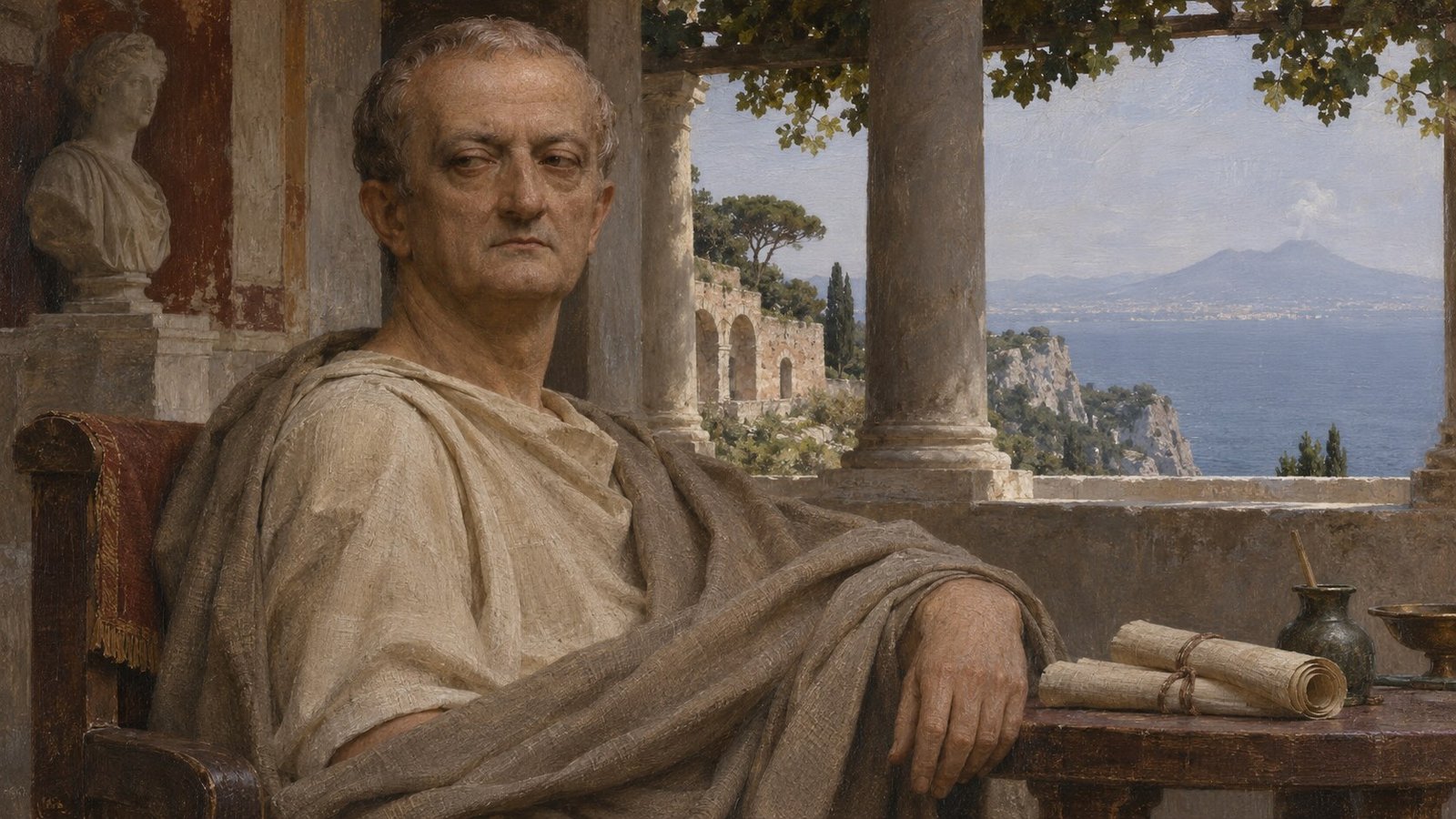
Tiberius ruled from AD 14 to 37, succeeding Augustus as Rome’s second emperor. He inherited an awkward arrangement: one man possessed overwhelming power while the Senate continued to conduct business as though the republic still functioned. Augustus had managed this contradiction with patience, prestige and considerable theatrical skill. Tiberius had military experience, administrative ability and little apparent enthusiasm for the performance. He wanted senators to exercise judgement, yet his presence made independent judgement hazardous. A room full of powerful men therefore spent much of its time trying to establish what he wanted before pretending they had thought of it themselves.
His private life had already demonstrated how thoroughly imperial politics could overrule personal wishes. In 11 BC, Augustus required him to divorce Vipsania Agrippina and marry the emperor’s daughter Julia. The marriage strengthened the ruling family’s arrangements, which offered limited consolation to the people involved. According to the later biographer Suetonius, Tiberius remained deeply attached to Vipsania. When he encountered her afterwards, he followed her with such an openly distressed gaze that arrangements prevented further meetings. The episode deserves the caution appropriate to a later literary account. Even so, it gives a different shape to a man generally remembered for inspiring fear rather than experiencing unhappiness.
Nor had he spent his early adulthood waiting decoratively beside the throne. Tiberius commanded armies in the Alps, the Balkans and Germany, earning a reputation for capable, careful leadership. When he succeeded Augustus at fifty-five, he brought decades of practical experience to the job. His accession followed the deaths of younger candidates whom Augustus had promoted, rather than a simple lifelong designation as heir. Rome acquired an experienced ruler, but experience did not make the relationship between emperor and aristocracy comfortable. Knowing how government worked offered no guarantee that he would enjoy governing the people who considered themselves entitled to help.
The difficulty ran deeper than an unfortunate personality. An emperor could invite frank advice, but nobody could safely forget that he remained emperor afterwards. Tiberius’s reserve encouraged people to search for concealed meanings, while flattery irritated him without necessarily making honesty safer. His critics interpreted hesitation as deception and restraint as temporarily suppressed cruelty. Such readings could become impossible to disprove: good behaviour merely demonstrated how successfully he concealed his true character. That does not establish his innocence. It does explain why accounts of his reign sometimes resemble a prosecution in which even favourable evidence assists the prosecution.
In AD 26, Tiberius left Rome; he subsequently settled on Capri and never returned to the capital. The island offered distance, privacy and defensible approaches, alongside views that required no senatorial approval. Yet withdrawal did not amount to abdication. Decisions, petitions and instructions continued to travel between the emperor and the mainland. The surviving remains of Villa Jovis suggest the substantial establishment required to support imperial life there. Its cisterns, service quarters, baths and private accommodation belong to an organised residence, rather than the solitary hiding place that the word “retreat” can suggest.
Distance also increased the influence of anyone who controlled access. Sejanus, commander of the Praetorian Guard, became dangerously powerful as an intermediary between Tiberius and political life in Rome. His position helped him advance allies and threaten rivals, including members of the imperial family. In AD 31, Tiberius turned against him. An imperial letter delivered to the Senate brought his downfall, and execution followed that day. The destruction of Sejanus did not end the violence. Investigations and punishments spread through his connections, making a previous friendship potentially fatal. Whatever uncertainty surrounds his precise ambitions, the consequences of his rise and fall were brutally tangible.
This is where rehabilitation reaches its limits. Doubting scandalous anecdotes does not make the treason prosecutions disappear. Informers exploited suspicion, senators attacked one another, and members of the ruling family suffered imprisonment and death. Tiberius sometimes restrained accusations, but he also authorised or encouraged repression. His absence could magnify insecurity rather than relieve it. An emperor did not need to attend every proceeding to bear responsibility for the political conditions under which it occurred. Competence in provincial administration or public finance could coexist with cruelty towards people thought to threaten his position.
The lurid stories about Capri require a different judgement. Suetonius, writing decades after Tiberius’s death, describes sexual abuse and elaborate depravity. These allegations have shaped the emperor’s reputation ever since, but they are not independently verified records of daily life. Roman writers repeatedly used sexual misconduct to characterise bad rulers, presenting private excess as evidence of public unfitness. A remote imperial household provided fertile ground for rumours. The responsible response is neither to repeat every accusation as established fact nor to declare all of them false. The evidence cannot support either certainty.
Meanwhile, the supposedly disengaged emperor still intervened when Rome’s financial machinery seized up. The rescue of AD 33 supplied three-year interest-free loans against substantial landed security. Comparing it directly with a modern central bank would stretch the resemblance, but the underlying problem feels familiar: forced sales depressed prices, weakening borrowers further. Tiberius could recognise a practical emergency even while presiding over a poisonous political atmosphere. When he died in AD 37, Caligula succeeded him. Posterity largely retained the island scandals and executions. The loans attracted fewer storytellers, perhaps because a properly secured credit facility has always struggled to compete with a wicked emperor.