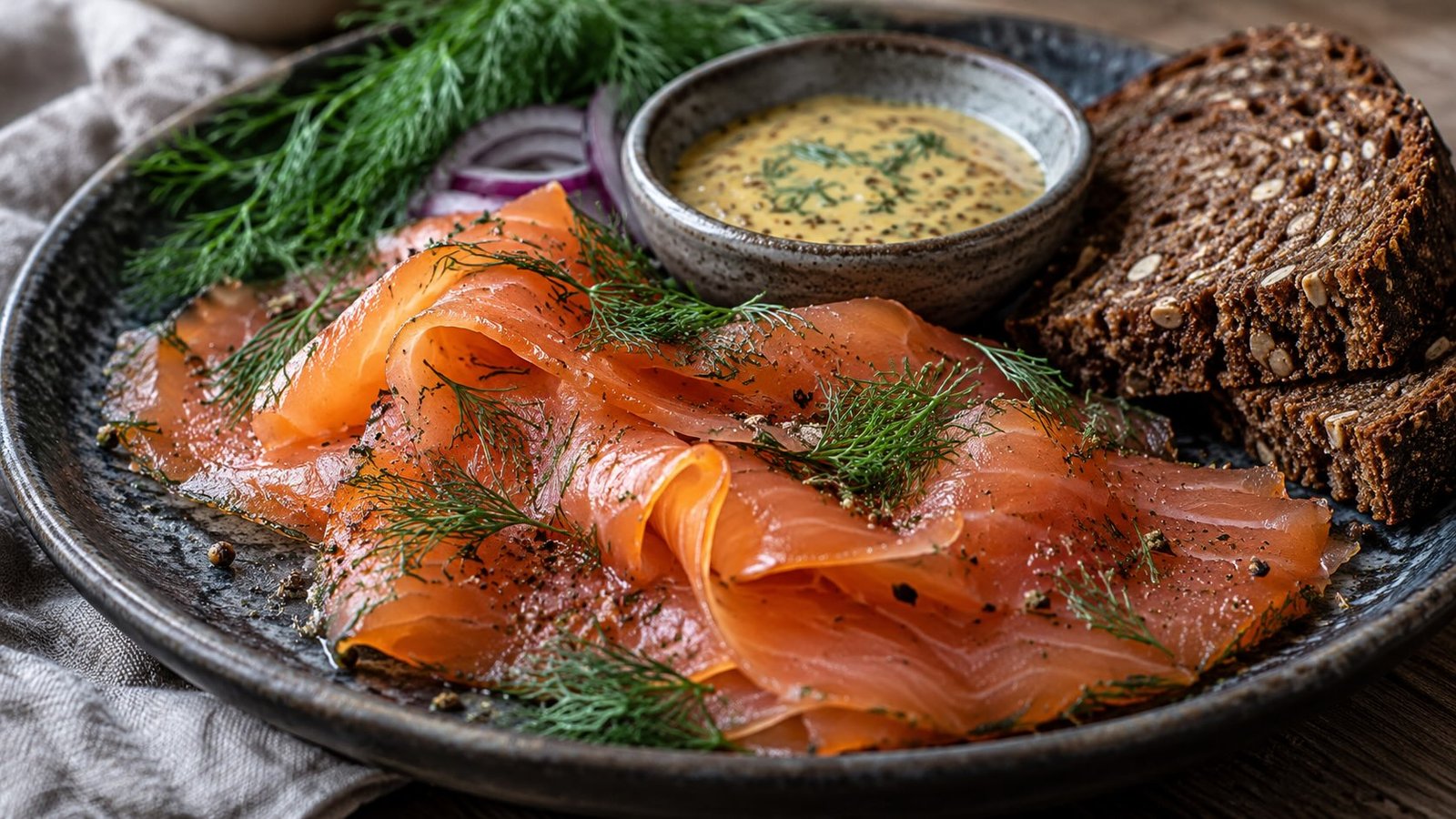
The delicate slices of salmon served with fresh dill and mustard sauce in Scandinavian restaurants have a rather earthy past. Gravlax, now associated with elegant starters and Christmas tables, began as fish buried in the ground. Medieval fishermen had no refrigerators, limited supplies of salt and an inconvenient problem: what to do when the catch was larger than anyone could eat. Their solution involved digging a hole, adding a little salt and letting nature take over. The result would have been almost unrecognisable to anyone ordering gravlax in a modern restaurant. It was fermented, pungent and probably something of an acquired taste. Yet this unlikely ancestor eventually became one of Scandinavia’s best-known culinary specialities.
The name still remembers the original technique. In Swedish, grav refers to a grave or excavation, while lax means salmon. Norwegian uses the closely related gravlaks, and the dish also appears as gravad lax or gravadlax. Its history stretches back to medieval Scandinavia, where fishing communities needed ways to preserve seasonal catches. Food historian Astri Riddervold traced references to the word as early as 1348, when a man named Olafuer Gravlax appeared in records from Jämtland. The name may have reflected an occupation associated with preserving fish, although it cannot establish precisely how the dish was prepared at the time. Another historical term, surlax, literally means sour salmon. That gives a rather better indication of what medieval diners might have encountered.
The original method relied on conditions that would horrify a modern food safety inspector. Fishermen lightly salted their salmon and placed it in pits, sometimes lining them with birch bark and covering them with earth or stones. Cool ground temperatures slowed deterioration, while limited oxygen and the activities of microorganisms encouraged fermentation. The flesh gradually changed in flavour and texture. Some preparations developed a pronounced sourness, together with aromas that modern diners might associate more readily with aged cheese than fresh fish. These techniques were practical responses to an environment where salmon might be plentiful for a few weeks and scarce for much of the year. The burial ground was effectively an early attempt at controlled food preservation, although the results were far less predictable than anything produced in a contemporary kitchen.
Gravlax also belongs to a much larger story about human ingenuity and fermented fish. Long before refrigeration, societies across northern Europe and Asia developed ways of making perishable seafood last. Norwegian rakfisk, traditionally prepared from trout or other freshwater fish, still undergoes fermentation. A particularly surprising parallel comes from Japan. The early ancestors of sushi involved preserving fish through fermentation with rice, rather than simply placing fresh seafood on top of a neat little mound. Modern sushi and modern gravlax look nothing alike, but both retain traces of food preservation traditions that changed dramatically over the centuries. What began as a necessity gradually became a matter of flavour, preference and culinary identity.
Modern gravlax no longer needs a hole in the ground. Instead, a salmon fillet receives a generous coating of salt, sugar and usually fresh dill. Black or white pepper frequently joins the mixture, sometimes accompanied by crushed coriander seeds, citrus zest or a small amount of spirits. The fish rests under refrigeration, commonly for around two days, while the ingredients work their way through the surface. Unlike the original version, the objective is not deliberate fermentation. The result is fresh-tasting, mildly seasoned salmon with a firmer texture and a glossy appearance. The transformation from fermented survival food to a carefully balanced cold starter says quite a lot about changing Scandinavian tastes.
The science behind this modern cure is surprisingly straightforward. Salt draws moisture from the fish and helps change the behaviour of its proteins. As the cure dissolves in the released liquid, a concentrated brine forms around the fillet. Some water moves out of the flesh, salt moves in, and the salmon becomes firmer and easier to slice. Sugar contributes sweetness and balances the salty flavour, while dill supplies the fresh, distinctive aroma. The fish remains uncooked because no heat is involved. Curing changes its texture and taste, but it does not make it equivalent to cooked salmon. That distinction matters both gastronomically and from a food safety perspective.
There is also a common confusion between gravlax and smoked salmon, particularly outside Scandinavia. Both appear in delicate pink slices, often accompanied by rye bread, lemon and something creamy. Yet their preparation differs considerably. Cold-smoked salmon undergoes curing followed by exposure to smoke at relatively low temperatures. Gravlax normally receives no smoke at all. Its dominant flavours come from the salmon itself, the curing mixture and the herbs. The distinction becomes obvious when the two are tasted side by side. Smoked salmon has the characteristic aroma of wood smoke, while gravlax tends to taste softer, sweeter and more herbal. Neither is necessarily superior, although Scandinavians might have firm opinions about which belongs on a particular festive table.
The traditional accompaniment is almost as distinctive as the fish. In Sweden, gravlax frequently appears with hovmästarsås, a sweet mustard and dill sauce whose name translates as head waiter’s sauce. Mustard, sugar, vinegar and oil combine into a dressing that cuts through the salmon’s richness. The pairing feels so established that it is tempting to imagine medieval fishermen enjoying something similar beside their freshly excavated dinner. They almost certainly did not. Research into Swedish food history suggests that dill sauces accompanied gravlax in the nineteenth century, while mustard became a characteristic addition only in the early twentieth. Some contemporary food enthusiasts apparently regarded the change with suspicion. Culinary traditionalism, it seems, has always had a flexible understanding of tradition.
Gravlax holds a comfortable position in Scandinavian festive cooking, especially in Sweden, where it often appears on Christmas and midsummer tables. It suits the traditional smörgåsbord, alongside pickled herring, potatoes, bread, cheeses and other cold dishes. Its appeal lies partly in convenience. A properly prepared fillet can be sliced shortly before serving, making it useful when a table must accommodate several courses and numerous guests. Thin slices are traditionally cut at an angle, producing broad, elegant pieces rather than thick chunks. With dark rye bread, boiled new potatoes or crispbread, the salmon needs very little assistance. A generous spoonful of mustard sauce is usually sufficient.
Making gravlax at home has become popular because the preparation looks impressively sophisticated while requiring little active work. The essential ingredients remain salmon, salt, sugar and dill, with refrigeration doing most of the work. Yet simplicity should not obscure an important precaution. Gravlax is not cooked, and salt-and-sugar curing cannot reliably eliminate parasites or harmful bacteria. Fish intended for raw or lightly cured consumption must come from an appropriate supplier, with parasite-control freezing where required. Freezing does not eliminate the risk of listeria, either. British food safety authorities advise pregnant women and people with weakened immune systems to avoid ready-to-eat cold-smoked and cured fish unless it has been thoroughly cooked. A traditional recipe is no substitute for modern food hygiene.
Today, inventive chefs prepare gravlax with beetroot, which colours the outer flesh an intense crimson, or introduce flavours such as juniper, fennel and citrus. Some replace salmon with trout, while others experiment with different curing times and seasonings. These variations reflect a broader change in Nordic cooking, where old preservation methods have become sources of culinary creativity. Yet the classic preparation remains remarkably restrained. Salmon, dill, salt, sugar and patience achieve what elaborate cooking sometimes struggles to accomplish: a recognisable transformation without disguising the original ingredient.
Perhaps the strangest aspect of gravlax is not that Scandinavians once buried salmon underground, but that the name survived long after the practice disappeared from ordinary kitchens. The modern dish is refrigerated, carefully seasoned and presented on immaculate plates, while its medieval predecessor relied on cold earth and microbial activity. Almost everything about the preparation has changed except the basic idea of improving fish without cooking it. The next time a waiter presents a neat arrangement of salmon and dill, the word gravlax offers a small reminder that one of Europe’s more refined starters began with a fisherman and a spade.