
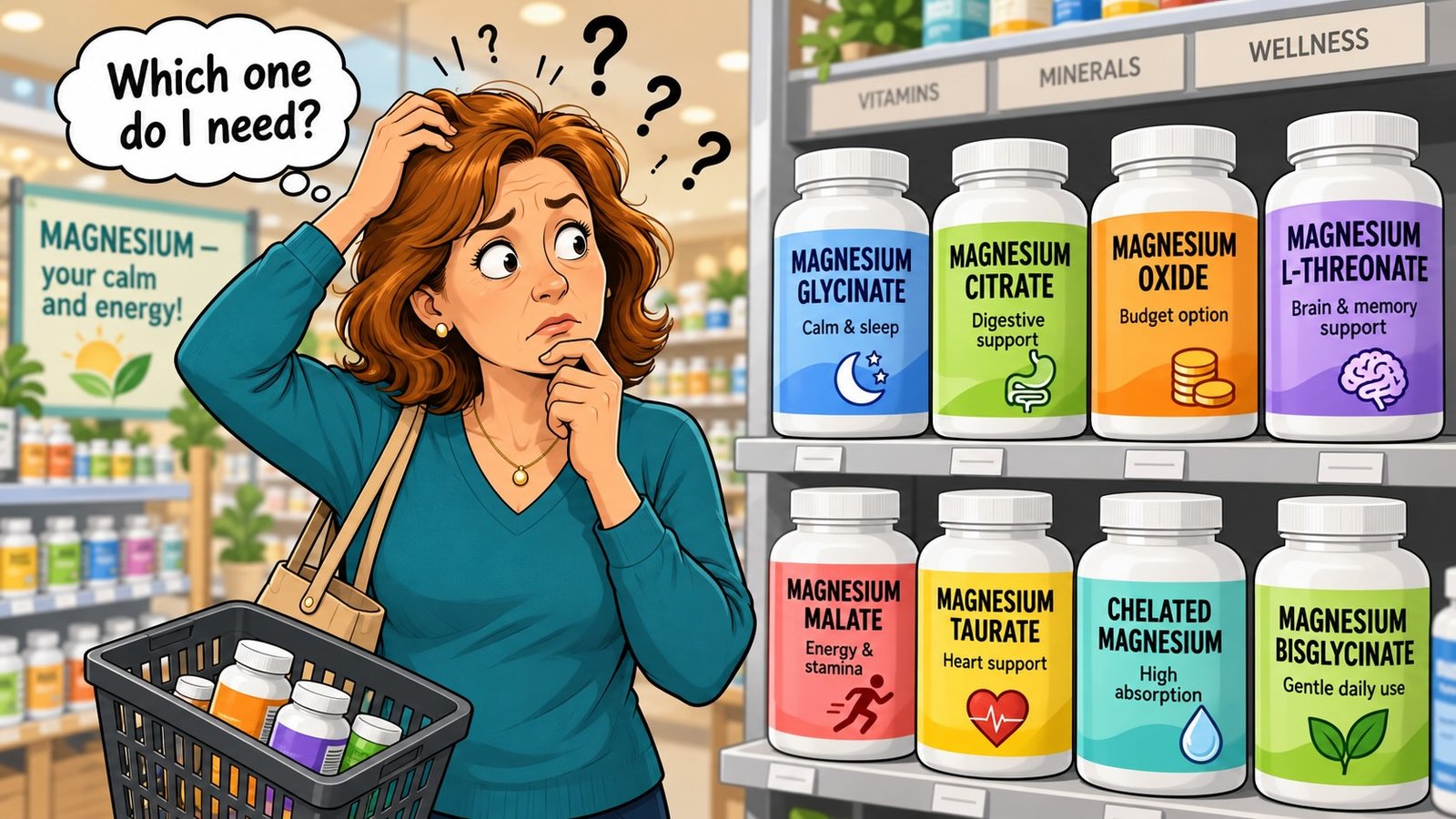
Magnesium has acquired a rather enviable reputation. It helps you sleep, calms your nerves, stops cramps, improves your heart, strengthens your bones, fixes headaches and, depending on which supplement advert you happen to encounter, may turn you into an altogether more serene and efficient human being. There is citrate for your digestion, glycinate for bedtime, malate for energy and L-threonate for your brain. One could reasonably wonder how humanity managed before supplement companies thoughtfully divided a chemical element into lifestyle categories.
Behind the marketing, however, sits a genuinely remarkable mineral. It is essential to human life. An adult body contains roughly 25 grams of it, with more than half stored in bones and much of the rest inside cells and soft tissues. It participates in hundreds of enzyme systems and helps with energy production, protein synthesis, DNA and RNA production, nerve signalling, muscle contraction, glucose regulation and normal heart rhythm. Calcium gets considerably better publicity for bones, yet this nutrient works quietly in the same neighbourhood. Without enough of it, the machinery begins to complain.
Its importance extends far beyond humans. A magnesium atom sits at the centre of chlorophyll, the molecule plants use to capture light during photosynthesis. So the mineral marketed today in little white capsules as a sleep aid also occupies a rather more impressive position in the biological machinery that ultimately feeds much of the planet.
People knew its compounds long before they understood the element itself. The story has a particularly British chapter. In the seventeenth century, mineral-rich water around Epsom became famous for its bitter salts and their enthusiastic laxative properties. Those Epsom salts are magnesium sulphate. In 1755, Scottish chemist Joseph Black demonstrated that magnesia differed chemically from lime. Humphry Davy later used electrolysis in 1808 to obtain a tiny amount of the metal. The French chemist Antoine Bussy subsequently produced it in more substantial quantities. A substance that began its British celebrity career encouraging bowel movements eventually became a darling of twenty-first-century wellness.
So what does magnesium actually do for us? Its most convincing role remains the least glamorous one: preventing deficiency. Severe shortage can cause weakness, tingling, muscle contractions, cramps, abnormal heart rhythms and, in extreme cases, seizures. Yet genuine symptomatic deficiency caused simply by eating slightly too little is uncommon in otherwise healthy people. The kidneys are rather good accountants and reduce losses when supplies fall.
Certain people face greater risks. Gastrointestinal disorders can reduce absorption, while diabetes can increase losses. Some medicines, including prolonged use of certain proton-pump inhibitors, can affect levels in the body. Diuretics may alter excretion as well. Older age and long-term heavy alcohol consumption can also increase the likelihood of inadequate intake or poor status.
Curiously, measuring deficiency is not straightforward. Less than one per cent of the body’s supply circulates in blood, while most sits in bones and tissues. A serum test therefore offers an imperfect picture of total stores. This genuine medical complication has helped create one of the supplement world’s favourite myths: that almost everyone has a hidden deficiency that ordinary doctors somehow fail to detect. The first half of that argument contains some truth; the second makes a spectacular leap. An imperfect test does not prove a universal epidemic.
Food provides the mineral rather democratically. Nuts, seeds, beans, whole grains and green leafy vegetables supply useful quantities, as does dark chocolate, which is perhaps the most commercially attractive nutritional fact in this entire subject. British NHS guidance gives daily requirements of around 300 mg for adult men and 270 mg for adult women. Someone eating a varied diet may therefore have no particular reason to buy a separate supplement.
Supplements complicate matters because the word “magnesium” on the front of a bottle does not tell the whole story. Oxide contains plenty of elemental mineral and tends to be inexpensive, but the body absorbs it relatively poorly. Its gastrointestinal effects can also make it useful when a laxative effect happens to be the objective rather than an unfortunate surprise.
Citrate dissolves and absorbs considerably better and also draws water into the bowel, making it useful for people who want supplementation while simultaneously addressing constipation. Chloride and lactate also have relatively good bioavailability. In practical terms, these forms make considerably more pharmacological sense than simply buying whichever bottle contains the largest number printed on the label.
Then comes glycinate, or bisglycinate, the sophisticated-looking favourite of the sleep and relaxation market. Glycine itself has interesting neurological properties, and chelated forms can be well tolerated. That makes glycinate a perfectly reasonable option. What does not automatically follow is the marketing claim that it possesses some unique ability to send everyone peacefully to sleep. Evidence for supplementation and sleep remains mixed, and strong comparative evidence showing that glycinate is the definitive “sleep form” remains much thinner than the confidence displayed on supplement websites.
L-threonate occupies an even more luxurious neighbourhood. It gets marketed for memory, cognition and brain health, partly because animal research suggested that it could increase concentrations in the brain. Human research has become more interesting recently. A 2026 randomised controlled trial in adults with dissatisfied sleep reported improvements in some cognitive measures after six weeks of L-threonate. Yet objective sleep measurements did not improve significantly. Earlier systematic reviews also found insufficient randomised evidence to conclude that supplementation prevents cognitive decline. Promising is a perfectly respectable scientific description; “brain magnesium” as an established cognitive enhancer is several stations further down the railway line.
Sleep illustrates the broader problem beautifully. Observational studies often find relationships between mineral status and sleep quality. Randomised trials, however, have produced inconsistent results. One review of trials in older adults found that supplementation might shorten the time required to fall asleep, but the studies were small and the evidence quality low. It may help some people, particularly when their intake is poor. Calling it a proven natural sleeping pill goes considerably further than the evidence permits.
Muscle cramps provide another surprise. The connection between cramps and this mineral seems so natural that it feels almost self-evident. Yet trials in older adults with ordinary nocturnal cramps have generally failed to show meaningful benefit. Cramps can occur during genuine deficiency, certainly, but experiencing a cramp does not itself demonstrate that a shortage caused it. Biology has an irritating habit of refusing to follow supplement advertising.
Migraine provides a more credible case. Reviews of clinical trials suggest that supplementation can help prevent migraines in some people, although the evidence is not overwhelming. Blood pressure offers another modest positive. Recent analyses of randomised trials suggest small reductions, with larger effects appearing among people who already have hypertension or low levels of the mineral. That distinction matters enormously. Correcting something that is deficient and adding more of something already adequate are two different biological experiments.
Mental health research has produced intriguing but similarly incomplete results. Some trials and meta-analyses suggest supplements may reduce depressive symptoms, while research into anxiety remains suggestive rather than definitive. Associations between higher dietary intake and better health outcomes also create another problem: people who eat lots of nuts, vegetables, legumes and whole grains tend to differ from people living largely on ultra-processed food in many ways besides their mineral intake. Sometimes this nutrient may deserve the medal; sometimes it may simply be standing next to the winner.
More is certainly not always better. Amounts obtained from normal food present little concern because healthy kidneys regulate them effectively. Supplements behave differently. Higher doses commonly cause diarrhoea, nausea and abdominal cramping. Very large quantities can become dangerous, particularly when kidney function is impaired, because the body may struggle to remove the excess. Severe toxicity can affect blood pressure, breathing and heart rhythm.
The mineral can also interact with medicines. Supplements may interfere with the absorption of some antibiotics and osteoporosis drugs, while other medicines can change levels in the body themselves. This is another reason why treating capsules as harmless food makes little sense. They contain biologically active substances; that is, after all, precisely why people take them.
Perhaps the strangest part of the magnesium boom is therefore that both camps can exaggerate. Supplement enthusiasts sometimes present it as an overlooked solution to insomnia, anxiety, cramps, migraines, hypertension and brain ageing. Sceptics can swing too far in the opposite direction and dismiss supplementation altogether. Neither position fits the evidence particularly well.
Magnesium matters enormously. Deficiency matters. Supplementation can make excellent sense for people who need it, and research suggests useful effects in several specific conditions. Yet the mineral does not become more essential merely because somebody attaches “premium bisglycinate” to its name and puts it in a matt-black bottle.
The practical approach is considerably less exciting. Eat foods naturally rich in the mineral. Consider why you want a supplement before choosing one. Look at the amount of elemental magnesium rather than the impressive weight of the whole compound. Citrate, chloride and other soluble forms generally offer better absorption than oxide. Treat glycinate as a reasonable formulation rather than bottled tranquillity, and L-threonate as interesting rather than miraculous. If you have kidney problems or take medicines that may interact with supplements, extra care makes sense.
Magnesium, in other words, occupies an unusual position between genuine nutritional importance and exaggerated wellness mythology. Your muscles need it, your nerves need it, your bones store it and every green leaf outside owes part of its existence to it. That is already an extraordinary CV. There really was no need to make one mineral responsible for fixing everything else as well.