In the 1930s, two confectioners in Honolulu began selling chocolate-covered macadamias. One was Ellen Dye Candies, the other the candy shop at the Alexander Young Hotel. It was an inspired pairing. Chocolate gave the pale, buttery kernel a coat considerably easier to get through than the one nature had provided. It also helped give the macadamia a new identity. A seed from the subtropical rainforests of eastern Australia became a Hawaiian speciality, the sort of thing visitors could take home in a box. Decades later, a study of the trees behind that industry would narrow much of their maternal ancestry to two wild sites in south-east Queensland.
Long before anyone dipped a macadamia in chocolate, Aboriginal peoples in eastern Australia ate and traded the nuts. The names recorded in different places reflect that longer history. Around Mount Bauple, the smooth-shelled macadamia was known as jindilli. Further south, the rough-shelled species was known as kindal kindal. The name that travelled internationally came from a different source. In 1857, the botanist Ferdinand von Mueller named the genus after John Macadam, a chemist and fellow member of the Philosophical Institute of Victoria. The man on the packet owed his place there to a colleague’s choice of name.
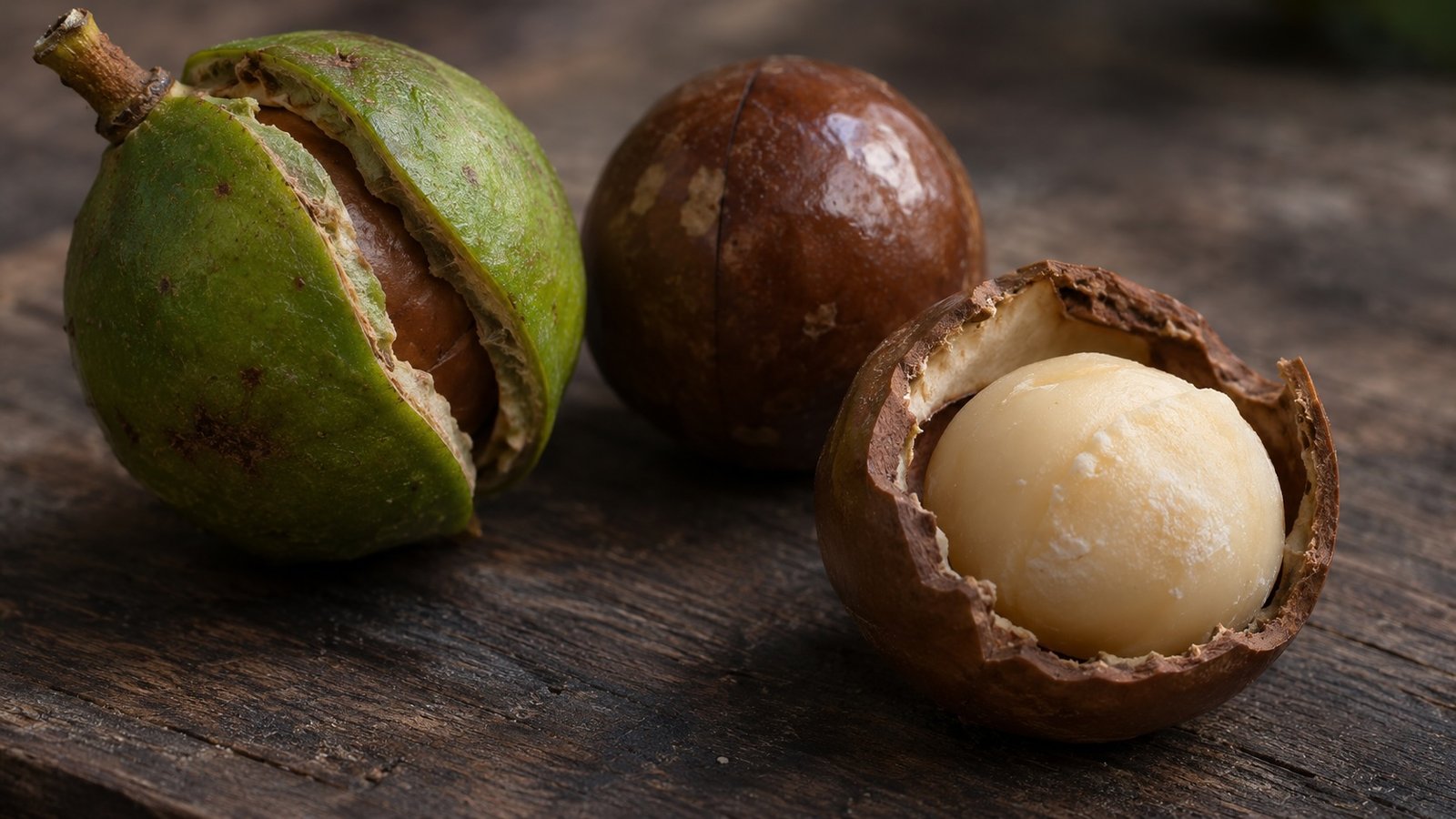
Australia has four wild macadamia species, all native to its east. Two supply the familiar edible kernels, the smooth-shelled Macadamia integrifolia and the rough-shelled Macadamia tetraphylla. Commercial orchards also grow hybrids of the two. In the rainforest, a macadamia can grow among taller trees, its small flowers strung along slender, hanging clusters. The fruit develops a green outer husk around the hard brown shell. Inside sits the soft-looking ivory kernel. The green husk and brown shell are easy to confuse if all you ever see is what gets tipped from a bag into a bowl.
The brown shell is so resistant to fracture that materials scientists have studied it under microscopes. Its strength comes partly from the way the tissues fit together. The shell contains layers of thick-walled cells and bundles of fibres, so a crack has to work its way through a structure that changes as it goes. That is good news for a seed and less welcome news for anyone trying to sell whole kernels. A confectioner wants enough force to split the shell, with very little left over for the contents. The smooth, unbroken nut in a box of chocolates is a small processing achievement.
The first recorded Hawaiian planting dates to the early 1880s, when William Herbert Purvis, a sugar mill manager, planted seeds at Kapulena on the island of Hawai‘i. In 1892, the Jordan brothers planted another batch at their home in Nu‘uanu on O‘ahu. Commercial planting took off in the 1920s. Ernest Van Tassel leased land at Round Top in 1921 and planted seeds reportedly gathered from trees associated with both early introductions. By 1934, his factory in Honolulu’s Kaka‘ako district was shelling, roasting, salting and bottling the nuts. The confectioners followed within a few years. A rainforest seed had acquired a factory, a brand and a place on a hotel counter.
Hawaiian growers did something just as consequential in the orchard. Trees raised from seed vary, which makes an orchard a good place to look for an unusually productive tree and a difficult place to reproduce it. Grafting gave growers a way to make that tree the basis of a commercial variety. A shoot from a selected tree could grow on another tree’s roots while retaining the characteristics of the variety above the graft. Researchers could survey orchards, choose promising individuals and propagate them. As Hawaiian varieties spread overseas, growers elsewhere could plant the results of that selection work.
In 2019, researchers compared chloroplast DNA from cultivated trees with samples from the Australian wild. In macadamias, this DNA can trace the maternal line, following the ancestry of the tree that supplied the seed. Most of the Hawaiian varieties in the study shared a chloroplast pattern also found at Mooloo and Mount Bauple, both in south-east Queensland. One seed-bearing tree might account for that shared pattern, although several trees could have carried it. Pollen can contribute other genes, and the researchers found other maternal lines in the Hawaiian material. There is room in the family tree for several Australian ancestors, even if one branch grew much bigger than the others.
The researchers also found a curious pattern in a macadamia planted in Brisbane’s botanic gardens in 1858. Its maternal line grouped with that of a tree from a suburban garden south of Brisbane and another from a University of California collection. None of the wild trees in the study shared that branch of the family tree. It may survive somewhere the researchers did not sample. The other possibility is that the original wild population has gone and a few cultivated trees are now the surviving record of it. A backyard tree can outlast the piece of forest that explains how it got there.
All four Australian macadamia species face threats in the wild. Clearing and fragmentation have left some populations small and isolated, even as orchards have made the nut familiar around the world. The wild trees sampled in Queensland carried a much wider range of maternal lines than the Hawaiian varieties did, and some of that wider diversity could prove useful to future breeders. There is a pleasing reversal in that. The commercial crop owes much to growers who spent decades deciding which trees were worth copying. Somewhere in a remnant of Australian rainforest, a tree nobody has thought to copy may have something the orchards could use.