The history of Hinduism begins with a slightly awkward problem. Hinduism does not behave like a religion that wants a neat birth certificate. It has no single founder, no one dramatic moment of revelation, and no tidy story where everything begins on a Tuesday. Instead, it grew across thousands of years on the Indian subcontinent. It absorbed rituals, philosophies, gods, local customs, arguments, poetry, politics, village traditions and enormous metaphysical questions.
Even the word “Hinduism” arrived relatively late. British writers helped popularise it in the early nineteenth century. The traditions it describes, however, reach back to the second millennium BCE and possibly earlier. So, before anyone tries to squeeze Hinduism into a clean definition, it politely refuses, lights a lamp, quotes a scripture, tells three myths and asks what “self” means.
Long before the modern label appeared, people lived, farmed, traded and worshipped in the Indus Valley Civilisation. This was one of the great urban cultures of the ancient world. Its cities, including Harappa and Mohenjo-daro, had planned streets, drainage systems and impressive civic organisation. Many later cities would have looked at that plumbing and quietly changed the subject.
Archaeologists have found objects that may hint at religious practices later associated with Hindu traditions. Yet the evidence remains difficult. The Indus script has not been deciphered, so certainty is impossible. Some symbols may connect to later ideas around fertility, animals, water or yogic-looking figures. Still, nobody can honestly claim to have read the Indus people’s spiritual diary.
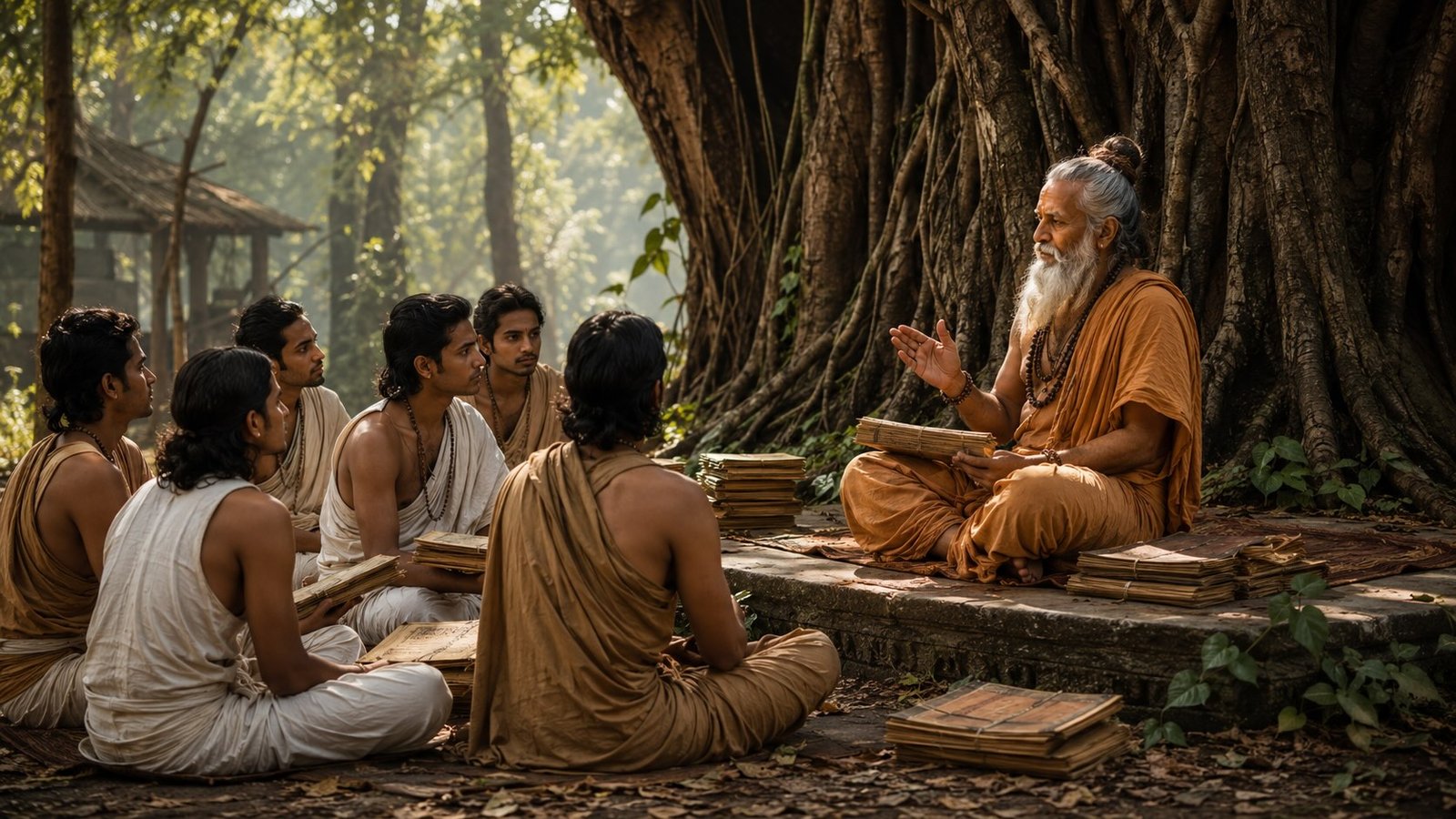
The next major chapter usually gets called the Vedic period. It began roughly in the second millennium BCE. The Vedas became foundational texts for Hindu traditions, though calling them “books” slightly misses the point. For centuries, people transmitted them orally with remarkable precision. Sound, rhythm and memory carried sacred knowledge long before printed pages entered the scene.
The Vedas include hymns, ritual formulas, philosophical dialogue, poetry and incantations. Ancient India did not separate religion, language, performance and cosmic speculation into tidy departments. Sacred words mattered. Correct sound mattered. Ritual knowledge carried authority, beauty and power.
Early Vedic religion centred heavily on sacrifice, ritual and gods such as Indra, Agni, Varuna and Soma. Fire mattered enormously. Speech had force. Correct performance could maintain cosmic order, honour the gods and strengthen the patron’s status. A ritual could look like worship, social order, political theatre and metaphysical engineering all at once.
That may sound transactional, but it was also deeply poetic. The Vedic imagination saw the world as alive with forces. Dawn, storm, fire, breath, order and chaos all carried meaning. Human beings stood in the middle of this vast pattern, trying to understand how the universe worked and how not to offend it before breakfast.
Then came one of Hinduism’s great intellectual turns. Between roughly 700 and 500 BCE, the Upanishads began asking questions that changed Indian religious thought. They explored the nature of the self, the reality behind appearances, the meaning of ultimate truth and the mystery of what happens after death. The mood shifted from ritual performance alone towards inward searching, meditation and liberation.
The focus moved beyond outward ritual alone. Inward knowledge, meditation and liberation became increasingly important. Concepts such as Brahman, the ultimate reality, and atman, the self, became central to many later Hindu philosophies. Suddenly, the spiritual project did not only involve keeping the gods pleased. It also involved asking whether the deepest truth had been sitting inside you all along.
Around the same broad period, the religious landscape of India became wonderfully crowded. Buddhism and Jainism challenged older Brahmanical traditions. They questioned sacrifice, social hierarchy and the path to liberation. Hindu traditions did not simply collapse under pressure. They argued, adapted and rebuilt themselves.
This became one of Hinduism’s recurring survival tricks. When challenged, it rarely disappears. It mutates, debates, absorbs and returns wearing several new philosophical scarves.
The great Sanskrit epics helped bring Hindu ideas into story form. The Mahabharata, which includes the Bhagavad Gita, gave India one of its most influential conversations about duty, action, devotion and moral confusion. The Ramayana offered the story of Rama, Sita, exile, loyalty and kingship. It also delivered enough family drama to make modern soap operas look underprepared.
These epics did not merely entertain. They taught values, shaped festivals and inspired theatre. Their stories travelled across Asia and gave people moral characters to admire, question, imitate and argue about. A good epic never just sits quietly on a shelf. It follows people into temples, homes, performances and political speeches.
Later, the Puranas helped shape the Hinduism many people recognise today. They developed rich mythologies around Vishnu, Shiva, Devi and countless local forms of divine power. Temple worship grew in importance. Pilgrimage routes expanded. Sacred geography turned the landscape into a living map of stories, gods and memory.
Devotional images, festivals and regional storytelling made Hinduism less dependent on elite ritual knowledge alone. The divine became visible and visitable. A god could rule the cosmos and still have a favourite hill, river, shrine, flower, sweet or festival procession. This is one of Hinduism’s great talents: it can think in cosmic scale while caring deeply about local detail.
One of the most important developments was bhakti, the path of devotion. Beginning strongly in South India between the seventh and tenth centuries, bhakti poets and saints praised personal devotion to a chosen deity. Many bhakti movements welcomed people across caste and gender lines, at least in aspiration. They also used local languages rather than only Sanskrit.
That mattered. Religion stepped out of the exclusive seminar room and into song, longing, tears, dancing and poetry. Devotees did not need to sound like scholars to love God directly. They could sing, weep, quarrel, surrender and complain. Divine love became emotional, personal and gloriously untidy.
Of course, the history of Hinduism also carries controversy. Pretending otherwise would make the story too polished. The caste system remains one of the most debated and painful parts of South Asian history. The relationship between varna, the four broad social categories described in some Hindu texts, and jati, the thousands of lived caste communities, is complex.
The origin of caste remains uncertain. Scholars have linked it to ritual status, occupation, social differentiation and inherited identity. Whatever its origins, caste has shaped marriage, labour, status and exclusion for centuries. Modern reformers have repeatedly challenged caste injustice. They have argued that hierarchy should not be treated as a spiritual inevitability.
Another controversy involves the origins of Indo-Aryan language and culture. Older colonial-era theories spoke of an “Aryan invasion”, often with too much confidence and not enough evidence. Many scholars now discuss Indo-Aryan migration or cultural movement instead. The topic remains politically sensitive because it touches identity, nationalism, colonial history and who gets to tell India’s past.
The argument has become a historical campfire. Archaeology, linguistics, genetics and politics all turn up. Each brings evidence, assumptions and a suspiciously firm voice.
Islamic rule, especially during the Delhi Sultanate and Mughal periods, added another layer to Hindu history. Temples were sometimes patronised, sometimes taxed, sometimes destroyed and sometimes rebuilt. Hindu and Muslim cultures also interacted through music, architecture, poetry, administration, trade and shared local practice.
The simple story of endless conflict does not work. Neither does the equally simple story of endless harmony. Indian history refuses to behave for people who want slogans. It gives them complexity instead, which is less convenient but far more honest.
Under British colonial rule, Hinduism changed again. Reformers such as Rammohan Roy, Dayananda Saraswati, Vivekananda and others reinterpreted Hindu traditions for a new age. Print culture, empire, missionary criticism, science, nationalism and global conversation all shaped the debate.
Some reformers criticised idol worship, caste or social customs. Others defended Hindu philosophy as profound, rational and universal. Colonial categories also hardened religious identities in new ways. Bureaucracies love boxes almost as much as empires love maps.
Modern Hinduism now lives as both a religious tradition and a global cultural force. The global Hindu population is well over one billion, with most Hindus living in India. Nepal also remains one of the world’s major Hindu-majority countries. Hindu communities have spread widely through migration, trade, colonial labour routes and modern diasporas.
Temples, festivals, yoga traditions, devotional music and Hindu philosophy now appear far beyond South Asia. Sometimes they carry deep continuity. Sometimes they arrive with a rather enthusiastic Western habit of turning complex spiritual ideas into lifestyle accessories. Ancient metaphysics, after all, looks very marketable when printed on a yoga mat.
The modern political controversy lies in the relationship between Hinduism and Hindutva. Hinduism is a broad, diverse religious tradition. Hindutva, by contrast, is a modern political ideology tied to Hindu nationalism. Supporters see it as civilisational pride. Critics argue that it narrows a plural tradition into a nationalist project and risks marginalising minorities.
This debate matters. It asks whether Hindu identity should remain a vast religious and cultural umbrella or become a sharper political instrument. For a tradition that has survived by being layered, flexible and argumentative, that question carries real weight.
The fun fact, if such a vast subject can tolerate that phrase, is that Hinduism may be the world’s most successful argument with itself. It contains strict ritualism and wild devotion. It holds abstract philosophy beside village goddess worship. Renunciation sits near family duty, while temple splendour coexists with forest meditation. Monism, dualism, scepticism and faith all find space under the same enormous roof.
That may be the best way to understand the history of Hinduism. It did not march from primitive ritual to sophisticated philosophy in a clean upward line. It grew like a banyan tree, dropping roots in many places and creating new trunks. Old stories found new homes. New ideas attached themselves to older forms.
Perhaps that is the point. Hinduism survives because it never had to be just one thing. It became a civilisation of questions, rituals, stories, gods and arguments. It remains ancient without being frozen, diverse without being random, and spiritual without being easy to summarise neatly. History likes categories. Hinduism smiles politely and keeps expanding.