
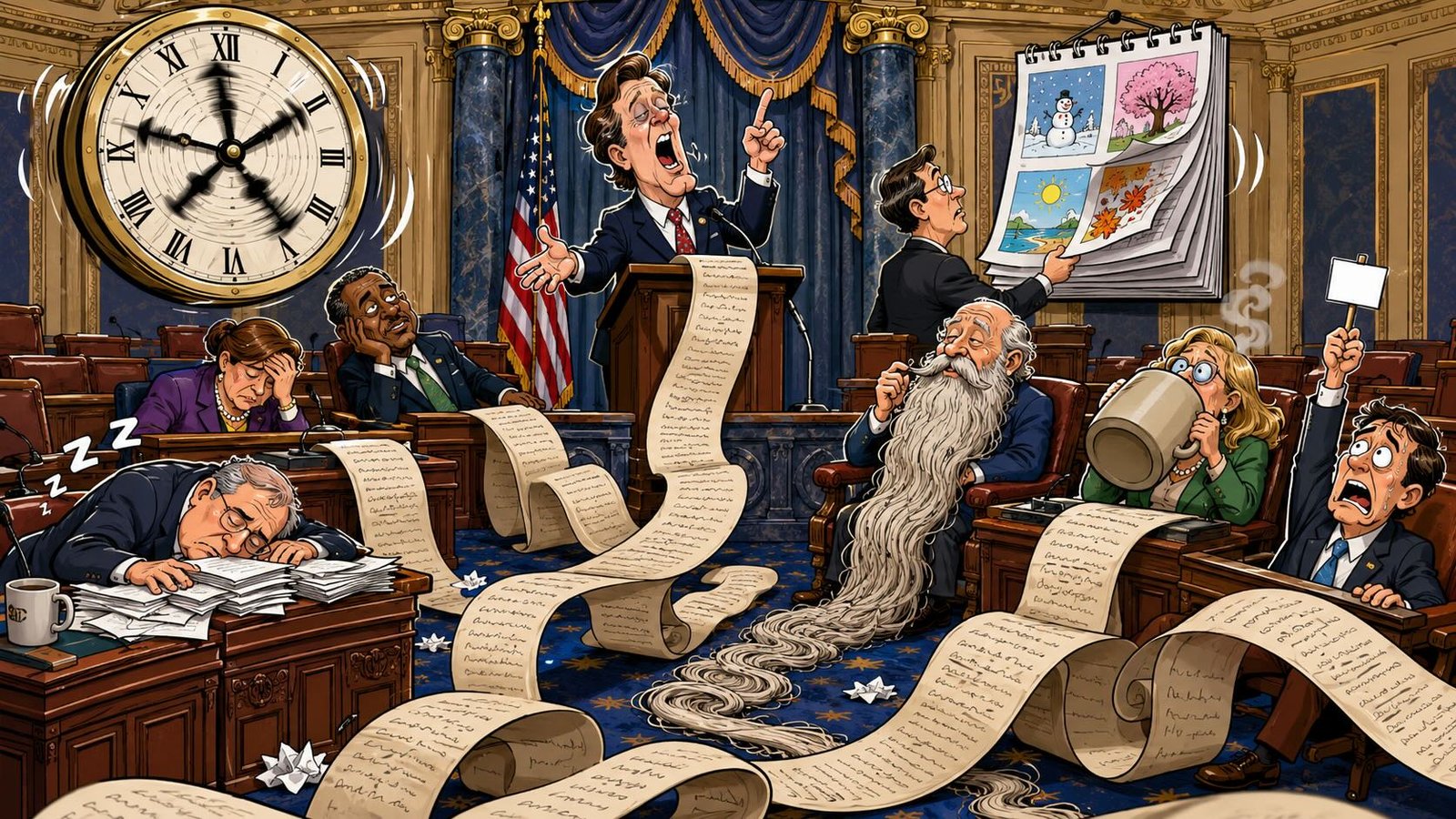
Politics loves a grand principle, especially when that principle can hide something much less noble underneath. The filibuster looks, at first glance, like democracy in its most talkative outfit: a legislator stands up, speaks for ages, resists the majority and defends scrutiny. Very heroic and marble-columned. Very “I alone shall hold back the tyranny of rushed decision-making.” Then you watch it in action and realise it can also mean one politician reading recipes, committee minutes or moral outrage into the record until everyone else loses the will to live.
The word itself arrives with more swagger than most parliamentary jargon. “Filibuster” comes from a family of words linked to pirates, privateers and freebooters. Etymologists trace it through Spanish filibustero and French flibustier towards the Dutch vrijbuiter, meaning a freebooter or plunderer. So before the filibuster became a legislative tactic, it belonged to the world of sea raiders, military adventurers and men with suspicious hats who believed rules applied mainly to other people. Honestly, politics did not have to work very hard to adopt it.
In its modern political sense, a filibuster means using extended debate or procedural delay to slow down, block or kill a proposal. The UK Parliament’s own glossary defines filibustering as deliberately wasting time through overlong speeches or unnecessary procedural points so that a bill or motion gets “talked out”. That phrase captures the whole dark comedy of it. Nobody burns the bill. Nobody tears it up dramatically. They simply talk until time itself becomes the executioner.
Westminster offers a particularly British version of this theatre. In the House of Commons, filibustering often matters most with Private Members’ Bills, because these bills usually receive limited debating time and lack the same government control over scheduling. A handful of MPs can talk for long enough to stop a vote from happening, which means a bill may die without suffering the embarrassment of being openly defeated. The Hansard Society notes that the absence of programme motions and speech limits can allow just one or two MPs to time-waste a Private Member’s Bill into oblivion. It is murder by timetable, carried out with excellent stationery.
This creates one of the great tensions in parliamentary life. Supporters call the tactic scrutiny. Critics call it sabotage. Both can sound convincing, depending on whether you like the bill. A law on a complex moral issue may deserve slow examination, awkward questions and detailed amendments. Yet the same techniques can also protect inertia, shield vested interests and avoid a clean democratic choice. The filibuster therefore survives because it wears two masks: guardian of debate on Monday, procedural mugger by Tuesday afternoon.
The U.S. Senate turned the filibuster into something much bigger, stranger and more consequential. The Senate’s tradition of unlimited debate gave individual senators huge power to delay business. Before 1917, the chamber had no formal way to force an end to debate and move to a vote. That changed when the Senate adopted the cloture rule, now Rule XXII, after pressure grew for a mechanism to stop endless obstruction. In 1975, the Senate lowered the cloture threshold for most matters to three-fifths of senators duly chosen and sworn, which usually means 60 votes.
That change produced the filibuster’s most famous modern oddity. In popular culture, people imagine a senator physically speaking for hours, sweating through a noble marathon while aides carry in glasses of water and emergency throat lozenges. That version exists, and it gives us the cinematic mythology. Strom Thurmond spoke for more than 24 hours against the Civil Rights Act of 1957, a fact that still haunts any romantic account of the filibuster. But the modern Senate often works through the threat of a filibuster rather than a continuous talking performance. The real weapon became the vote threshold. If you cannot get to 60, your bill may never properly breathe.
This is where myth and reality part company. The filibuster did not appear in the U.S. Constitution, even though defenders sometimes describe it with near-sacred reverence. It grew from Senate rules and habits, then hardened into a central feature of American lawmaking. Nor has it always served plucky minorities in a noble sense. For much of the twentieth century, segregationist senators used it to block civil rights legislation. That history matters because it punctures the comforting idea that obstruction always protects liberty. Sometimes it protects injustice with a very long speech and a procedural manual.
The Senate has also weakened parts of the filibuster when majorities found it too annoying. Judicial and executive nominations now operate under different rules after “nuclear option” changes in 2013 and 2017, with the latter extending simple-majority confirmation to Supreme Court nominations. The legislative filibuster, however, remains the big prize in America’s procedural cold war. Both parties denounce it when it blocks their agenda and defend it when they move into opposition. This may look hypocritical, because it is. It may also look rational, because unfortunately that is true as well.
Other legislatures have produced their own spectacular talkathons. South Korea staged a record-breaking filibuster in 2016 against an anti-terrorism bill, with opposition lawmakers speaking around the clock for days. Reports at the time described it as running beyond 100 hours, and later accounts put the total at roughly 192 or 193 hours. One South Korean lawmaker spoke for 11 hours and 39 minutes non-stop. If democracy were an endurance sport, this would need hydration stations and sponsorship from sensible shoes.
Canada has its own proud tradition of procedural stamina. In 2011, Canadian opposition MPs used a 58-hour filibuster to delay legislation linked to postal workers, with more than 100 lawmakers taking turns in a relay of resistance. Ontario once saw delay tactics involving thousands of amendments. Austria, meanwhile, supplied one of the strangest examples: in 1925, a Social Democratic lawmaker reportedly stretched his speech by speaking at around two words per minute. That is not debate. That is political slow cooking.
The European Parliament works differently, with formal time limits, committee structures and a legislative process shared with the Council of the European Union. Its ordinary legislative procedure relies on readings, amendments and negotiations rather than the classic Anglo-American talking blockade. That does not mean obstruction disappears; it simply changes costume. Delay can move into amendments, committee tactics, agenda control and negotiation bottlenecks. The filibuster, in other words, belongs to a wider family of democratic friction. Every legislature needs brakes. The argument begins when someone welds those brakes to the floor.
So should we admire the filibuster or abolish it?…